
Strategy Execution: Why Good Plans Fail and How Managers Deliver Results

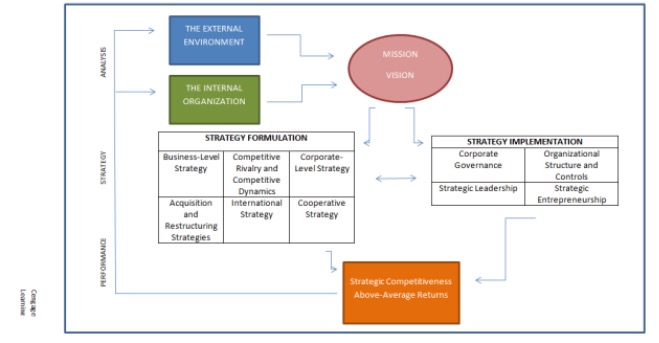
Strategy execution connects strategic planning with the activities,
decisions and performance reviews required to achieve organisational
objectives. Diagram: Acanizares /
Wikimedia Commons —
CC BY-SA 4.0.
A business can develop an ambitious strategy, identify attractive markets and invest in promising capabilities — yet still fail to achieve its objectives. The difference between strategic ambition and business performance often lies in execution.
Strategic management is not complete when leaders approve a plan. Strategy must be translated into decisions, budgets, responsibilities and daily activities across the organisation.
Execution is challenging because organisations are complex. Departments may have different priorities, employees may not understand the strategic direction, and managers may continue to measure performance using indicators that do not reflect the new strategy.
Successful strategy execution requires more than monitoring results. It requires alignment between what the company wants to achieve and how people work, resources are allocated and performance is evaluated.
Translate strategy into clear objectives
A strategic objective describes an important result the organisation intends to achieve. Objectives should be specific enough to guide decisions while remaining connected to the company’s long-term direction.
For example, a company that wants to strengthen its position in international markets might establish objectives such as improving export-market profitability, increasing the reliability of international deliveries or developing local distribution partnerships.
These objectives are more useful than broad statements such as “become a global leader” because they help managers determine which activities and investments deserve priority.
Objectives should also be connected. Improving delivery reliability may require better inventory planning, stronger supplier relationships and investment in logistics systems. Strategy execution therefore involves coordinating several activities rather than assigning isolated targets to individual departments.
Connect objectives with resources
One of the most common execution problems occurs when a company announces strategic priorities but continues allocating resources according to its previous plans.
If digital transformation is a strategic priority, the organisation may need to invest in technology, employee training, cybersecurity and process redesign. If international expansion is a priority, resources may be required for market research, regulatory compliance, logistics and local partnerships.
Budgets communicate what the organisation truly values. When resources are spread across too many initiatives, the company may lack the capacity to execute its most important strategic choices.
Managers should therefore review whether financial resources, employee time and leadership attention are aligned with the strategy. They should also be willing to stop or postpone initiatives that no longer support the chosen direction.
Assign ownership and accountability
Strategic objectives need clear ownership. Employees should understand who is responsible for a result, which decisions they can make and how their work contributes to the wider organisation.
Accountability does not mean blaming individuals whenever a target is missed. It means making responsibilities transparent and ensuring that problems are identified early enough to be addressed.
Cross-functional objectives require particular attention. For example, improving customer experience may involve marketing, sales, operations, technology and customer service. If each department optimises only its own performance, the overall customer experience may not improve.
Senior managers must create coordination mechanisms that encourage departments to work toward shared outcomes.
Use performance indicators that support the strategy
Key performance indicators (KPIs) help managers evaluate whether the organisation is making progress. However, the wrong indicators can encourage behaviour that conflicts with strategic objectives.
A company that measures sales volume without considering profitability may reward unprofitable growth. A business that focuses only on cost reduction may weaken service quality or reduce investment in capabilities needed for the future.
A balanced set of measures can include:
Financial indicators: profitability, cash flow, revenue quality and return on investment.
Customer indicators: retention, satisfaction, complaints and service reliability.
Operational indicators: productivity, delivery performance, quality and process efficiency.
Capability indicators: employee skills, innovation milestones and progress in technology adoption.
Managers should distinguish between outcome indicators and leading indicators. Outcomes show what has already happened, while leading indicators provide information about activities that may influence future performance.
For example, annual profit is an important outcome. Training completion, process improvement milestones and customer response times may provide earlier signals about whether the organisation is building the capabilities needed to achieve future results.
Build a regular strategy review process
Strategy execution requires regular review, but meetings should not become a routine exercise in reporting numbers. The purpose is to understand why performance differs from expectations and decide what action is needed.
A useful review asks three questions:
Are we achieving the strategic results we expected?
What is preventing progress, and what have we learned?
Do we need to adjust our actions, resources or assumptions?
Managers should use performance information to identify problems and make decisions. If an initiative is behind schedule, the organisation may need additional resources, a revised process or a different approach.
At the same time, a review process should not encourage constant changes in strategic direction. Operational adjustments may be necessary, while the overall strategy should remain consistent unless important assumptions have changed.
Leadership and organisational culture
Leadership plays a central role in execution. Employees are more likely to support a strategy when leaders explain why it matters, demonstrate commitment and make decisions consistent with its priorities.
Communication is not enough on its own. Managers must also ensure that incentives, promotion criteria and performance evaluations reinforce the desired behaviour.
If a company says it values innovation but penalises every failed experiment, employees may avoid taking reasonable risks. If collaboration is a strategic priority but rewards are based entirely on individual departmental results, cooperation may remain limited.
Organisational culture influences how strategy is interpreted and implemented. Leaders need to identify behaviours that support the strategy and remove practices that create conflicting signals.
Adapt without losing strategic direction
Execution does not mean following a plan regardless of circumstances. Markets, technologies and customer needs can change, and new information may reveal that an initiative is less effective than expected.
Companies need a disciplined way to distinguish between implementation problems and changes that require strategic reconsideration.
If a project is delayed because responsibilities are unclear, management should improve coordination. If customer demand has fundamentally shifted, the company may need to reconsider its objectives or market position.
This distinction helps organisations remain adaptable without abandoning their strategy every time they encounter difficulty.
Conclusion: execution is a management system
Strategy execution is the process of turning strategic choices into coordinated organisational performance. It requires clear objectives, aligned resources, accountability, meaningful KPIs and regular review.
The balanced scorecard approach developed by Robert Kaplan and David Norton highlights the importance of connecting financial results with customer outcomes, internal processes and organisational learning. This broader view helps managers monitor both current performance and the capabilities needed for future success.
Ultimately, a strategy becomes real through the decisions people make every day. When employees understand the direction, resources support the priorities and performance measures encourage the right behaviour, the organisation is better positioned to convert strategic ambition into lasting results.
Further reading
Looking Times — Informed Today. A More Connected Tomorrow.

More Stories
Strategic Analysis: How Businesses Turn Uncertainty into Strategic Direction
Strategic planning helps organisations assess their position, evaluate uncertainty and make decisions about future priorities. Photo: Bart Everson / Wikimedia...
Competitive Advantage: Why Successful Businesses Compete on Value
Competitive advantage depends not only on a company's products, but also on the people, capabilities and activities that deliver value...
How to Recover a Hacked Facebook Account? A Quick Guide
Has your Facebook just been hacked? Looking for a way to recover your hacked Facebook account? Don’t worry! I’ve got...
Oracle’s Benefits Don’t Coordinate Themselves
An Oracle employee with a long tenure usually has more moving parts than they realize. There’s the 401(k) and its...
My Fire TV Stick Keeps Restarting? How to Fix It
Does your Amazon Fire TV Stick keep restarting in a loop? I know it’s frustrating when it interrupts your entertainment...
Best Open-World Games Like GTA 5
GTA 5 has set a high bar with its years of updates and attention to detail that keep players hooked....