
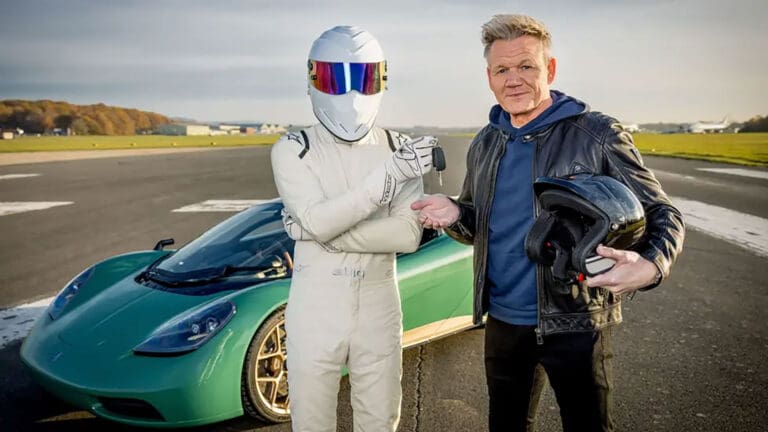
Save some for us, Gordon: Gordon Ramsay, Top Gear and key person risk

Every primary school in England has one. The father at sports day who enters everything. He is in the dads’ race, obviously, in proper running spikes he has brought from home.
He is in the egg and spoon, which is meant for the children. He volunteers to hold the tape at the finish, then somehow also wins the tug of war, and by three o’clock he is eyeing up the mums’ relay with the look of a man who has checked the rules and found no explicit prohibition.
Nobody dislikes him, exactly. He is enormously good at everything. It is just that by the end of the afternoon the rest of us have stood on the grass for four hours holding a cardigan, and not one of us has been allowed to run.
On Wednesday the BBC announced that Gordon Ramsay will be the new lead host of Top Gear when it returns in 2028, the show’s first presenter since production stopped after Freddie Flintoff’s crash. And I confess my first reaction was not admiration. It was the cardigan feeling.
Because consider the man’s existing timetable. A UK restaurant group with turnover above £100 million. Nine Michelin stars across his restaurants worldwide, including Chelsea, which has held three since 2001. Roughly ninety sites from London to Las Vegas. Hell’s Kitchen, Kitchen Nightmares, MasterChef in America, a Netflix documentary about being himself, and enough frozen ready meals to see out a nuclear winter. Gordon is not in the egg and spoon. Gordon has bought the field.
And now he wants the car park too.
I should declare an interest. I hold a racing licence. A modest one, earned at some expense on a wet Tuesday at Goodwood, but a licence nonetheless, which is more than most of the people Top Gear has historically hired could claim. I have been quietly waiting for my agent to say that the BBC’ has called call since roughly 2015. It has not come. It has gone, instead, to a man with nine Michelin stars who could presumably have had any job in British television simply by shouting at it.
Gordon, please. Leave something for the rest of us.
The sports day dad, you see, has a fatal flaw, and it is not vanity. It is that he cannot be in two races at once. Line up the sack race and the dads’ sprint back to back and something has to give, usually his hamstring, usually in front of the PTA. The more events he enters, the more each one depends on him alone, and the less anyone else has been trained to run.
Business readers will recognise this instantly, because it has a name in every due diligence pack in the City: key person risk. When the founder is the brand, the face, the chef and now the man behind the wheel of a Bugatti in Abu Dhabi, the whole enterprise is priced on one diary and one pulse. Investors discount for it. Lenders insure against it. And the more categories the founder colonises, the harder it becomes to tell where the person ends and the business begins.
There is a serious tension in the numbers. Ramsay’s group held 17 stars at its peak and holds nine today. His UK business reported an operating loss of £5.8 million on that £100 million turnover, even while generating cash, and losses have bounced around for years since the pandemic. None of that is a disaster. Fine dining is a brutal trade, and as I have argued before, energy costs and tax are pricing it out for almost everyone. But it does raise the question every board eventually asks its celebrity founder. Is the next hour of your time worth more on the pass or on the test track?
The generous reading, and I am in a generous mood, is that Top Gear is a halo product. It is the same logic I applied to Jaguar’s Type 01: you do not build it to sell, you build it to make people want everything else. Every Sunday evening viewer becomes a potential booking at Bishopsgate. On that view the BBC is not hiring a presenter, it is renting the most bankable face in global food television, and Ramsay is getting a prime time advert for his restaurants that he does not have to pay for.
The less generous reading is that the best founders know when to hand someone else the baton. The great family firms survive their founders precisely because somebody, somewhere, was allowed to run the relay. Ramsay has built a formidable bench of chefs. The question is whether the brand will ever let them out from under his shadow, or whether the whole thing still rests on a single set of shoulders that are now, apparently, also strapping into a roll cage.
And there is a more serious question for the BBC. Ramsay is, by any measure, a full-throttle petrolhead, with a reported collection of around 94 cars headlined by rare Ferraris and bespoke Aston Martins. Nobody begrudges a man his hobby. But this is the national broadcaster, licence-fee funded, relaunching its flagship motoring show at the very moment millions of households are trying to work out whether their next car should plug in.
Richard Hammond, who knows a thing or two about the old show, who was reportedly offered the role ahead of Ramsay, made the point recently on the High Performance Podcast. Electric versus petrol, he argued, is a false binary, and what Britain actually needs is an informed national conversation about cars and decarbonisation. He is right. A motorist weighing up a used EV, a hybrid or one last diesel does not need another V12 sliding sideways round a Surrey airfield. They need someone they trust to explain range, charging and resale values without either a sermon or a sneer.
That is a public service gap with a commercial value, and the BBC is about to hand the keys to a man whose garage suggests he will not be filling it. If Top Gear 2028 turns out to be the Clarkson era with better knife skills, the corporation will have bought the most famous face in food television and pointed it firmly at the past.
So good luck to him. He will probably be brilliant. The sports day dad usually is.
But if the BBC finds itself short of a co-presenter, I am available, licensed, and have been holding this cardigan for eleven years.

More Stories
What Is SaaS SEO? A Guide Plus the Best Agencies to Hire
Success is measured in qualified trials, demos and pipeline rather than raw traffic. This guide explains what makes it different...
How much does a voice over cost in the UK in 2026? Studio fees, usage and what to budget
Put the same read into a paid online advert and the card adds a usage fee of 400% of that...
Topic, country, traffic, authority: the best link building platforms to filter publishers on real data
When managing off-site campaigns across several regions, relying on basic spreadsheets or outdated metrics often leads to poor link placements...
ARCPE Holding, LLC on Real Estate Investment, Private Capital, and the Changing Financing Landscape
Real estate investment is often discussed in terms of property values, market trends, and potential returns. Behind those figures, however,...
Thousands of Games, Hundreds of Casinos, Little to Tell Them Apart
In the year to March 2026, online casino games in Great Britain generated £5.7 billion in gross gambling yield, the...
What Google Doesn’t Tell You About Online Gambling
The first link might take you to a business licensed to accept your bets. The next one could take you...