
China new models October 2026: VW ID.UNYX 09 and BYD Great Han launch

VW ID. UNYX 09
Now that we have covered October 2026 wholesales have been covered, let’s focus on the latest launches on the Chinese market. After a record 19 in September, we have 11 new entrants in October, 8 of them Chinese. To fully understand the scope of the Chinese market, make sure you consult our Exclusive Guide to all 161 active Chinese Brands.
1. Lynk & Co 20 (5,082 sales)
The Lynk & Co 20 (领克 20)—formerly marketed as the Lynk & Co Z20 prior to its September 2026 refresh and renaming—is the brand’s all-electric (coupe crossover SUV. Built on Geely’s Sustainable Experience Architecture (SEA2), the updated 2026 model introduces an 800V high-voltage platform with 6C ultra-fast charging, standard LiDAR hardware, and a significantly expanded front storage area. The 20 follows “The Next Day” second-generation design language, featuring a closed front fascia, signature claw-style LED daytime running lights, and an aerodynamic drag coefficient of 0.25 Cd. It is equipped with frameless doors and side mirrors, hidden rain gutters, a full-width rear LED light bar integrated into the rear spoiler. The 20 comes at 4,495 mm long, 1,845 mm wide and 1,573 mm high with a 2,755 mm wheelbase.
Inside, the 20 is driven by the Flyme Auto cockpit ecosystem (with the Super Eva AI voice assistant) across a 15.4-inch 2.5K floating central touchscreen, a 10.2-inch digital instrument cluster and a 13.8-inch head-up display. It is built on an 800V high-voltage architecture with single-motor Rear-Wheel Drive (RWD) configurations using Geely’s Aegis Golden Brick LFP batteries. It comes either as a 61.52 kWh battery for 545 km of CLTC range or a 70.01 kWh for 630 km of range. Promotional launch price stands between 118,800 and 158,800 yuan (16,200-21,600€ or US$17,800-23,800) and competes with the likes of the Zeekr X, Smart #1, BYD Yuan Plus (Atto 3) and Geely Galaxy E5.
The 20 received 14,663 orders within 1 hour of market launch and registered over 5,000 units in October. The Z20 peaked at 6,368 sales in January 2025 for its 2nd month in market, so we’d want the same to consider the 20 as a success.
Bar for success: 6,500 monthly sales
2. VW ID.ERA 8X (3,500 sales)
The ID. ERA 8X is a mid-to-large 5-seat extended-range electric vehicle (EREV) SUV. Positioned directly below the 6-seat ID. ERA 9X flagship, the 8X targets China’s mainstream premium family SUV segment with an 800V architecture, a range extender delivering over 1,600 km of combined range, and Momenta R7 LiDAR-backed autonomous driving. The exterior design is anchored by a full-width “Universal Light Wing” LED strip, L-shaped daytime running lights, and “six-core high-energy” matrix headlights with dynamic welcome animations. Includes flush aerodynamic door handles, a full-width rear light bar and a roof-mounted LiDAR sensor. It comes at 5,020 mm long, 1,997 mm wide and 1,750 high with a 2,970 wheelbase.
The cockpit is equipped with the “Yunqi” smart cockpit powered by a Qualcomm Snapdragon 8295P chip and VW OS. It features dual high-definition screens for the driver and front passenger, an industry-first “Smart Surface” magic screen, and a windshield head-up display. It is standard equipped across all trims with a 192-line roof LiDAR (part of a 26-sensor suite) running the Momenta R7 World Model for Highway NOA, Urban NOA, and end-to-end automated parking. The ID.ERA 8X is available in a choice of single-motor RWD with a 51.1 kWh battery for 373 km of CLTC pure electric range and 1,567 km combined range and dual-motor with a 451 km CLTC pure electric range and 1,602 km of combined range.
Limited-time launch promotional pricing goes from 206,800 to 269,800 yuan (28,100-36,700€ or US$31,000-40,400). Volkswagen is down -32.8% year-on-year so far so needs all the help it can get, and has delivered a constant flow of BEV and EREV models this year. So far, only the VW ID. AURA T6 has been truly successful, selling 12,032 units in October. The want the ID.ERA 8X to reach at least half that amount to be successful.
Bar for success: 7,500 monthly sales
3. BYD Great Han (1,018 sales)
The Great Han is BYD’s new flagship full-size luxury sedan under the Dynasty series (which recently celebrated its 10 millionth units), positioned above the existing Han EV. It pushes the brand into the ultra-long-range luxury sedan segment at an aggressive price point. The Great Han features an ultra-low drag coefficient of 0.197 Cd. It comes at 5,256 mm long, 1,999 mm wide and 1,510 high with a 3,130 mm wheelbase. The Great Han features a three-screen dashboard anchored by a high-resolution 3K central touchscreen, paired with real-wood trim, Nappa leather upholstery and a 31-speaker surround-sound audio system. There are also electrochromic dimming rear windows.
The model is available as a single-motor RWD with a 102.3 kWhLFP Blade Battery delivering 820 km to 1,008 km range (CLTC), a dual-motor AWD using the same battery for a 880 km range and a PHEV variant pairing a 1.5T turbo engine and electric motor paired with a 54.5 kWhh Blade Battery for 370 km to 470 km of pure electric range. 1,000V architecture charges from 10% to 70% in 5 minutes and 10% to 97% in 9 minutes. The Great Han is priced from 235,900 to 275,900 yuan (32,100-37,500€ or US$35,400-41,400) and will compete with the likes of the Stelato S9, Maextro S800 (entry trims(, NIO ET7, Zeekr 001 (flagship trims), Xiaomi SU7 and Luxeed S7 (competing on charging speed and smart cockpit ecosystem).
The Han peaked at 31,580 sales in November 2022 but fell to just 2,236 sales in October. The Great Han is priced significantly higher so we can’t expect the same level for it.
Bar for success: 5,000 monthly sales
4. M-Hero X700 (957 sales)
The X700 is a mid-to-large, rugged plug-in hybrid (EREV/PHEV) SUV. Breaking away from the heavy body-on-frame construction of the M-Hero 917 and M817, the X700 is the brand’s first model built on a unibody (monocoque) architecture, co-developed with Huawei to blend daily urban comfort with light off-road capability. The exterior features a boxy, upright silhouette with heavy lower black cladding, a full-width front LED daytime running light bar, and an illuminated front M-Hero emblem. It comes at 5,035 mm long, 1,999 mm wide and 1,890 mm high with a 2,920 mm wheelbase. It delivers a 37.5 degrees approach angle, 38.3 degrees departure angle, up to 328.8 mm ground clearance, and an 800 mm water wading depth.
The X700 offers and an 850 L rear cargo compartment (expanding to 2.77 m3 with the second row folded flat. Inside, it runs Huawei HarmonySpace 6 across twin 15.6-inch screens including one for the passenger in what is becoming the norm for Chinese new launches. It is powered by Huawei Qiankun ADS 5 utilizing a 27-sensor suite (including an 896-line roof-mounted LiDAR on Max/Ultra trims) supporting highway and urban Navigation on Autopilot (NOA), off-road navigation cruise assist (NCA), and roaming cruise assist (RCA). It comes as a 325km RWD EREV with a 1.5T range extender and single rear electric motor with a 51.46 kWh battery, 285 km 4WD PHEV and 360 km PHEV for a combined CLTC 1,100 km range.
The promotional launch pricing is 209,800-269,800 yuan (28,500-36,700€ or US$31,40,400) and competes with such models as the Fang Cheng Bao Tai 7 and Leopard 5, Deepal G318 and Jetour Shanhai T2. The M-Hero M817 peaked at 2,995 sales in December 2025, and the X700 is already at a strong level for the brand, we’d want it to reach higher than the more expensive M817 to be deemed a success.
Bar for success: 4,000 monthly sales
5. Smart #2 (315 sales)
The Smart #2 is an all-electric two-door, two-seat microcar serving as the spiritual successor to the iconic Smart Fortwo.Lazily styled by Mercedes-Benz’s global design team (it looks like a slightly refreshed Smart Fortwo) and engineered by Geely on the new Electric Compact Architecture (ECA), the #2 revives the ultra-compact “wheels-at-the-corners” city car formula. It comes at 2,751 mm long, 1,669 mm wide and 1,555 mm tall with a 1,875 mm wheelbase. The turning radius is 3.35 metres. Rear cargo capacity offers 305 L behind the seats, expanding to 527 L with the underfloor storage and front seat folded.
The interior is equipped with a 12.8-inch central touchscreen paired with an 8.8-inch digital instrument cluster. It Includes a panoramic glass roof, faux leather upholstery, heated seats and steering wheel and 256-colour ambient lighting. The #2 is powered by 35.8 kWh CATL LFP Battery Pack for a 410 km CLTC range. It supports 65 kW DC fast charging (10% to 80% in 20 minutes; 30% to 80% in 15 minutes). It is priced at 99,900 yuan (13,600€ or US$15,000). Because true two-seat microcars are virtually nonexistent in China, the Smart #2 competes against lifestyle-oriented compact and subcompact city EVs on price and urban style, such as the Firefly EV, BYD Seagull, Geely Xingyuan Wuling Hongguang Mini EV and Baojun Yep.
The Smart revival has turned out to be a complete flop in China: apart from the #1 (3,396 sales in October), the rest of the range is way down the ranking: the #5 is at 233 sales, the #6 at 70 and the #3 at 48. We’ll be relatively cautious for our bar to success.
Bar for success: 4,000 monthly sales
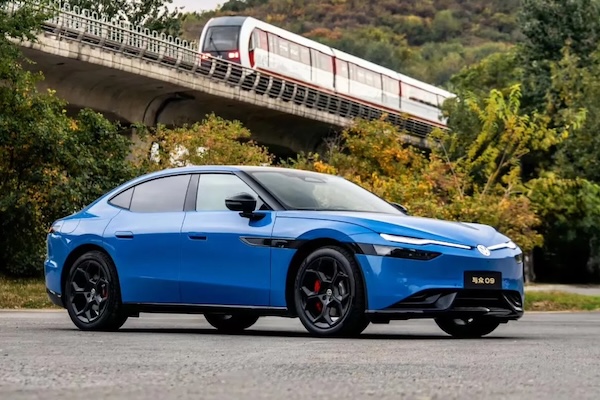
6. VW ID. UNYX 09 (270 sales)
The ID. UNYX 09 is a mid-to-large all-electric fastback sedan launched by VW Anhui. It is the second model jointly developed with XPeng (following the ID. UNYX 08 SUV), pairing VW’s gold-badged “ID. UNYX” styling with XPeng’s platform architecture, 5C fast-charging CATL batteries, and vision-based VLA autonomous driving. The 09 features semi-hidden door handles, and a full-width crystal laser-engraved LED taillight bar. It comes at 5,081 mm long, 1,980 wide, 1,509 tall with a 3,030 mm wheelbase. The 09 is a five-seater and both front and rear rows feature heating and power adjustment as standard, while front seats add ventilation and 10-point pneumatic massage. The interior includes a 15.6-inch floating central touchscreen, a slim digital instrument cluster, a standard 85-inch AR-HUD, an electrochromic PDLC panoramic roof, built-in fragrance system and a 20-speaker 7.1.4 Dolby Atmos sound system.
The 09 uses XPeng’s VLA large-model vision-only ADAS powered by a single XPeng Turing AI chip (750 TOPS), 11 cameras, three 4D mm Wave radars, and 12 ultrasonic sensors (no LiDAR) for highway/urban Navigation on Autopilot (NOA) and remote/automated parking. It is available as a single-motor RWD (0-100 km/h in 6.8 sec, 755 km CLTC range) or a dual-motor AWD (0-100 km/h in 4.6 sec, 705 km CLTC range).Te 91.96 kWh CATL Shenxing LFP battery pack adds 250 of range in 5 minutes (10% to 80% in under 12 minutes; 30% to 80% in 10 minutes). All this tech for just 169,900 to 249,900 yuan (23,100-34,000€ or US$24,500-37,500). Competitors include the Xiaomi SU7, Xpeng P7/P7+, BYD Han L and Zeekr 007.
The fact that this is the second VW launched this month and the fifth in the past four months (alongside the ID. AURA T6, ID. ERA 5S and ID. UNYX 08) shows how hard the German brand is trying to reclaim market share. We hope for the best…
Bar for success: 5,000 monthly sales
7. iCar V25 (220 sales)
The iCar V25 (badged as iCaur V25 in export markets) is a compact-to-mid-size, boxy extended-range electric (EREV) SUV from Chery’s iCar sub-brand. Positioned squarely between the subcompact V23 and flagship V27, the V25 pairs retro-rugged styling with over 1,200 km of combined range, practical 5-seat family dimensions, and LiDAR-equipped intelligent driving. It comes at 4,636 mm long, 1,920 mm wide and 1,855 mm tall with a 2,820 mm wheelbase. Inside, the 5-seat layout features 41 storage compartments and front seatbacks that fold flat to form an in-car resting area.It is available with front-seat heating, ventilation and massage, plus a powered front passenger leg rest. The V25 is powered by a Qualcomm QCM8538 cockpit chip driving a 15.4-inch 2.5K central touchscreen alongside an 8-inch digital driver instrument cluster (a key upgrade over the cluster-less V23). It retains physical rotary HVAC controls, overhead toggle switches, 50W wireless phone charging, 64-colour ambient lighting, and wireless Apple CarPlay, Huawei HiCar, and CarLink.
Upper trims feature a roof-mounted LiDAR running Chery’s Falcon Pilot 700+ ADAS suite for highway and urban Navigation on Autopilot (NOA), automated parking, and active emergency steering (AES) up to 135 km/h. It is powered by a 1.5 turbo range-extender generator paired with a 33.67 kWh LFP battery pack. The RWD variants have a 210 km CLTC pure electric range and 1,240 km combined range, while the AWD variants go from 0 to 100 km/h in 5.8 sec and have a 200 km CLTC pure electric range and 1,210 km combined range. The V25 is priced from 139,800 to 175,800 yuan (19,000-23,900€ or US$21,000-26,300) and competes with the Jetour Shanhai T2, Haval Raptor, BAIC BJ30e and BYD Fang Cheng Bao Tai 3.
The iCar brand is down -39.1% year-to-date – despite the launch of the V27 – and therefore is in need of fresh metal. The V25 is very similar design-wise to the V23 and may lack sales potential as a result, or be the boost the brand needs. The V23 peaked at 7,679 sales in September 2025, we’re not expecting a similar result for the more expensive V25.
Bar for success: 3,500 monthly sales
8, Stelato V8 (120 sales)
The Stelato V8 was co-developed by BAIC and Huawei under the Harmony Intelligent Mobility Alliance (HIMA). This is the brand’s first full-size luxury MPV. It Breaks away from upright van proportions with a sleek, sloping roofline, a closed front fascia and an ultra-low drag coefficient of 0.226 Cd. The V8 features continuous front and rear LED light bars, flush aerodynamic door handles and up to four LiDAR sensors integrated around the body. It comes at 5,335 mm long, 2,005 mm wide, 1,805 mm tall with a 3,250 mm wheelbase. The V8 is a 7-Seat Family & Executive Layout (2+2+3, featuring second-row individual zero-gravity captain’s chairs with heating, ventilation, and massage, alongside a spacious third row and 674 L of rear luggage capacity behind all three rows.
The V8 has a 12.3-inch digital instrument cluster, a 17.2-inch central infotainment touchscreen, 17.2-inch front passenger entertainment screen and a rear ceiling-mounted 21.4-inch entertainment screen, a built-in heating/cooling refrigerator and Huawei Sound panoramic audio. The BEV versions (RWD and AWD) use a 120 kWh battery delivering 830 km (RWD) and 775 km (AWD) CLTC range while the EREV versions (RWD and AWD) have a 1.5T range-extender generator paired with a 56 kWh or 75.4 kWh battery packs for up to 330 km CLTC pure electric range and 1,465 km CLTC combined range. It is priced from 329,800 to 449,800 yuan (44,800-61,200€ or US$49,400-67,400) and competes with such vehicles as the Li Auto Mega, Xpeng X9, Denza D9, Zeekr 009 and Voyah Dream.
Stelato sales are up 34.5% year-to-date but down -45.5% in October. This is a luxury brand so limited volumes. Yet the Stelato S9T peaked at 7,186 sales in December 2025.
Bar for success: 2,500 monthly sales
9. Aion Ray 7 (2 sales)
The Aion Ray 7 is a mid-to-large all-electric fastback sedan targeting younger buyers. As the debut model of Aion’s new “Ray” product series and the first car to carry the brand’s redesigned emblem, it combines lightweight engineering,Huawei DriveONE powertrain and braking hardware and aggressive pricing. The exterior design is anchored by full-width front and rear LED light bars, semi-hidden door handles, a three-layer silver-coated panoramic glass roof and a roof-mounted LiDAR sensor on upper trims. It is offered in vibrant colours including Lightning Yellow and Midsummer Purple. The Ray 7 comes at 4,960 mm long, 1,900 mm wide, 1,455 tall with a 2,920 mm wheelbase.
It is powered by a Qualcomm Snapdragon 8295P chip with 24 GB of RAM driving a floating 15.6-inch 2.5K central touchscreen paired with a slim digital driver instrument cluster. The upper LiDAR Trims (3 variants) are equipped with a 27-sensor suite featuring a 192-line roof LiDAR and three 4D mm Wave radars, running autonomous driving software co-developed with WeRide’s Level 4 robotaxi technology for urban and highway Navigation on Autopilot (NOA). The Ray 7 is available with either a 45.58 kWh LFP battery for 530 km CLTC range or a 62.98 kWh CATL LFP battery for 702 km CLTC range. The flagship trim debuts Huawei’s DriveONE EMB (electromechanical brake-by-wire) system, boasting a 78-millisecond response time, a 33-meter stopping distance from 100 km/h, and redundant four-wheel backup braking.
Its limited time launch promotional prices go from 114,700 to 144,700 yuan (15,600-19,700€ or US$17,200-21,700), making it compete with the Xpeng Mona M03, Deepal L07, BYD Qin L EV and BYD Seal 06 GT. Aion sold over 30,000 units in October and is on a roll. This upgrades our sales expectations.
Bar for success: 4,500 monthly sales
This month we also have two models which are not really new ones: the GAC Trumpchi Xiangwang M8 (516 sales) is positioned above the standard M8 lineup while looking exactly the same, while the Arcfox Koala S (25 sales) and Koala share the exact same exterior body shell, 4,500 mm length, 2,820 mm wheelbase, and right-side power sliding rear door. The S is a broader-appeal, 5-seat re-positioning of the original niche 4-seat “mother-and-baby” Arcfox Koala minivan, adding a stronger motor in its 2026 update, and significantly lower pricing.
More Stories
Malaysia October 2026: Perodua Axia takes the lead, Proton S70 up to #4
The Proton S70 is up to 4th place in Malaysia in October. 75,004 new light vehicles hit Malaysian roads in...
India October 2026: Records galore as monthly volume crosses 500,000 mark for the first time
The Maruti Suzuki Vitara Brezza crosses the 20,000 monthly sales mark. It’s yet another record month for new car wholesales...
Average New Car Price Hits a Record $51,109 as Big Trucks Lift the Market
A $51,000 new vehicle used to sound like something you bought after talking yourself into the nicer trim. In October...
How Modern Telematics Impact Serious Crash Investigations
Telematics systems can turn the seconds before a serious commercial vehicle crash into a detailed record of speed, braking and...
2027 Volkswagen Tiguan Invoice Price, Dealer Cost, and What You Should Pay
The 2027 Volkswagen Tiguan is a minor update to the third-generation model that was significantly redesigned for 2025. For 2027,...
2027 Volvo XC60 Invoice Price, Dealer Cost, and What You Should Pay
The 2027 Volvo XC60 arrives as the most significant update to Volvo’s best-selling SUV since the second generation launched. The...