
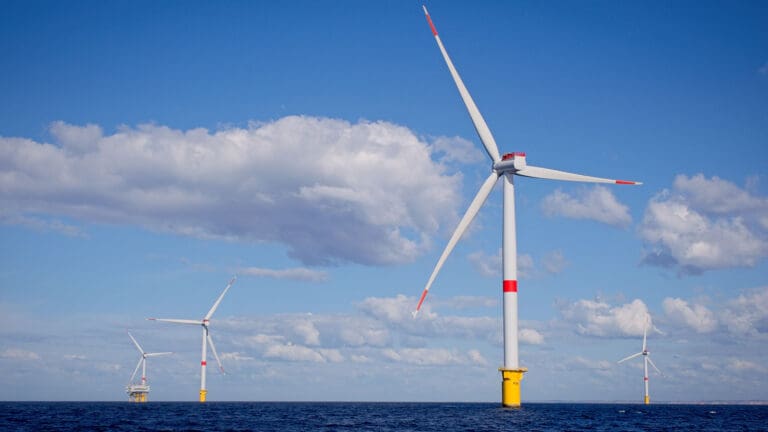
RWE and KKR commit £12bn to two Norfolk offshore wind farms

Energy company RWE and investment firm KKR have committed £12bn to build the Vanguard West and Vanguard East offshore wind farms off the Norfolk coast, with both projects due to be operational by 2030, the government said today.
The government said the sum was believed to be the biggest investment of its kind in UK history. It said the developers had now made their final investment commitment, with onshore works already well advanced and offshore construction set to begin in early 2027.
The announcement came as Prime Minister Andy Burnham prepares to travel to the COP31 Leaders’ Summit in Türkiye.
According to the government, the projects will support more than 2,400 jobs during construction and operation and, once running, will have the capacity to supply the equivalent of around three million UK homes. In its own statement, RWE said financial close had been reached on both projects, which have a combined capacity of 2.8 gigawatts and sit 50 to 80km off the coast.
The financing includes £1bn from the National Wealth Fund, the publicly owned policy bank that aims to drive more than £100bn of finance into the UK economy. The government said it was the fund’s largest investment in offshore wind to date. In January the fund set out plans to invest up to £5bn a year in clean energy and strategic infrastructure.
The government also pointed to its recently announced Energy Wealth Fund, which will be linked to future government revenues from the North Sea and will invest in renewable and low carbon energy projects, starting with a £2bn injection.
Burnham said: “This major investment in UK renewables is a vote of confidence for building in Britain. And it is great news for billpayers because every turbine we put up is power under British control, not at the mercy of events on the other side of the world.”
Markus Krebber, chief executive of RWE AG, said: “Together with KKR, we are delivering two of the UK’s largest offshore wind projects, strengthening domestic electricity generation and making an important contribution to the country’s long-term energy security.”
Vincent Policard, co-head of European infrastructure at KKR, said the partnership “demonstrates how private capital can help turn the UK’s energy ambitions into reality”.
In January, RWE’s UK chief executive Tom Glover was asked whether the group’s five newly contracted UK offshore wind projects would be online by 2030 and answered “Probably not”.
Separately, SSE said the latest phase of its Berwick Bank offshore wind farm, Berwick Bank B, will back 2,677 skilled jobs in manufacturing, engineering and project delivery across the north of England and Scotland. The Scottish-headquartered company has contracted Siemens Energy to manufacture wind turbines and substation platforms, and the total includes 130 new project delivery roles in Glasgow and Montrose.
According to the government, Berwick Bank, off the east coast of Scotland, could become the world’s largest offshore wind farm at full capacity and meet more than 6 per cent of current UK electricity demand.
Martin Pibworth, chief executive of SSE, said: “This is public-private partnership in action. Clear political direction, matched by businesses prepared to invest, is translating into real-world investment in British jobs, skills and manufacturing.”
Rain Newton-Smith, chief executive of the CBI, said: “Investment on this scale can attract further private capital, create skilled jobs and support growth in communities across the country.”
The announcements follow the introduction of the Energy Independence Bill last week, which the government described as a down payment on reforms that will put affordability at the heart of the energy system. Its measures include bringing rogue operators under greater public oversight, strengthening protections for households and businesses, and giving local people a greater stake in clean energy projects built around them.
Under the Bill, energy brokers and price comparison services will be brought under Ofgem regulation, a change the government expects to save businesses around £100m a year through reduced mis-selling and hidden commissions.
Energy Secretary Miatta Fahnbulleh said: “Investment in offshore wind and clean power is creating quality jobs and rebuilding industry, while delivering the clean power we need to lower bills and reach net zero.”

More Stories
The Succession Audit Every SME Should Run Before Year-End
Somewhere in that list the succession check rarely gets a look in, and that omission tends to matter more than...
Black Friday 2026 Electric Dirt Bike Buying Guide: How to Get the Best Value
However, a lower price does not automatically make every model a worthwhile purchase. From rider age and top speed to...
Why Busy Professionals Need Leisure That Doesn’t Require Extensive Planning
Even when you recognize the importance of taking a break, figuring out what to do with your free time can...
When Ageing Business Software Becomes a Business Risk
For a small business, the resulting delay can affect sales, service, and staff time. The age of the software is...
How to Assess Long-Lasting Disinfection Claims in the Workplace
What was tested, on which surfaces and under what conditions? How must the treatment be applied, and what cleaning will...
Starting a YouTube Channel for Your Podcast: Setup, Format and Growth Tips
If you’re wondering how to start a podcast on YouTube, you don’t need a professional studio or expensive equipment. You...