
How Rolls-Royce Is Taking Project Nightingale to Extraordinary New Heights

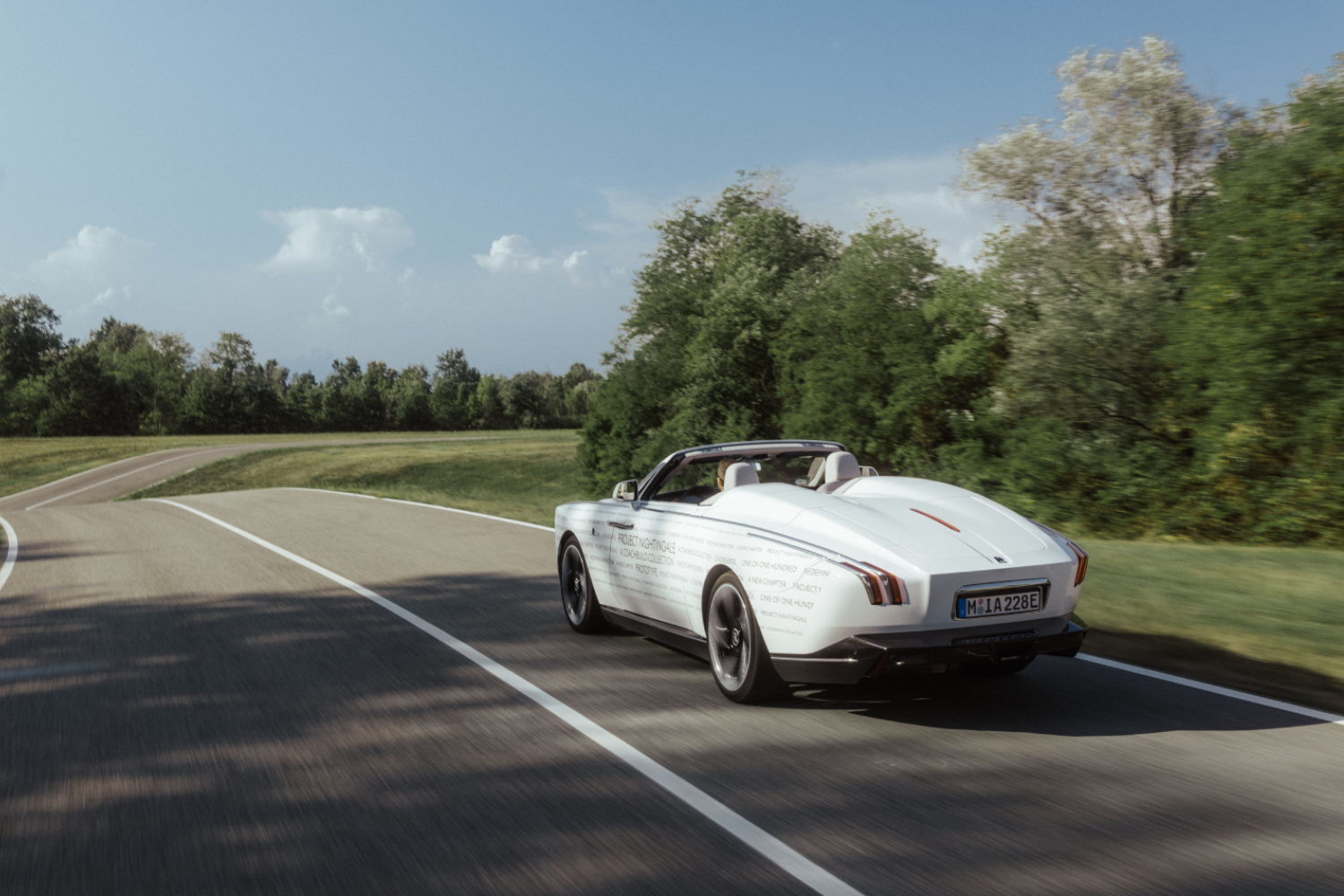
Rolls-Royce has begun the next major stage of Project Nightingale, putting its extraordinary Coachbuild Collection through a demanding global testing programme.
Only 100 client cars will be produced. Yet Rolls-Royce is giving the project an enormous amount of engineering attention. The programme will involve 350 collective weeks of testing across some of the world’s most challenging environments.
The goal is simple. Project Nightingale must deliver the same effortless refinement wherever its owners choose to drive it.
The testing programme began in September 2026, starting in Southern Europe before moving into harsher climates and higher altitudes.
From the French Riviera to the Arctic Circle
Project Nightingale takes its name from Le Rossignol, French for ‘the nightingale’. Henry Royce used the name for a house near his winter residence on the French Riviera.
The location also has an important connection with Rolls-Royce engineering history.
More than a century ago, the marque tested its cars on the roads between Monte Carlo and London. Engineers also worked from its facility in Châteauroux and used the French Riviera as a base for durability testing.
Now, Project Nightingale is returning to those roads.
However, its testing journey will eventually extend much further. Prototypes will face:
Mediterranean roads and high-speed routes
The Arctic Circle
Deserts across the Arabian Peninsula
Temperatures at extreme ends of the scale
Altitudes of up to 2,750 metres
That range matters because Rolls-Royce says its commissioning clients intend to drive their cars around the world and throughout the year.
Project Nightingale has already spent years in development
The road testing may be starting now, but the engineering work began almost three years ago.
Before the prototypes reached public roads, Rolls-Royce subjected them to 1,430 hours of aerodynamic modelling. This included digital simulations and wind tunnel testing.
The next stage will put those findings to work in the real world.
At a private high-speed testing facility, Project Nightingale will reach speeds of up to 155 mph. Engineers will also focus on reducing wind noise to extremely low levels.
That matters particularly for an open-top Rolls-Royce. The car must deliver strong performance without sacrificing the calm cabin environment expected from the marque.
A roof designed for extreme conditions
Project Nightingale’s roof has also received considerable attention.
Rolls-Royce has created a sound-deadening material combining cashmere, fabric and high-performance composites. The roof will face 10 separate tests covering its fabric, closing mechanism and overall performance.
Some tests will take place at temperatures reaching 80°C.
The roof must also perform when temperatures drop dramatically. Project Nightingale is intended for year-round use, so its systems need to work in very different environments.
The same principle applies to the car’s electric wind deflector.
Rolls-Royce developed the system specifically for Project Nightingale. It helps prevent high-pressure air from moving back into the cabin when the roof is open.
Engineers will test it at different speeds and temperatures. They will also assess how effectively it limits turbulence inside the cabin.
Even the Piano Boot faces thousands of tests
One of Project Nightingale’s most distinctive features is its Piano Boot.
The sideways-opening boot uses a cantilever mechanism and brings another carefully considered detail to the Coachbuild Collection.
Rolls-Royce will open and close it 15,000 times during testing.
That number might sound excessive for a boot. However, Rolls-Royce is not testing only whether the mechanism works.
The engineers are also assessing how it sounds and feels after thousands of operations. The aim is to ensure that the experience remains effortless over many years of use.
For a car built in such limited numbers, that level of testing says plenty about the standards involved.
A Rolls-Royce built without conventional limits
Project Nightingale was unveiled in April 2026 as the first example of Rolls-Royce’s new Coachbuild Collection. The production concept is an open-top, two-seat motor car combining bespoke design with the marque’s fully electric powertrain.
Rolls-Royce plans to produce only 100 examples, with deliveries scheduled to begin from 2028. The cars are available by invitation only.
The project also draws inspiration from Henry Royce’s experimental EX cars of the 1920s. Those machines allowed Rolls-Royce to explore ideas beyond the conventions of the company’s regular production cars.
Project Nightingale follows a similar philosophy.
Its design, engineering and testing programme give Rolls-Royce an opportunity to explore what an ultra-luxury electric road car can become.
What happens next for Project Nightingale?
The global testing programme represents a crucial stage in the car’s development.
Engineers will gather data from extreme temperatures, different road conditions, high speeds and repeated use of its most complex features. However, numbers alone will not determine when the car is ready.
Rolls-Royce says experienced engineers will also rely on their judgement and instincts. Their role will be to ensure that Project Nightingale delivers the quietness, refinement and sense of authority expected from the marque.
That combination of measurement and human judgement could prove just as important as the car’s striking design.
Final thoughts
Project Nightingale already looks like one of Rolls-Royce’s most ambitious projects. Now, its prototypes must prove that ambition on roads and in climates around the world.
Would you drive an open-top Rolls-Royce through the Arctic Circle? Or would you choose a warmer route through the French Riviera?
And which detail of Project Nightingale would you most like to experience?
The post How Rolls-Royce Is Taking Project Nightingale to Extraordinary New Heights appeared first on My Car Heaven.


More Stories
GM Defense Unveils Driverless Chevrolet Silverado 3500HD Military Truck for the U.S. Army
General Motors is taking the Chevrolet Silverado into some unexpected territory, and this time, there won’t be anyone behind the...
India September 2026: Record market (+20.9%), Kia, Maruti Suzuki Baleno at record high
The Maruti Suzuki Baleno is the best-selling vehicle in India in September. The Indian wholesales market continues on its fantastic...
USA Q3 2026: Ram (+29.3%) surges, Jeep (-19.9%) falls, Detroit 3 at lowest ever 36% share
Ram Pickup sales are up 33.7% in a declining market. New light vehicle sales in the US edge down -0.8%...
China new models September 2026: Hongqi G919, VW ID.AURA T6 and Hyundai Ioniq V arrive
Hongqi G919 Now that September 2026 wholesales have been covered, let’s focus on the latest launches on the Chinese market....
Fuel Crisis Accelerates Fall in Used Diesel Values
Soaring fuel prices are accelerating the decline in used diesel car values, with prices down 6.9% over the past 12...
Best Car Accident Attorneys in Illinois
A car accident can create challenges that extend well beyond vehicle repairs. Injured drivers and passengers may face medical expenses,...