
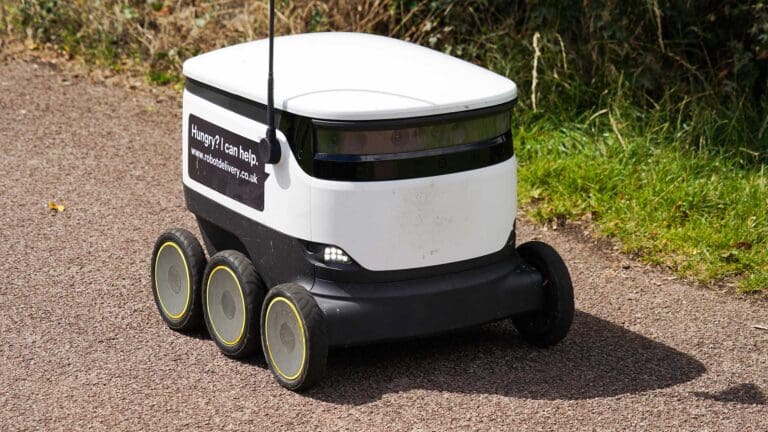
Living Streets calls for ban on delivery robots as trials spread

Living Streets has called for an outright ban on delivery robots on UK pavements, as London, Stockton-on-Tees and Nottingham prepare to join the seven towns and cities where the campaign group says the machines already operate.
The group said this week that autonomous delivery robots are running in Leeds, Barnsley, Milton Keynes, Sunderland, Reading, Bristol and Cambridge, and that there are no laws governing their use.
It said the robots present a dangerous obstacle to all pedestrians, and especially to disabled people, those who are blind or partially sighted, and families with young children.
A spokesperson at Living Streets said: “This has to stop. Our pavements are not for sale, they should be for people only.
“The government is losing control of our pavements and needs to cease all robot deliveries until the issue has been debated and decided upon in due process.”
Living Streets cited a recent YouGov poll in which 60 per cent of people in the UK said delivery robots should not be on pavements. Four in five thought the robots could cause problems for blind people and those with mobility issues, according to the group. It did not give the sample size or the dates of the survey.
The group said current trials have had no involvement or approval from the UK government. It said a Bill is due to pass through Parliament this year to determine whether delivery robots can operate in legal, approved trials.
The Department for Transport has given a different account of the existing schemes. In a written parliamentary answer on 7 July, Simon Lightwood, responding for the department, said: “Where pavement robots currently operate, they do so in partnership with the relevant local authority.”
In the same answer he said the government would facilitate new trials of pavement delivery robots through powers in the Regulating for Growth Bill, “with a view to creating a clear, lawful route to market”. He said local leaders would decide whether to trial the robots and shape how any trial operates.
In a second answer, on 15 July, Lightwood said that no permanent regulations will come into force without detailed public consultation. “A key part of the trial will be understanding the impact on pedestrians, particularly the most vulnerable groups,” he said.
The call for a ban follows a Business Matters report on Sunday that Deliveroo is to begin using pavement robots for takeaway and grocery orders. Its first robot deliveries are due in Canary Wharf, east London, in the coming weeks, with Milton Keynes, Leeds, Stockton-on-Tees and Nottingham to follow. All five are areas where local councils allow robot deliveries, according to the report.
Deliveroo’s robots are made by Coco, a US technology firm. The company is in talks with more councils and with the Department for Transport as it seeks permission to use the technology more widely.
Miki Kuusi, the chief executive of Deliveroo, said of objections to the robots: “These are the kind of things where it’s very easy to come up with all the concerns and fears on paper in theory. But then when you actually see these things on the streets and how they work as a part of the city, the reality is that they blend in quite well.”
Kuusi said robots would lower delivery costs. “A plastic box on wheels rolling around a city is incredibly energy-efficient, the hardware can be very low-cost, and that ultimately makes the service a lot more affordable,” he said.
Other companies have used the machines for several years. The Co-op extended its robot grocery service to Northampton in November 2020, having started in Milton Keynes with Starship Technologies. The parcel carrier DPD began robot deliveries in Milton Keynes in 2022, with its robots working within a one-mile radius of the depot. Just Eat uses Starship robots in some parts of Britain.
Living Streets said it wants an outright ban so that pavements are safe and accessible for everyone.

More Stories
Invest NI to host GB firms in London after £764m investment year
Invest Northern Ireland will make its case to British companies at a business reception in London on 15 October, after...
Lidl cuts prices on more than 1,200 products in £400m investment
Lidl GB has invested £400m in price cuts and promotions on more than 1,200 products so far this year and...
Friends of the Earth calls Tory environment plans ‘dangerous’
Friends of the Earth has accused the Conservatives of offering “free rein to polluters” after the party used its conference...
Getting to know you: Paul Hodnett, founder and CEO, POWWR
Paul Hodnett is the founder and chief executive of POWWR, the Manchester-based company whose software is used by energy suppliers...
Getting to know you: Matt Falconer, CEO, Ares Intelligence
Matt Falconer is co-founder and chief executive of Ares Intelligence, a London-based company whose AI interviewer holds 20-minute voice conversations...
Getting to know you: Chloe Wallace, founder, OneSource HR
Chloe Wallace is founder and managing director of OneSource HR, a South Yorkshire consultancy that specialises in workplace conduct, complex...