
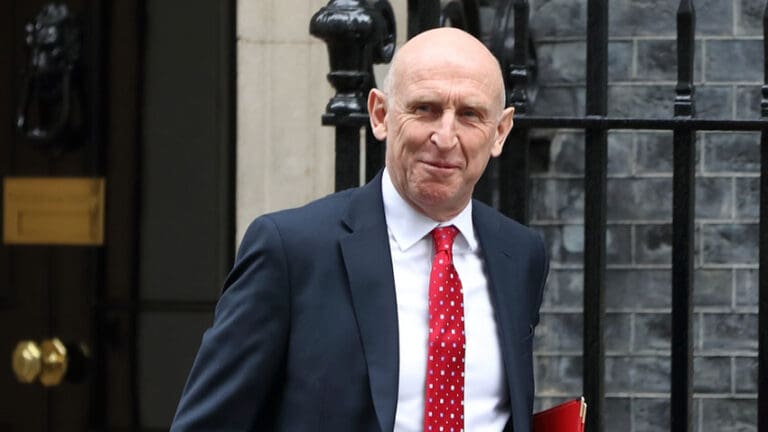
Healey tells bank chiefs no decision made on windfall tax

John Healey, the chancellor, told the chief executives of Britain’s biggest banks today that the UK faces a tough fiscal position but that he has yet to decide whether to raise taxes on the industry, according to people with knowledge of the meeting.
The talks took place in Downing Street this morning and lasted just under an hour, it is understood. They were run by Lucy Rigby, the City minister, and Healey was said to have been in “listening mode”.
It emerged last week that the chancellor had summoned the heads of lenders including Barclays, HSBC, Lloyds Banking Group, Nationwide Building Society and NatWest. That added to speculation in the City that he will target banks in his first budget, on 28 October.
Sources said the executives warned Healey about the potential impact of a windfall tax on investor sentiment towards the UK. One person with knowledge of the discussions said there was a collective recognition that most bank shareholders are international, and that there was strong distaste for windfall taxes generally, which risked making the UK more broadly increasingly uninvestable.
Two sources said Georges Elhedery, the HSBC chief executive, who attended by video link, reminded the chancellor that his bank had attracted an activist investor in recent years, as an example of the difficulties lenders face in managing shareholder sentiment.
Ping An, a Chinese insurer and big HSBC shareholder, called four years ago for the Asia-focused bank to break itself in two. The campaign was opposed by the lender’s board and failed to gain traction among other investors.
Healey summed up at the end of the talks by saying there was a tough fiscal backdrop and that he was yet to take decisions on taxes, the sources said.
“Nobody came out any the wiser” on whether the chancellor would target banks in the budget, one of the people said. The Treasury was approached for comment.
Some groups want the chancellor to raise taxes on banks because of the industry’s profits, which have been boosted by higher-for-longer interest rates in recent years.
The Trades Union Congress and Positive Money, a campaign group, have said a bank windfall tax could fund cost-of-living measures for households. The Green party has suggested that higher levies on banks could fund tax breaks for small businesses.
Economists said last month that Healey would need to find about £10bn in tax rises or spending cuts in the budget.
The banks argue that they already face a heavier burden than other types of company, because they pay an industry-specific corporation tax surcharge on profits and a levy on their balance sheets, both introduced in the years after the financial crisis.
HM Revenue and Customs figures show that the bank levy took effect in January 2011 and the surcharge in January 2016, and that they raised £1.3bn and £1bn respectively in the 2024 to 2025 financial year.
UK Finance, which lobbies for lenders and publishes an international comparison of bank tax rates, has warned that taxes on banks in the UK are already higher than in other jurisdictions and that a further increase could prompt international players to shift investment out of Britain.
It has calculated that the total tax rate this year on a model corporate and investment bank in London is 46.5 per cent, compared with 39.1 per cent for a lender based in Frankfurt and 27.9 per cent in New York.
Jeremy Hunt, the former Conservative chancellor, has separately urged Healey not to raise the bank surcharge, writing in The Times that an increase would mean less investment, lower growth and fewer jobs.
Jonathan Pierce, an analyst at Jefferies, proposed last month that lenders offer the chancellor a five-year freeze on deferred tax assets to head off a steeper tax rise.

More Stories
Haldane warns Burnham UK is on ‘thin ice’ before Budget
Andy Haldane, the president of the British Chambers of Commerce and an informal economic adviser to Andy Burnham, has warned...
Bradford tops ranking of hardest UK cities for charity shops
The Co-operative Bank has ranked Bradford as the UK city where charity shops face the greatest challenges in 2026, with...
Cost of switching off wind farms passes £1.5bn, topping 2025 total
The cost of switching off wind farms because Britain’s electricity grid cannot carry their power has reached just over £1.51bn...
Asos investigates app alert claiming hackers breached its data
Asos is investigating after a push notification sent from its mobile app to customers today claimed that hackers had “fully...
7 Best Enterprise Web Scraping Services for Scalable Business Data in 2026
Choosing the right provider depends on your data requirements, technical resources, and long-term business goals. Some companies need a fully...
Hair and beauty salons urge Chancellor to halve VAT to 10 per cent
Two thousand hair and beauty salon owners and workers have signed an open letter calling on Chancellor John Healey to...