
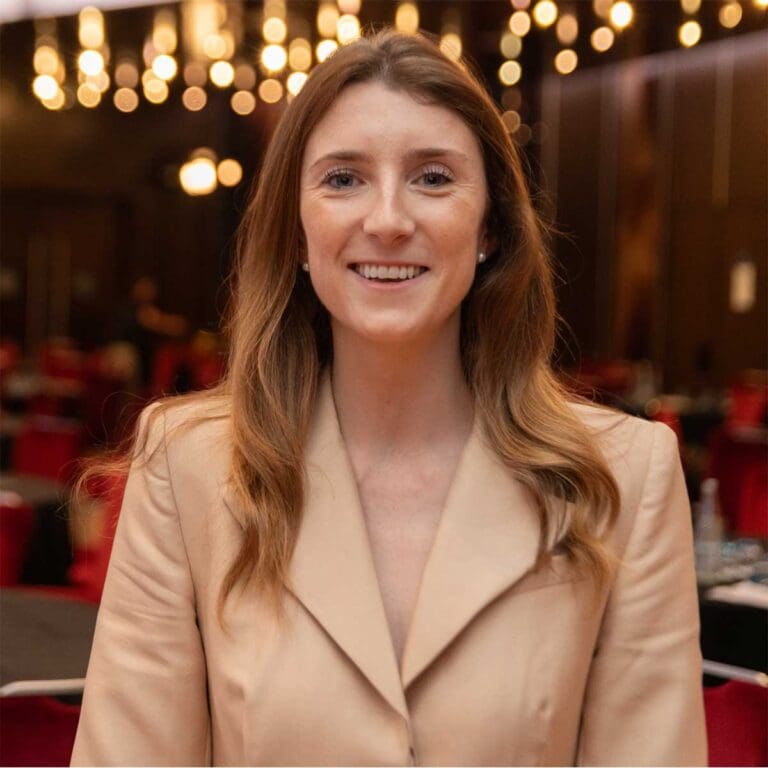
Getting to know you: Emily Harrison, founder, Nexus HE

Emily Harrison founded Nexus Healthcare Education in January 2024 to turn complex science, emerging evidence and clinical guidelines into education that healthcare professionals can use in practice.
On 17 September 2026, less than three years after launch, the company won gold in the Independent Medical Education category at the PMi Awards in London.
Nexus HE works from Great Portland Street in London and an office in Amsterdam, and measures the impact of its programmes through its own GAUGE outcomes model. She tells Business Matters why the real test of education is what changed as a result of it.
What do you currently do at Nexus Healthcare Education?
As Founder and Managing Director, I lead the strategic direction, growth and innovation of Nexus Healthcare Education. My role spans both the commercial and educational sides of the business, from identifying new opportunities and developing partnerships through to overseeing the design and delivery of complex, multi-channel medical education programmes.
Our work ranges from digital and personalised learning to immersive educational experiences, live and virtual programmes, and major congress-based activations. A particularly important part of my role is ensuring that everything we deliver combines educational innovation with scientific integrity, measurable outcomes and alignment with global compliance and accreditation standards.
As the company has grown, my role has increasingly shifted towards setting the vision for where Nexus HE goes next, building the right team around that vision and ensuring we continue to innovate without losing the quality and attention to detail that helped us grow in the first place.
What was the inspiration behind your business?
Working within the medical education industry, I could see a critical gap between scientific advancement and what actually happens in day-to-day clinical practice. There is an enormous amount of new evidence, data and guidance being generated, but simply giving healthcare professionals more information does not necessarily change how patients are managed.
I founded Nexus HE because I wanted to approach medical education differently: starting with the clinical problem we are trying to solve and the change we want to create, rather than simply the educational activity we want to deliver.
That means translating complex science, emerging evidence and clinical guidelines into practical, engaging education that healthcare professionals can apply in the real world, and then measuring whether that education actually made a difference.
That focus on measurable change has become fundamental to Nexus HE. Our ambition is not simply to demonstrate that someone attended an activity or completed a programme, but to understand whether their knowledge, confidence, clinical decision-making or practice subsequently changed, and where further education is still needed.
Who do you admire?
I tend to admire founders and business leaders who have built something genuinely distinctive rather than simply following an established model. In particular, I respect people who combine ambition with an obsessive focus on the quality of what they deliver and who are prepared to challenge the accepted way of doing things.
I also have enormous admiration for people who build successful businesses while creating strong teams around them. One of the things I have learned as Nexus HE has grown is that building a company is ultimately about people: finding talented individuals, trusting them with responsibility and creating an environment where they can do their best work.
Looking back, is there anything you would have done differently?
There is not anything fundamental I would change, because so much of building a business is learned through experience. You make decisions with the information you have at the time, learn very quickly from what works and what does not, and continually refine how you operate.
The biggest challenge has probably been managing the pace of growth. Once you start winning significant work, you suddenly need the people, processes and infrastructure to deliver at a much greater scale without compromising the standards that won you that work in the first place.
Within healthcare, that is particularly complex because growth has to sit alongside scientific integrity, quality, compliance and governance. You cannot allow commercial growth to outpace your ability to deliver responsibly.
If I were starting again, I would probably implement some of our systems and structures earlier and design them for the company I wanted Nexus HE to become, rather than the size it was at that moment.
Growth also requires a change in mindset as a founder. In the beginning, you naturally have visibility over almost everything. As the company scales, you have to build a team that can take genuine ownership and make decisions without everything coming back to you. Learning when to step away from the detail and trust other people has been one of the most important parts of that transition.
What defines your way of doing business?
For me, it is a combination of innovation, quality and accountability for impact.
Our core principle at Nexus HE is that it is not enough to deliver excellent education; we should also be able to demonstrate what that education actually changed for healthcare professionals and, ultimately, how those changes could contribute to better patient care.
That philosophy led us to develop GAUGE, our proprietary outcomes analytics approach. It measures educational impact across five levels (participation; satisfaction and confidence; knowledge; competence; and performance), with longitudinal follow-up extending for up to nine months.
We establish a baseline before education begins, define the change we are trying to achieve and then measure what happens afterwards against those objectives and relevant external benchmarks. Importantly, the process does not stop with demonstrating success. The data also helps us identify persistent clinical gaps and understand where the next educational intervention should focus.
I want Nexus HE to help move independent medical education beyond simply delivering activities and reporting attendance or engagement. The real question should always be: what changed as a result of this education? That principle influences almost every decision we make.
What advice would you give to someone starting out?
Be very clear about why you want to start a business. If the primary motivation is simply wanting to work for yourself, the uncertainty, responsibility and pressure of running a company can come as quite a shock. There need to be stronger reasons: a problem you genuinely want to solve, an opportunity you believe in or a better way of doing something that you feel compelled to pursue.
At the same time, do not spend forever waiting until everything is perfect. I learned more during the first six months of actually running Nexus HE than I ever could have learned from another six months of planning it. Once you have a clear proposition, understand your market and know your numbers, you have to be prepared to start.
I would also tell people to surround themselves with individuals whose strengths complement their own. As a founder, you do not need to be the best person at everything, and eventually you actively need people around you who are better than you in their specialist areas.
Most importantly, protect your reputation above short-term commercial gain. Listen carefully to your clients, be prepared to adapt, and never compromise on the quality of what you deliver.
In healthcare especially, there is another layer of responsibility. Behind every programme, data point or business decision are healthcare professionals making decisions about real people. Never losing sight of the patient at the end of that chain is incredibly important to me and to the way we have built Nexus HE.
More Stories
Getting to know you: Tim Morris, co-founder and CEO, Spotless Water
Tim Morris is co-founder and CEO of Spotless Water, the Frimley-based company behind a network of 177 self-service pure water...
Nicola Sturgeon to teach women leadership under pressure
Nicola Sturgeon, the former First Minister of Scotland, is to teach women how to lead under pressure in a full-day...
Getting to know you: Nick Mann, founder, Habitat Aid
Nick Mann is the founder of Habitat Aid, the Somerset business that supplies native British plants, trees and seeds to...
Trump ‘very seriously’ mulling diesel export ban
A US cutoff could hit Europe hard as Russian and Middle Eastern supplies remain disrupted The White House is still...
Getting to know you: Matthew Drew, managing partner, Goughs Solicitors
Matthew Drew is managing partner of Goughs Solicitors, the firm founded in Calne in 1882 that now runs seven offices...
Reynolds vows to close bogus self-employment loophole
Jonathan Reynolds, the business secretary, has pledged to close “bogus self-employment loopholes” that he said deny workers basic rights, telling...