
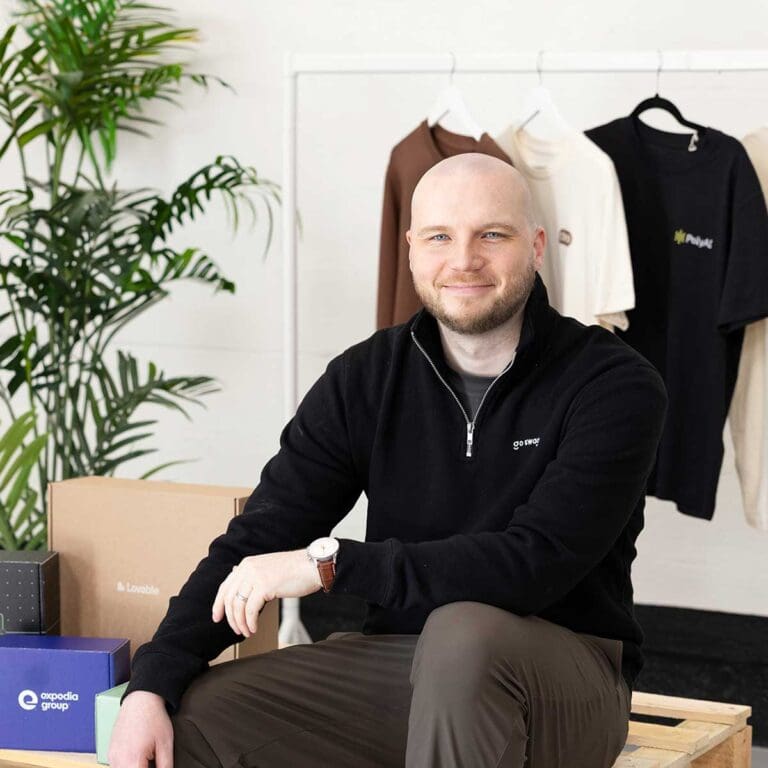
Getting to know you: Conor McKenna, co-founder and CEO, Go Swag

Conor McKenna is co-founder and chief executive of Go Swag, a Glasgow company that sources, stores and ships branded gifts and merchandise for more than 1,000 organisations, including Meta, Apple and Netflix.
In May 2026 the business raised $5m (£3.7m) in a round led by Mercia Ventures with Techstart Ventures, taking total funding to $6.2m. The money will push Go Swag further into the United States, open a warehouse in Southeast Asia and grow the team from 30 to 70 people. He tells Business Matters why he learned to say no to clients, and why he thinks the catalogue is finished.
What do you currently do at Go Swag?
As co-founder and CEO, my core focus is setting the strategic direction of the company, driving our global expansion and leading product innovation. We have built Go Swag as a tech-enabled corporate gifting platform to take the heavy lifting out of branded merchandise for global enterprises.
That means a lot of my day-to-day involves pushing our technology suite, from AI-driven product curation to customisable recipient management systems. Our Claim Pages let recipients enter their own details, and Sonny, our AI recommendation engine, helps clients choose products. Anything that ensures we are eliminating friction for our clients at every step.
What was the inspiration behind your business?
Go Swag started with a problem my co-founder Ben and I ran into first-hand while working at a software agency in Glasgow. We were asked to build an onboarding pack for a new designer, but quickly found that the available options were low quality and split across fragmented suppliers. We ended up sourcing and packaging everything ourselves to create the kind of first impression we wanted the new joiner to have.
When we asked HR about scaling that experience, they showed us the operational nightmare behind it: managing dozens of vendors, holding inventory and handling international shipping.
Coming from design backgrounds, we saw a trillion-dollar industry running on 20-year-old catalogues and manual processes. Companies were spending millions perfecting their digital brand, yet handing out disposable merchandise physically. We launched Go Swag to bridge that gap completely.
What will the new funding be used for?
We raised $5m, led by Mercia Ventures with Techstart Ventures and a group of strategic angel investors. It will help us grow in the United States and open a warehouse in Southeast Asia, alongside the ones we already run in the UK, the Netherlands and the US.
We also plan to grow the team from 30 to 70 people across sales, engineering and operations, and to keep automating quoting, account management and product recommendations.
Who do you admire?
My biggest inspiration is my mum. She left home at 17 and built a remarkable career through sheer determination and work ethic, eventually becoming a CEO. Watching her resilience up close taught me what leadership, adaptability and perseverance look like in practice.
In business, I admire founders and builders who question industry status quos rather than accepting them. Anyone who takes a stagnant category and fundamentally rebuilds it through better technology and design principles is someone I look up to.
Looking back, is there anything you would have done differently?
We should have learned to say no sooner. Early on, it is easy to assume the goal is simply to hit the brief and match the target price, when in fact clients rely on your expertise to push back. Accepting a product compromise might feel fine in the moment, but taking shortcuts on quality is too big a risk for any brand to take.
We work with some of the world’s most ambitious companies, and we have staked our reputation on making sure physical merchandise gets exactly the same attention to detail as their digital homepage. Bringing that level of honesty to a pitch is not always the easiest way to win business, but it is how you build real trust in the long term.
What defines your way of doing business?
I have always been a builder, someone who likes taking complex systems apart to figure out where they fail and how to rebuild them cleaner. That mindset dictates how we operate: lean teams, rapid execution and an uncompromising focus on quality.
We believe corporate gifting should not be treated as a transactional procurement task; it is a high-impact brand touchpoint. We act as an extension of our clients’ teams by taking complete ownership of the back end. That means handling everything from recipient sizing to global distribution across three continents, so enterprise leaders can stay focused on their core business.
What advice would you give to someone starting out?
Be prepared to outwork everyone, and surround yourself with smart, determined people. Most of building anything worthwhile is boring, repetitive work that nobody sees. You have to learn to enjoy that bit, not just the outcome.
And do not outsource your conviction. Most interesting businesses sound like terrible ideas until someone proves otherwise. Ask for opinions, listen and learn, but remember that most people have not tried what you are trying. Build it, find customers and let real transactions tell you whether you are right.


More Stories
Getting to know you: Toby Spooner, co-founder, METRIX
Toby Spooner is a sport scientist and former personal trainer who co-founded METRIX, an immersive fitness competition in which pairs...
Sovereignty concerns raised as Saudi-Sudan maritime delimitation push gains momentum
Sudan has been at war since April 2023, when fighting broke out between the Sudanese Armed Forces (SAF), led by...
Getting to know you: Barry Leahey MBE, president, Playdale Playgrounds
Barry Leahey MBE is President of Playdale Playgrounds, the Cumbrian manufacturer that has designed and installed more than 25,000 playgrounds...
Getting to know you: Paul Corcoran, founder and CEO, Agent
Paul Corcoran is the founder and CEO of Agent, a full-service marketing agency and certified B Corp with studios in...
Getting to know you: Peter Nailer, managing director, CloudCoCo
Peter Nailer is managing director of CloudCoCo Group plc, the AIM-listed IT procurement and e-commerce business. In August 2026 the...
The April Broadband Price Rise Isn’t Dead. It Just Looks Different
March and April remain the months when many broadband and mobile contracts become more expensive. But while the increases are...