
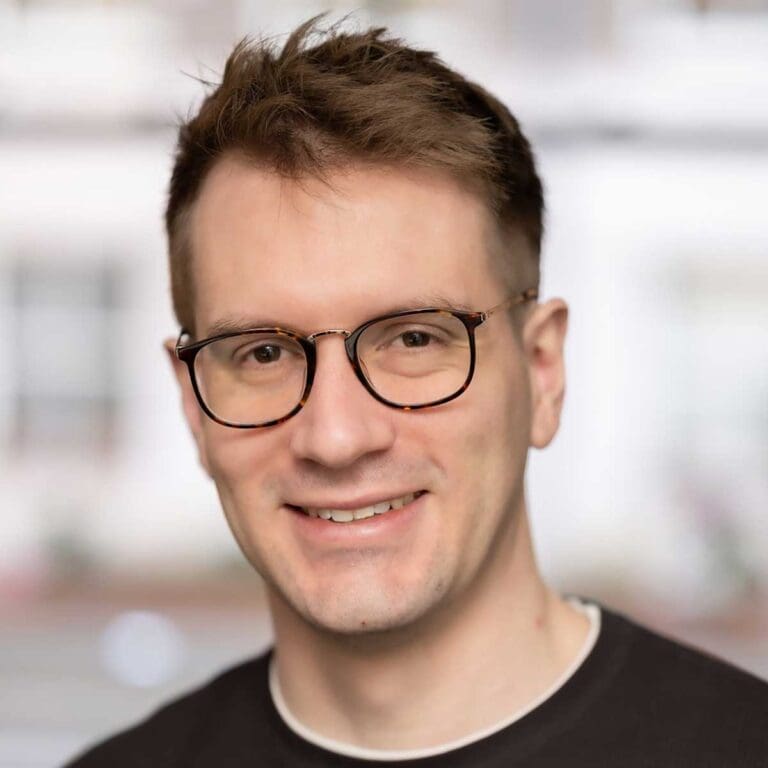
Getting to know you: Adam Kirby, co-founder and CEO, EvaluateLocate

Adam Kirby is co-founder and CEO of EvaluateLocate, a London geospatial AI company training its own models to predict how places across the UK change over time.
In August 2025 the business closed a £300,000 seed round from angel investors under the Seed Enterprise Investment Scheme, at a reported £2.75m valuation, and launched its UK subscription app, powered by its proprietary GSP-1 model and more than 100 location metrics. Kirby, a physics graduate, founded the company in 2024 with Duncan Lamb after the pair spotted how little attention investment proposals paid to location. He tells Business Matters why AI needs to think in space and time, what Thomas Edison taught him and why starting a business is always harder than you expect.
What do you currently do at EvaluateLocate?
I run a company building a new type of “spatial intelligence”: an AI that thinks naturally in space and time to predict how any place on Earth changes and evolves.
This ambition is part of an important next trend in AI: going beyond language-based intelligence. We are also a rare breed of European startups training our own models rather than purely building on top of outputs from American firms. Our first model, GSP-1, powers our UK app, which rates places on more than 100 metrics.
My role covers everything from leading research on our proprietary AI architecture to overseeing the operations of the business and supporting the team sharing our latest capabilities with clients. On an average day I might be deep in code, updating investors, talking to a housebuilder or retailer about site selection, or speaking to a local government about how economic growth is trending in their region.
What was the inspiration behind your business?
Whether or not the decision is literally about a building, bridge or piece of land, or whether a transaction itself happens online, everything in business and government has major exposure to different people and places. Location is opportunity, risk and differentiator for so many organisations, yet it is so often unmeasured.
Once upon a time my co-founder Duncan Lamb and I were reading an investment proposal worth tens of millions. This was from a well-known investment organisation, in our previous roles with the asset management industry. There were pages and pages on the building and its tenants, but half a paragraph of vague text on the surrounding area.
I suggested we should create a system to continuously measure that “location factor”. The rest was, if not history, then certainly a quest. Then it became a system, a codebase, eventually a company, and now a novel family of spatial AI models.
My love of a map and a technical challenge combined with Duncan’s knowledge of the people and businesses who have enormous value riding on location decisions.
Who do you admire?
Thomas Edison is a distant relative as well as a general inspiration. While you might know him for his hits such as the lightbulb, I admire two particular aspects of Edison.
First, he used the almost total deafness he had lived with since childhood as an advantage to concentrate better, not accepting that it should slow him down. Second, he had a seemingly unlimited capacity for new ideas, and when most failed he just kept going. Edison seemed to see further ahead than anyone else, researching efficient rechargeable car batteries in the 1890s.
Speaking of cars, Ron Dennis, who led McLaren for three decades, is a local hero where I live in Woking, and often a more practical type of engineer than Edison. Alongside an infamous attention to technical detail, he is admirable for managing a company from challenger to behemoth.
Back to family connections, I admire my own child, who helps me see the world with all the curiosity of a Thomas Edison or a three-year-old looking for frogs.
Looking back, is there anything you would have done differently?
Start sooner, go faster, be bolder.
That said, if we started again with the answers from our apparent mistakes, we might never learn the right questions.
What defines your way of doing business?
Internally we have a mantra of “truth, trust, grit”, which is my best attempt to capture in words what motivates me: the kind of team and technology we are building, and the kind of service we provide to our clients.
Truth means we are honest with each other, obviously. But it also relates to what our product does: we are aiming for a way to measure reality on the ground as closely as possible, with practical metrics that describe real places. It sets us apart slightly from language models that can claim something different every time. That is not what we do. Trust is similar, and it is basically the personal responsibility we have to each other and to our clients in the same respect.
Grit is what is required to achieve the other two, but it also sums up what I describe as “never walking past a problem”. It could be a dirty cup left on a desk (hello, Ron Dennis) or it might be a piece of code or marketing copy that just does not look right. It is the responsibility of everyone to look out for each other and the shared mission.
More prosaically, I believe in a ruthless attention to detail when it comes to the work itself, but the kindest attention to your colleagues.
What advice would you give to someone starting out?
I have learnt again and again that starting a business is harder than you expect. And then harder again. And then again, just like the rule on budgets and time estimates: even when you account for it being harder than you expect, it is still somehow harder again.
Personally, I think this “optimism bias” is a massive benefit of human nature, because it allows you to do things that might otherwise be irrational. Voting, in terms of personal impact on the result. Signing up for a marathon, in terms of immediate comfort. Starting a family, in terms of finance and sleep. We do these good things anyway. We persevere with them for reasons we struggle to explain but would never change.
Similarly, starting a business will not make you feel younger, sleep better or get “rich quick”. It changes you in some other, deeper way. Perhaps that is my only real piece of advice: choose an idea you love.

More Stories
Getting to know you: Minal Backhouse, CEO, Backhouse Solicitors
Minal Backhouse founded Backhouse Solicitors in 2005, eight years after qualifying as a solicitor, and still leads it as chief...
Getting to know you: Myles Anderson, founder and CEO, BrightLocal
Myles Anderson is the founder and CEO of BrightLocal, the local SEO software company he started with co-founder Ed in...
Getting to know you: Alexander Jay, CEO, Little Green Button
Alexander Jay is CEO of Little Green Button, the Norfolk business behind panic alarm software used by staff in healthcare,...
Getting to know you: Will Polston, founder, Evolution Institute
Will Polston is an Essex-based business strategist and performance coach who works with ambitious entrepreneurs through one-to-one coaching, masterminds and...
Investing in Singapore as an Expat: What Should You Consider First?
For expats, investing while living in Singapore can provide opportunities to build long-term financial security, but it also comes with...
Designing a Dream Home on a Realistic Budget
The good news for anyone renovating on a modest budget is that the principles professional designers rely on cost nothing...