
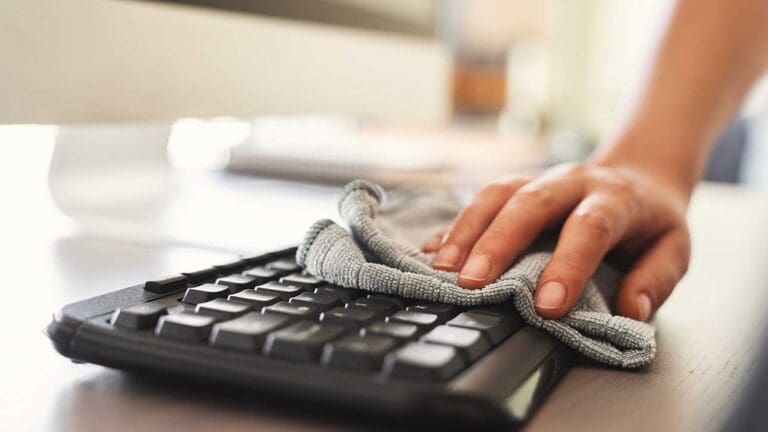
The Dirty Desk Economy: How Workplace Grime Quietly Drains Billions From Business Bottom Lines

Almost none will mention the item that research suggests is silently taxing their payroll every single day — the physical cleanliness of their workplace.
The numbers are not small. As a company that cleans commercial spaces across one of the most competitive business environments on earth, we at Green Hands Cleaning Services Corp in New York City have watched businesses treat cleaning as a grudge purchase — the first line item cut when budgets tighten. The research says that instinct is spectacularly expensive. Here’s the evidence, and why the humble cleaning contract may be one of the most underrated productivity investments in business.
Your Desk Has 400 Times More Bacteria Than a Toilet Seat
Let’s start with the finding that made headlines around the world and still shocks every executive who hears it. Research led by Dr. Charles Gerba, a microbiologist at the University of Arizona, found that the average office desk harbours roughly 400 times more bacteria than the average toilet seat — around 10 million bacteria on a typical work surface.
The reason is behavioural, not mysterious. Toilets get disinfected regularly because they’re perceived as dirty. Desks don’t, because they’re perceived as clean. Meanwhile, Gerba’s research found that the areas where employees rest their hands and eat lunch are bacterial hotspots: the average office phone carried around 25,000 bacteria per square inch, keyboards roughly 3,300, and computer mice about 1,600. The office kitchen fared even worse — communal sponges, fridge handles, and coffee pot handles ranked among the most contaminated objects in the entire building.
And contamination doesn’t stay put. A University of Arizona tracer study placed a harmless virus surrogate on a single office door handle at the start of a workday. Within four hours, the virus was detectable on more than half of all commonly touched surfaces in the office — and on the hands of roughly half the employees. One handle. Four hours. Half the workforce.
Now consider that 80% of common infections are transmitted by touch, according to widely cited public health research, and the business implications start coming into focus.
The £14 Billion Question: Sickness Absence Is a Cleanliness Problem
For UK readers, the macro numbers are sobering. The Office for National Statistics reported that UK workers lost approximately 185.6 million working days to sickness absence in 2022 — the highest on record — with minor illnesses such as coughs and colds consistently the single largest cause. Estimates of the total cost of sickness absence to the UK economy run into the tens of billions of pounds annually, and that’s before counting presenteeism: employees who turn up ill and work at a fraction of capacity, which research by Deloitte and others suggests costs employers considerably more than absence itself.
Here’s where cleaning stops being janitorial and starts being financial. A frequently cited workplace hygiene study found that implementing a targeted disinfection programme for high-touch office surfaces reduced surface contamination dramatically — and related research on workplace hygiene interventions has associated proper cleaning protocols with reductions in employee absenteeism of up to 30–40% for illness-related absence. When flu season alone costs businesses billions in lost output, a professional cleaning regime targeting phones, keyboards, door handles, and kitchen surfaces isn’t overhead. It’s insurance with a measurable payout.
The pandemic taught every business this lesson at gunpoint. The follow-up lesson — that the economics of workplace hygiene were compelling before COVID and remain compelling after it — has been forgotten remarkably quickly. It’s a core reason demand for structured commercial programmes like https://www.greenhandscleaningservices.com/services/office-cleaning-new-york-city has remained well above pre-2020 levels even as pandemic-era anxiety has faded: the firms that measured the absence data kept the contracts.
Clean Workplaces Don’t Just Prevent Sickness — They Manufacture Productivity
The second body of evidence is, if anything, more commercially interesting than the first: cleanliness doesn’t merely stop losses. It actively improves output.
The clutter tax on cognition. Princeton University neuroscientists demonstrated in The Journal of Neuroscience that visual clutter competes for the brain’s processing capacity, measurably degrading focus and performance. Your employees’ brains are running background processes on every stack of paper and dusty surface in their field of vision.
The air they breathe is a performance variable. A landmark Harvard T.H. Chan School of Public Health study (the COGfx study) found that workers in well-ventilated offices with low levels of indoor pollutants showed cognitive scores 61% higher than in conventional office conditions — rising to 101% higher in optimised environments. Dust-laden carpets, clogged vents, and grimy surfaces are direct contributors to the indoor air quality problem, and the US EPA estimates indoor air is typically two to five times more polluted than outdoor air. Given that office workers spend roughly 90% of their time indoors, the air inside your office is arguably a line on your P&L.
Employees notice — and judge. A survey by Staples found that 94% of workers reported feeling more productive in a clean workspace, and 77% said they produce higher quality work in a cleaner environment. Separate research found a majority of employees judge their employer by the state of the workplace — with dirty toilets and grubby kitchens repeatedly cited in surveys as factors that damage morale and even influence decisions to stay or leave. In a tight labour market, that’s a retention issue wearing a mop’s disguise.
Clients judge faster than employees do. Multiple commercial surveys have found that around 95% of customers say exterior and interior cleanliness influences their perception of a business, and a significant share say they would not return to a business with dirty facilities — with unclean toilets being the most cited deal-breaker. First impressions form in seconds; grime forms them for you.
The Hybrid-Work Trap: Why Offices Are Getting Dirtier, Not Cleaner
Here’s a counterintuitive development from the post-pandemic workplace that business owners should understand: hybrid working has made office hygiene worse, not better.
The logic seems backwards — fewer people should mean less mess. But three forces work in the opposite direction:
Hot-desking multiplies exposure. When desks were assigned, each keyboard hosted one person’s microbes. Desk-sharing means every surface is now a rotating exchange point for the whole workforce. Studies of shared-desk environments have found significantly higher contamination on hot desks than on assigned ones.
Cleaning contracts were cut to match headcount, not usage. Many firms reduced cleaning frequency proportionally to attendance — but a desk used by three different people across a week needs more attention than one used by a single occupant, not less.
Intermittent occupancy creates its own problems. Water sitting in unused taps and appliances, dust accumulating in low-traffic zones, and kitchens used heavily on peak days but cleaned on schedules designed for even usage.
The businesses handling this well have shifted from fixed-schedule cleaning to usage-based programmes — deeper cleans aligned to peak occupancy days, disinfection of shared workstations between users, and periodic intensive cleans that reset the whole environment. It’s the model behind flexible offerings such as Green Hands’ custom cleaning plans, and it’s rapidly becoming the standard sophisticated tenants demand rather than a premium option.
What New York’s Hyper-Competitive Market Teaches Every Business
Operating in New York City is a stress test for any theory about commercial cleanliness, and a few lessons from our market translate directly to businesses anywhere — London, Manchester, or Leeds:
Lesson 1: The businesses that measure it, keep it. Our longest-standing commercial clients are the ones who tracked something — sick days, client feedback, Glassdoor mentions of the office environment — before and after establishing a proper cleaning programme. Cleaning survives budget reviews when it has a KPI attached. When it’s a vague “facilities” line, it gets cut, and the costs reappear elsewhere, unlabelled.
Lesson 2: Frequency beats intensity. A monthly blitz clean is far less effective than lighter, more frequent attention to high-touch points. Microbial recolonisation of surfaces happens within hours, not weeks. The University of Arizona door-handle study proved contamination spreads building-wide in half a working day — your cleaning cadence needs to respect that timeline.
Lesson 3: The kitchen and the toilets are your brand. Employees forgive a scuffed floor. Surveys show they do not forgive a dirty kitchen or washroom — and neither do visiting clients. If budget forces prioritisation, prioritise where humans eat and where they’d rather not think about.
Lesson 4: Deep cleans are infrastructure, not indulgence. Carpets, vents, blinds, upholstery, and the zones behind and beneath furniture are where the Harvard air-quality findings live. Quarterly or biannual deep cleaning — the kind detailed at https://www.greenhandscleaningservices.com/services/deep-cleaning-service-new-york-city — is what keeps the daily cleaning meaningful, in the same way servicing a boiler keeps the radiators worth bleeding.
Lesson 5: Insurance and vetting are non-negotiable. Whoever cleans your premises has out-of-hours access to your offices, your equipment, and potentially your data environment. Insured, bonded, background-checked teams aren’t a luxury tier — they’re baseline commercial risk management.
Running the Numbers for Your Own Business
Sceptical? Good — run your own maths. Here’s the back-of-envelope model we suggest to every commercial prospect:
Take your average fully-loaded daily cost per employee (salary, NI/benefits, overheads).
Multiply by your annual sick days per employee (UK average: roughly 5.7 days per worker, per ONS).
Assume a professional hygiene programme trims illness-related absence by a conservative 20% (well below the reductions reported in workplace hygiene studies).
Add a modest 2–5% productivity uplift from the environment effects documented by Harvard, Princeton, and the Staples survey data.
For a 30-person business with a £45,000 average fully-loaded cost, even the conservative version of that calculation typically lands between £25,000 and £60,000 in annual recovered value — against a cleaning programme costing a fraction of that. The ROI conversation ends quickly.
Then add the unquantifiables: the client who noticed the immaculate meeting room, the candidate who accepted the offer partly because the office “felt looked after,” the review that mentioned your premises. Cleanliness compounds.
The Bottom Line
Business leaders spend fortunes on productivity software, engagement consultants, and wellbeing programmes — while the physical environment their people inhabit eight hours a day carries 10 million bacteria per desk, air that measurably dulls cognition, and clutter that taxes every brain in the building.
The research verdict is unambiguous: workplace cleanliness is not a facilities expense. It is a performance input with one of the clearest, most measurable returns available to any business — a rare investment that simultaneously cuts costs (absence), raises output (productivity), protects revenue (client perception), and supports retention (morale).
The dirtiest secret in business isn’t hiding in the accounts. It’s sitting on the desk.
About Green Hands Cleaning Services Corp
Green Hands Cleaning Services Corp is a professional commercial and residential cleaning company headquartered in East Elmhurst, Queens, serving businesses and homes throughout New York City, including Manhattan, Brooklyn, and Queens. The company provides office cleaning, commercial cleaning, janitorial services, disinfection services, and deep cleaning for workplaces of every size, alongside a full range of residential services including apartment cleaning, move-in/move-out cleaning, and recurring maid service. Fully insured and bonded, with vetted professional teams, custom cleaning plans, transparent pricing, and flexible scheduling — including same-day and after-hours service — Green Hands partners with businesses that understand a clean workplace is a competitive advantage, not a cost centre.
Green Hands Cleaning Services Corp
22-16 79th St, East Elmhurst, NY 11370, United States greenhandscleaningservices.com
+1 212-812-9418

More Stories
Customer Service Outsourcing Options for UK Ecommerce Brands, Compared
This comparison looks at three ways to add external support. A brand can use a dedicated outsourced provider, keep an...
Candy mansion sale structure cut buyer’s stamp duty bill by £18.5m
The sale of Nick Candy’s £265m Chelsea mansion was structured so that the buyer paid £18.5m less in stamp duty,...
Why Retail Agents Are Becoming the Next Layer of Retail Intelligence
That model is starting to change. A new generation of tools, often referred to as retail agents, is shifting the...
The Nearshoring Countries UK Firms Keep Overlooking
Everyone is chasing the same markets, and as demand rises the wage advantage narrows and the best candidates field three...
Getting to know you: Andrew Fishwick, founder and CEO, Hestia
Andrew Fishwick is the founder and chief executive of Hestia, a London-based platform that acquires premium restaurant groups and gives...
What UK SMEs Get Wrong About Their First Office
However, the first office selection process is always made on the basis of cost, convenience of location, or even size...