
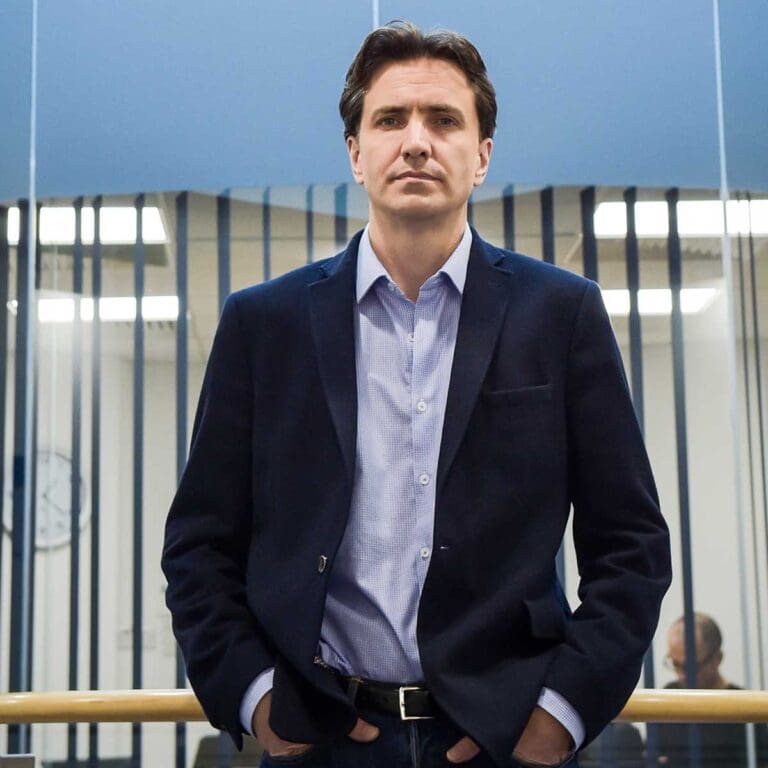
Getting to know you: James Cobb, CEO and founder, Crowd Connected

James Cobb founded Crowd Connected at the Surrey Technology Centre in Guildford in 2013, after years as a tour manager and event safety specialist. The company now has more than 400 deployments across 30 countries, working with Informa, Live Nation, Coachella, CES and PCMA. He tells Business Matters why he still hoovers the office on a Friday.
What do you currently do at Crowd Connected?
I am the founder and CEO of Crowd Connected, a location intelligence company I started in Guildford in 2013. At its simplest, we help organisations understand what people are actually doing in physical spaces.
The digital world measures everything. Every click, search and transaction leaves a trail of data. Yet a surprising amount of the physical world is still managed using assumptions, rules of thumb, booking systems and somebody’s best guess.
Our technology measures things such as movement, occupancy and dwell time across events, venues, university campuses and other complex spaces. The platform handles indoor positioning, wayfinding, occupancy counting and asset tracking, and it self-calibrates rather than requiring anyone to walk a site fingerprinting it first, so it goes live in hours. We have now supported more than 400 deployments across 30 countries, including Informa events and conferences and music festivals such as Coachella and BST Hyde Park, and tracked more than 250,000 delegates.
My role has changed considerably as the company has grown, but I still spend a lot of time sitting in the gap between the technology and the customer problem. I like understanding why something works, why it does not and whether what we are building genuinely creates value.
We have deliberately remained a fairly small team. There was a time when I was slightly embarrassed about that, because startup culture can encourage you to measure success by headcount. I am not anymore. A small team forces discipline. You have to automate, build products properly and be very clear about what actually creates value. Scaling without locking into fixed costs is a live question for a lot of owner-managers, and headcount is the biggest fixed cost most of them take on.
What was the inspiration behind your business?
Before Crowd Connected I spent many years working in live events, initially as a tour and production manager and later specialising in event safety.
Festivals are effectively temporary cities. You plan everything in extraordinary detail, from how many people can fit into an area, to how quickly a crowd can move through an entrance, to how long it will take to empty a car park. What struck me was how little real measurement sat behind some of those plans.
I remember being challenged at a licensing hearing about where some traffic-flow figures had come from. The honest answer was that I had stood on a corner in a hi-vis jacket and counted how many cars could turn left out of a car park onto a single carriageway in ten minutes.
I simply thought there had to be a better way, so I started experimenting with technology, initially with early GPS equipment and previous-generation Bluetooth devices. At one Wembley Stadium show I strapped a Bluetooth transmitter to a handrail to see whether I could use it to estimate crowd density. That question, how do people really move through physical spaces, has effectively been my career ever since.
Crowd Connected grew out of that frustration with the gap between the plan and reality. Our early breakthrough was an Innovate UK backed proof of concept with Live Nation at Wireless Festival. The technology has changed enormously since then, but the underlying problem is much the same.
Who do you admire?
I admire people who are prepared to discover that they are wrong. One of our company values is “I seek to be corrected, not just validated”, and I increasingly think it is one of the hardest things to do well in business. We are all very good at collecting evidence for what we already want to believe.
I studied history and philosophy of science, so my examples are often historical. Darwin had a rule that any observation contradicting his theory had to be written down immediately, because he knew inconvenient facts fade from memory faster than convenient ones. If you do not admire him for the theory of evolution, you can admire him for that.
Closer to home, I admire people who change their position in a meeting. It is a small thing but I notice it every time.
Looking back, is there anything you would have done differently?
When I was at university, Procter and Gamble contacted me and invited me to an event to learn about its graduate programme. I could not, or more accurately would not, make the date they suggested, and rather arrogantly assumed that if they really wanted me they would work around me. They quite reasonably explained that it did not work like that, so I did not go.
It sounds like an incredibly small decision, because it was. I was not turning down a job. I was turning down lunch. But looking back, it was absolutely the wrong decision, made for the wrong reasons.
What I failed to understand was that an opportunity does not have to be something you want to do for the rest of your life to be worth taking. A few years inside an organisation like P and G could have taught me an enormous amount about management, strategy, finance and leadership, a lot of which I have had to learn the hard way.
What defines your way of doing business?
In live events, you very quickly learn that the plan and reality are not necessarily the same thing. In business I try to apply the same discipline: ask questions, look for evidence and pay particular attention to information that suggests you might be wrong.
I also believe quite strongly in autonomy. Earlier in my career I liked the feeling of being the person with the radio whom everybody needed in order to make a decision. I now realise that is usually evidence of a badly designed organisation. If everything has to come through one person, you have created a bottleneck, not a leader.
Good leadership is about creating systems, giving people responsibility and then letting them get on with it.
What advice would you give to someone starting out?
Treat opportunities as opportunities to learn rather than permanent decisions. When you are young, it is very easy to imagine that every choice closes off all the alternatives. Usually it does not. If an opportunity is going to expose you to interesting people, problems or skills for a couple of years, that can be enormously valuable even if you eventually decide it is not what you want to do.
I would also say that founding a business is considerably less glamorous than people sometimes imagine. I still hoover our office on a Friday. If you calculated my hourly rate you could probably make a convincing argument that this is economically irrational, but that slightly misses the point. In a small company nobody should think a job is beneath them.
And finally, learn to stop as well as start. Once we invest time and emotion in an idea, it becomes surprisingly difficult to walk away from it. Being willing to stop something that is not working can be every bit as important as having the confidence to begin.


More Stories
Saudi Arabia cuts off October oil supplies to Europe – Bloomberg
The reported extension of supply disruptions follows a Houthi attack that knocked out a key export pipeline Saudi Arabia’s state-owned...
JPMorgan throws in towel on forecasting oil price
The bank no longer knows how to model the market, given the lack of a clear endgame in the US...
Getting to know you: Neeral Shah, founder and CEO, YardLink
Neeral Shah launched YardLink in 2018 to move construction buying off the phone and onto a platform. It now lists...
Getting to know you: Tony Earnshaw, CEO, UK Commercial Group
Tony Earnshaw is chief executive of UK Commercial Group, a national facilities management business with offices in Gateshead, Manchester, Leeds...
FCA finds no evidence its rules block SME access to finance
The Financial Conduct Authority has found “no evidence” that its own regulation is a major barrier to small and medium-sized...
Bank of England warns interest rate rise likely if Iran war goes on
The Bank of England has warned that interest rates are likely to rise if the war in Iran continues, with...