
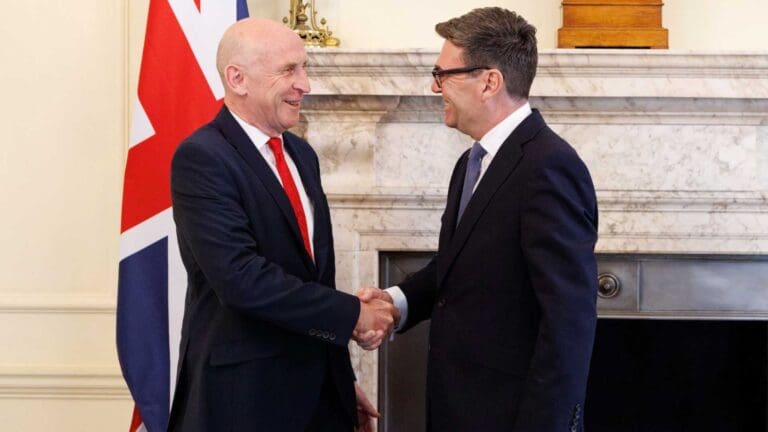
Healey faces £10bn gap as borrowing costs hit 19-year high

John Healey, the chancellor, will need to find about £10bn in tax rises or spending cuts in the government’s first budget under Andy Burnham on 28 October, according to economists, after the cost of government borrowing hit its highest level for 19 years in the past week.
The Office for Budget Responsibility has entered its ten-day forecast period, The Times reported, in which the fiscal watchdog assesses the state of the economy. The OBR will publish its Economic and Fiscal Outlook on 28 October, the same day as the budget.
A senior government source told The Times that the timing is “hugely challenging” for Healey because of the impact of the war in Iran.
Headroom and tax options
Economists said the government’s £23bn of fiscal headroom has fallen to as little as £5bn once the cost of Burnham’s cost of living pledges is factored in. The Resolution Foundation puts the headroom at between £5bn and £10bn once those pledges and an extra £4.7bn for defence over the next five years are taken into account.
Healey has described his plans to colleagues as a “focused budget”. According to The Times, he is exploring raising taxes on banks, increasing capital gains tax and raising windfall taxes on oil and gas.
Ruth Curtice, chief executive of the Resolution Foundation, said: “It looks like borrowing will be higher in the forecast by a significant amount and with the bond markets in such turmoil that is not something the chancellor can avoid having to address, either with tax rises or spending cuts.”
Neil Shearing, group chief economist at Capital Economics, said: “Given the government’s fiscal rules, Healey faces little choice but to weigh up tax rises or spending cuts to make up the shortfall.”
Helen Miller, director of the Institute for Fiscal Studies, said the OBR’s judgment on inflation could boost tax revenues and give the chancellor more room for manoeuvre. She warned, however, that existing spending plans already looked “extremely tight”.
“If he wants to increase defence spending to 3 per cent of GDP next year that would take up all the government’s planned increases in other public services,” she said. “The chancellor has to decide whether to address this now or kick the can down the road.”
Andy Haldane, the former Bank of England economist and an ally of Burnham, urged the prime minister not to raise taxes. “The market now suspects that this is a traditional tax-and-spend socialist government with better TikTok videos,” he told LBC.
The Institute of Directors has warned against further tax increases on business in its budget submission.
Energy bills and pensions
The average energy bill is forecast to rise by as much as 26 per cent in January, equivalent to £442 a year.
Earnings data published yesterday showed wages rose by 3.9 per cent, meaning the state pension will rise by the same rate under the triple lock. That will take it above £13,000 a year, higher than the £12,570 threshold at which income tax becomes payable.
Sir Howard Davies, a former deputy governor of the Bank of England, told Times Radio that Healey should signal a review of the triple lock. “We’ve got very little headroom against our fiscal rules,” he said.
Why borrowing costs are rising
In March, before the war in Iran, markets expected inflation to fall back to the Bank of England’s 2 per cent target. Inflation is now predicted to rise as high as 4 per cent, and the Bank is expected to follow other central banks in raising interest rates. In August the government sold ten-year gilts at 5.155 per cent, the highest rate since 2007.
Total UK government debt stands at just under £3tn, or 94 per cent of GDP, compared with £1.5tn, or 83 per cent, ten years ago, according to The Times. The UK’s debt interest bill has topped £100bn a year, making it the biggest area of government spending after the NHS, and official figures for July showed borrowing came in above the OBR’s forecast.
The Times reported that competition for capital from the AI boom and market memories of Liz Truss are also pushing up UK borrowing costs.

More Stories
Sam Altman says world should trust AI firms to keep technology safe
Sam Altman, chief executive of ChatGPT maker OpenAI, said yesterday that the public should trust AI companies to keep the...
KPMG to cut 200 UK advisory roles as too few consultants quit
KPMG has confirmed it will make about 200 roles redundant in its UK advisory division over the coming weeks, citing...
McLaren commits £500m to UK expansion with 1,000 jobs by 2032
McLaren Automotive has announced a £500m investment programme to expand its UK manufacturing, engineering and operations, which the company said...
Getting to know you: James Vyse, CEO, deltaH Innovations
James Vyse is the founder and chief executive of deltaH Innovations, the Cardiff company behind Cool>Can, a drinks can that...
Getting to know you: Lawrence Harmer, founder and MD, Solve
Lawrence Harmer is the founder and managing director of Solve, the digital agency he started in a spare bedroom in...
Nvidia’s Jensen Huang says AI needs no new laws or regulations
Jensen Huang, chief executive of Nvidia, has rejected the need for new laws and regulations to control the development of...