
Miliband says late mother shaped his decision to call out Gaza

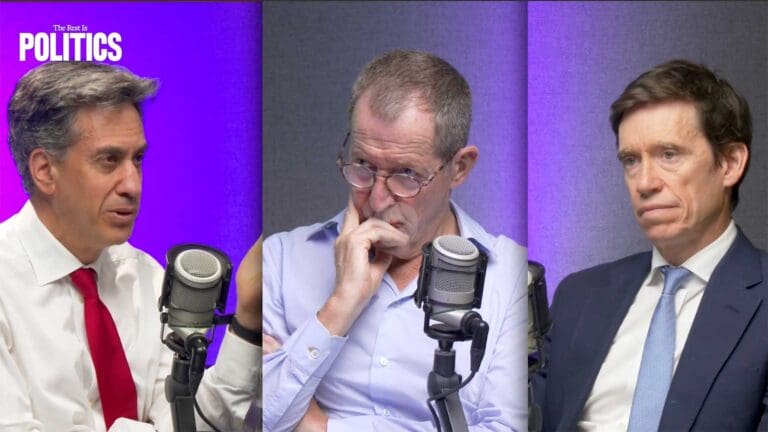
Foreign Secretary Ed Miliband has said the memory of his late mother, a Jewish refugee who died at the end of May, shaped his decision to speak out more forcefully on the treatment of Palestinians, in an interview with The Rest Is Politics podcast.
Miliband told presenters Alastair Campbell and Rory Stewart that he had wrestled with the language he should use and how far he should go, particularly over the terms “ethnic cleansing” and “war crimes”.
He said his mother had lost her father and 60 relatives in the concentration camps, and had spent 20 years of her life focused on the situation of the Palestinians.
“I thought a lot about, as I wrestled with this statement and what I should say and what I shouldn’t say and how far I should go, I wrestled a lot with what she would say. And she’d say: look at what is happening to Palestinians. Look at what is happening to these poor people. It’s wrong, and you’ve got to call it out,” he said.
Sanctions and Gaza
Miliband defended the Government’s new sanctions targeting settlement expansion in the occupied West Bank. According to a House of Commons Library briefing, the measures announced this month include an import ban on goods from illegal settlements, restrictions on services supporting settlement expansion and a ban on settlement advertising in the UK. The briefing says the Government planned to implement the new trade legislation within six to nine months, and that France and Canada announced similar measures.
Asked whether the sanctions would work, Miliband said: “And will it definitely succeed? I can’t say it’ll definitely succeed. Does it have a chance of succeeding, particularly with other international partners acting? Maybe it does. And that’s the whole intention behind it.”
He said people “the world over” were “deeply disturbed by what is happening in the West Bank and Gaza”, adding: “I think the Israeli government is losing friends. I mean, it’s not gaining allies; it’s lost allies. It’s losing allies all over.”
On Gaza, Miliband described the humanitarian situation as “unspeakable and appalling”. He said restrictions on so-called dual-use goods meant “very, very innocent goods” were being stopped from entering, and that “it seems like absolutely a deliberate strategy”.
He said Israeli ministers “have made comments that would be suggestive of wanting to not just kill Hamas terrorists, but at least push out and displace all residents of Gaza”.
“All of us condemn in the strongest terms the murder that Hamas did on October the 7th, but nothing can justify what has unfolded in Gaza since then,” he said, adding that 1,200 Palestinians had been killed since what he called “the so-called ceasefire”.
Miliband said Gaza had “mobilised a whole generation of people, but those people were right, not wrong”. He said a number of people, including from the Global South, had contacted him since he made the statement.
US relations and Hormuz
Pressed by Campbell and Stewart on how the UK should respond to a changing relationship with the United States, Miliband said: “Our alliance with the US matters, but if what you’re saying is we need to recognise the world has changed, particularly regarding our relationship with Europe and the importance of our relationship with the European Union, but also working with middle-sized powers beyond that, a hundred percent, and that’s what we’re gonna do.”
Miliband said his immediate diplomatic focus was reopening the Strait of Hormuz, whose closure had stranded $125bn of ships and cargo by June, according to insurer Allianz.
“My job as Foreign Secretary is to help the British people with the terrible cost-of-living crisis they face. And one of the biggest contributors to that is the fact that the Strait is closed,” he said.
“So my job is not to say what should have happened at the beginning. My job is to say: okay, what can we do now to get out of the mess we’re in? And that is absolutely what my diplomatic focus is on.”
Watch or listen to The Rest Is Politics wherever you get your podcasts.

More Stories
Carney pitches Canada’s AI for All strategy to global investors
Canadian Prime Minister Mark Carney set out his government’s artificial intelligence strategy to global investors yesterday, pledging to give every...
Carney opens Canada’s four largest airports to private investment
Canada will seek private investment through long-term concessions to operate its four largest airports and will allow immediate expensing for...
US Treasury yield highest since 2007 ahead of Fed’s interest-rate decision
The bond rout threatens higher borrowing costs worldwide and could pile further pressure on Washington’s $40 trillion debt The 10-year...
Edward Schmidt: Building a Career on Service and Integrity
From emergency scenes to hospital hallways, classrooms, and military service, Schmidt has spent decades preparing for situations where every decision...
Government plans to nationalise Speciality Steel UK after bid rejected
The government is developing a plan to nationalise Speciality Steel UK (SSUK), the country’s third-largest steelworks, after deciding against backing...
What Actually Separates a Good WordPress Development Agency From the Rest
Search “WordPress development agency” and you’ll get thousands of results, all promising more or less the same thing: fast, responsive,...