
Uber launches London’s first self-driving taxis with 15 Wayve cars

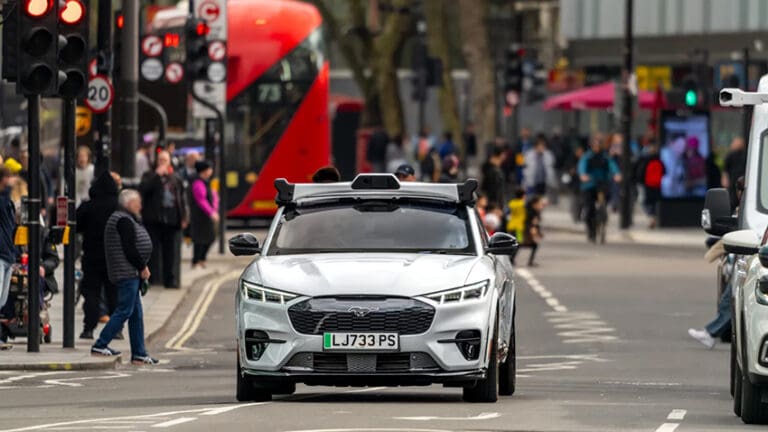
Londoners can hire self-driving taxis for the first time after Uber added rides in Wayve’s autonomous vehicles to its app on 3 September, with 15 cars licensed so far and a human safety driver in the front seat of each.
The capital has more than 100,000 private hire vehicles, roughly the same number as the Uber customers who have registered to take autonomous rides, so the chances of being matched with a robotaxi on request are slim.
Transport for London in August licensed Uber and Wayve’s modified Ford Mustang cars as private hire vehicles. The licence conditions still require a safety driver to supervise each journey.
Regulatory approval for vehicles to operate fully autonomously without a safety driver has to be granted under a separate government process run by the Driver and Vehicle Standards Agency, and is now seen as unlikely this year. The Department for Transport opened applications in May for operators to run taxi and bus-style self-driving services under its pilot scheme.
The launch puts Uber ahead of rivals in bringing driverless taxis to London, seen as a crucial market for a wider European rollout. Google-owned Waymo, which has confirmed plans for a London service, and the Chinese company Baidu are both testing their robotaxis in the capital.
Driverless services to follow
Alex Kendall, chief executive and co-founder of Wayve, said he was proud to introduce the company’s AI Driver technology to the public for the first time in London, “our home city and one of the most complex driving environments in the world”.
Kendall said the technology was “still maturing” but that services without a safety driver would come, without predicting when: “I don’t want to put a timeline on it, but we’re pushing as fast as we can.”
He said Wayve would be moving to “scalable manufacturer-produced vehicles”, new Nissan Leaf robotaxis fitted with its technology, and needed to “validate the safety metrics on that platform” as well as secure regulatory approval. “We’re working on all three in parallel. As soon as they come together, we’ll launch [fully] driverless services,” Kendall said.
Wayve’s self-driving technology is based on an AI learning model rather than the mapping used by rivals such as Waymo. Uber and Wayve announced their partnership to run autonomy trials in London in June 2025.
The cars are hailed and unlocked through the Uber app. The driver explains at the start that they will not speak during the ride but can be asked to take over control if the customer prefers.
Fully driverless services already operate in many cities worldwide, primarily in the US and China. Uber partnered in launching Europe’s first commercial robotaxi service earlier in the summer in Zagreb, Croatia, also with a human driver on board.
Drivers and unions
Sarfraz Maredia, head of autonomous mobility at Uber, said the London launch was “a major milestone in scaling safe, accessible AV technology in a city with some of the world’s most complex roads”.
He said: “The benefit for consumers should be, over time, that it’s both safer and cheaper. Today, nobody’s able to operate AVs cheaper than a traditional human-driven ride, so that’s going to take a while to prove.”
Maredia said Uber had heard concerns from drivers but did not believe they would be put out of work. “One of the most common ones we hear from our drivers is: ‘Hey, I drive in this city and it’s very complex, and I don’t think this product is going to be able to compete with me anytime soon.’”
He added: “We always want Uber to be a platform where both human drivers and AVs can operate, and because the market and our business are still growing here we think that’s going to be true for a long time.”
Heidi Alexander, the transport secretary, said: “This is a major milestone for the future of transport in London, as British innovation brings this technology on to our roads and gives passengers more choice.”
David McMullen, a senior organiser at the GMB union, said: “With hundreds of thousands of people employed to drive every day, we need to be really careful with the rollout of driverless cars unless we are prepared to see unprecedented levels of social and economic disruption.”

More Stories
Third of investors would pause UK investment if business taxes rise
A third of senior investors and corporate executives would consider pausing, reducing or stopping all UK investment over the next...
US threatens EU with ‘devastating’ retaliation over Starlink restrictions
The bloc has proposed reserving satellite spectrum for local firms, potentially limiting access for foreign players such as Elon Musk’s...
Hate the new Jaguar? Good. That’s rather the point
Most Sunday mornings in winter, I can be found in a cold garage doing what owners of classic cars do...
Beyond the Microphone: British Comedians Who Became Directors and Presenters
Stephen Merchant co-created The Office and went on to write and direct for the cinema. Simon Amstell writes and directs...
Top 10 Best Hair Transplant Doctors in Turkey: A 2026 Guide to Surgeons
This guide names the top 10 best hair transplant doctors in Istanbul for 2026 and explains, in plain terms, how...
How to Choose an HR System for a Growing UK Business
For a while, email and spreadsheets seem good enough. Then managers start asking where the latest file is, staff have...