

2027 Mitsubishi Pajero Returns as a Rugged Toyota Land Cruiser Rival and Potential ‘Montero’ for US Market

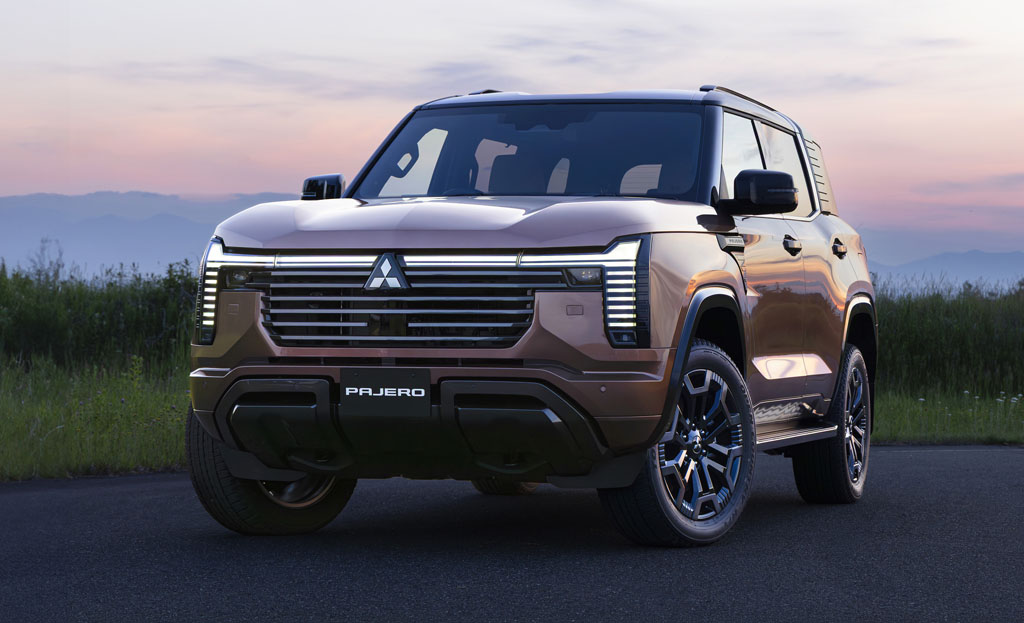
One of Mitsubishi’s most important names is officially back. The Mitsubishi Pajero, known to many Americans as the Montero, returns for a fifth generation after disappearing from global showrooms several years ago. First introduced in 1982, the Pajero built its reputation on durability, genuine off-road ability, and a long history of success in grueling rally competition. Now Mitsubishi is reviving that formula with a completely redesigned three-row SUV that looks ready to challenge vehicles such as the Toyota Land Cruiser while reclaiming some of the adventurous personality that once defined the brand.
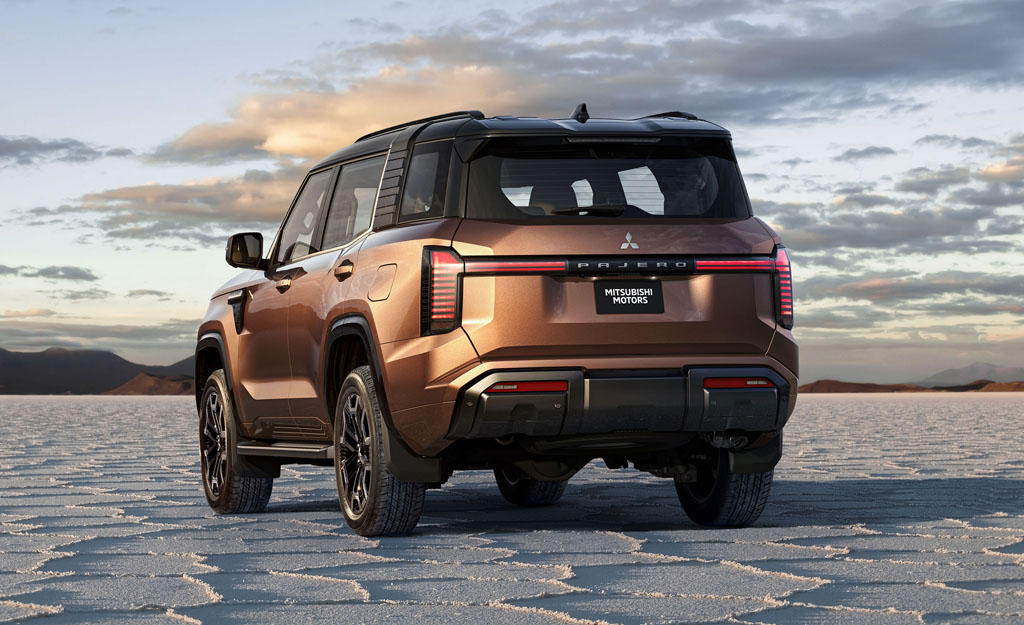
The new Pajero certainly looks the part. Mitsubishi has given it an upright, squared-off profile with prominent fenders, generous ground clearance, substantial underbody protection, and a broad front end that gives the SUV a serious presence. There are hints of Mitsubishi’s newer design language, but everything has been scaled up and toughened considerably for the Pajero. At 193.7 inches long, 75.8 inches wide, and 75.2 inches tall, it has the dimensions of a substantial family SUV, while its 113-inch wheelbase should provide enough space for three rows without turning it into an oversized highway barge. One notable change from Pajeros of the past is the absence of the familiar rear-mounted spare tire, with the spare now stored beneath a conventional liftgate.
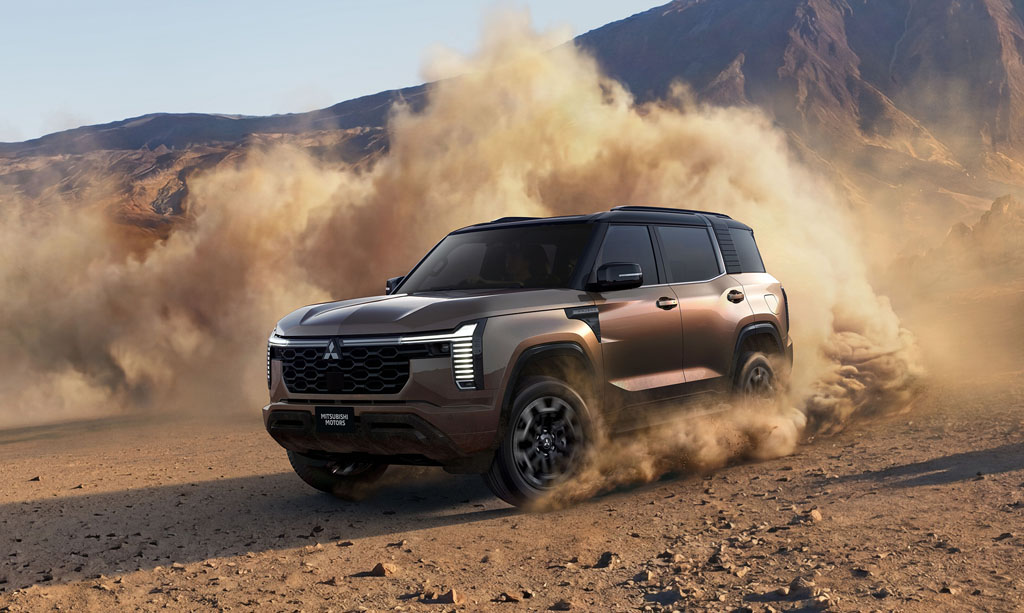
More important than the styling is what sits underneath. Mitsubishi has based the new Pajero on the rugged ladder-frame architecture related to the Triton pickup, significantly adapting the platform for its new flagship SUV. The company says extensive use of high-tensile steel increases rigidity, while a high-mounted double-wishbone front suspension and five-link rigid rear axle are intended to deliver a useful combination of off-road articulation and better pavement manners. With 9.1 inches of ground clearance, a 30.4-degree approach angle, 22.6-degree breakover angle, and 25.8-degree departure angle, this is clearly not another crossover dressed up to look adventurous.
For now, Mitsubishi has confirmed a turbocharged 2.4-liter diesel engine producing 204 horsepower and 354 lb-ft of torque, paired with an eight-speed automatic transmission. Those numbers are not going to win many stoplight races, but outright acceleration has never been the point of a vehicle like the Pajero. Of greater interest is Mitsubishi’s Super Select 4WD-II system, which works alongside the company’s Super-All Wheel Control technology. The system combines four-wheel-drive management, Active Yaw Control, stability and traction control, and ABS to help distribute power and braking force based on road conditions. Long-travel suspension and a nearly balanced 52:48 weight distribution should also help keep the Pajero composed when the terrain gets challenging.
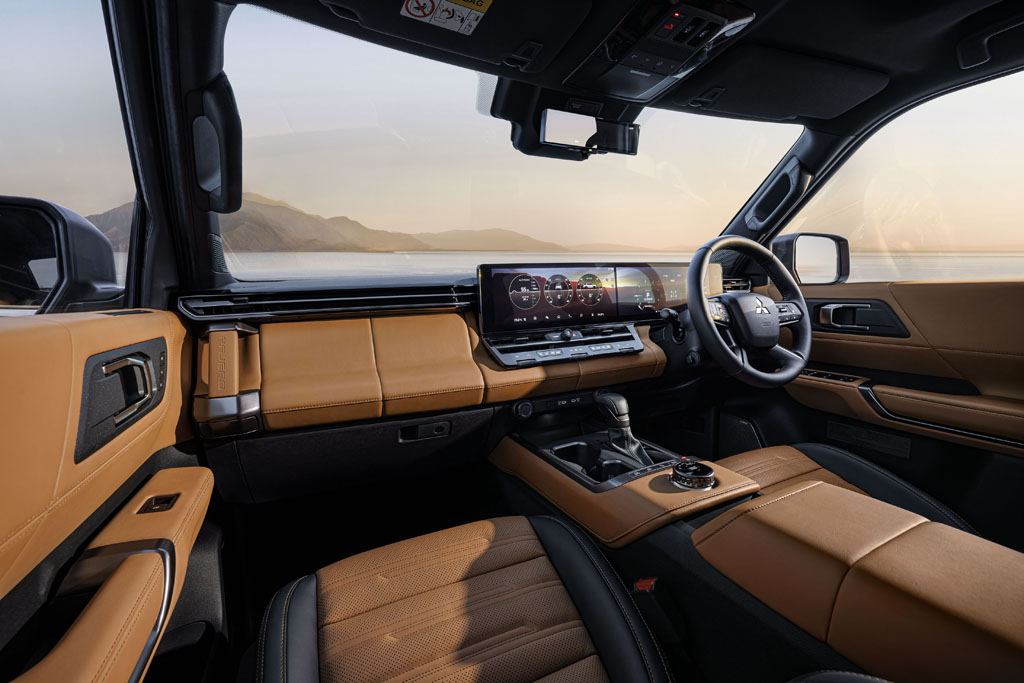
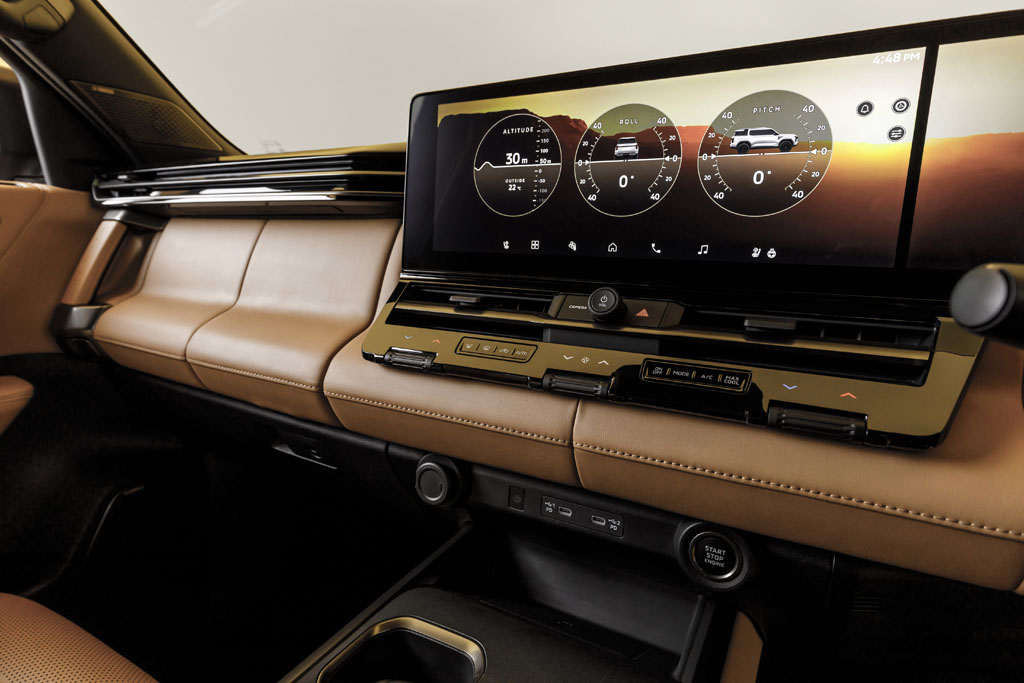
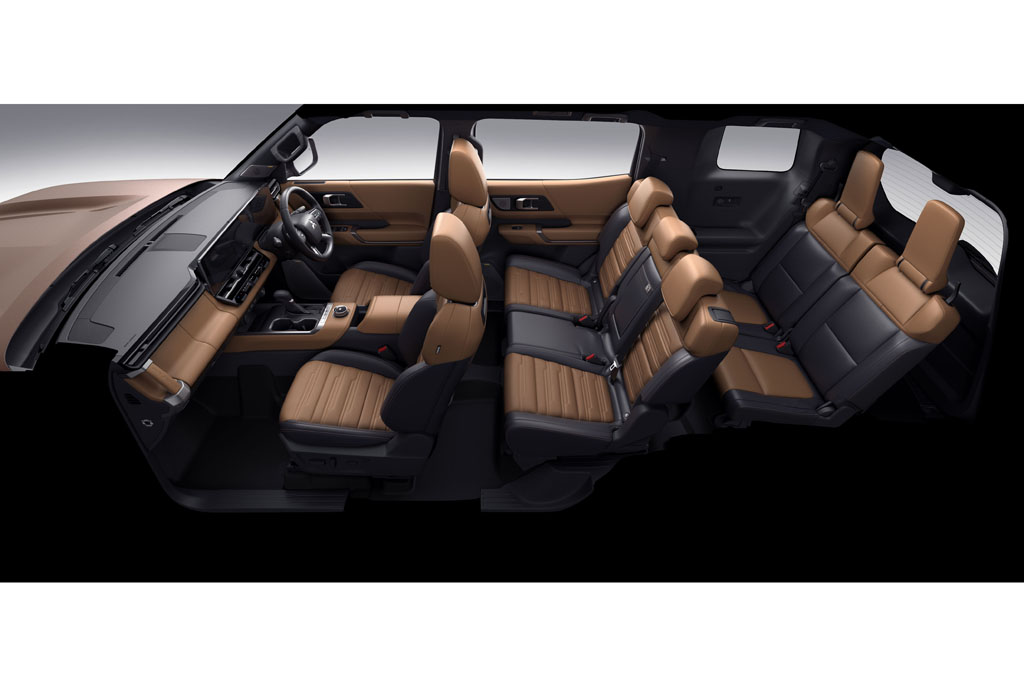
Mitsubishi has made an equally dramatic effort inside, where the new Pajero looks far more premium than many people may expect from the brand. Seven passengers can fit across three rows, and the second-row seats can slide nearly six inches while also tumbling forward to improve third-row access and cargo flexibility. Higher trim levels feature extensive leather or soft-touch materials, double-glazed door windows, an acoustic windshield, tri-zone climate control, heated second-row seats, rear sunshades, cooled center-console storage, and a 12-speaker Yamaha audio system. Dual displays measuring as large as 14.3 inches dominate the dashboard, but thankfully Mitsubishi has retained physical controls for frequently used functions rather than forcing everything through a touchscreen.
There is even a modern interpretation of one of the old Pajero’s coolest cabin details. Mitsubishi has revived its Multi Meter concept digitally, displaying information such as vehicle pitch and roll, altitude, compass heading, and torque distribution through the infotainment system. It is a small touch, but one that gives the new model a connection to its predecessors beyond simply wearing the Pajero badge. Drivers can also select four-wheel-drive settings from a physical rotary controller, another welcome decision for something designed to be operated on trails where digging through screen menus is the last thing anyone wants to do.
The bigger question for enthusiasts on this side of the world is whether Mitsubishi will revive the Montero name in the United States. The company has not committed to a U.S. launch, although the new Pajero is planned for roughly 100 markets worldwide following its initial rollout in Thailand, Japan, and Australia. Mitsubishi also intends to expand Pajero into a broader family of off-road-oriented vehicles, suggesting this revival is more than a one-model experiment. If the new Pajero delivers the toughness its specifications promise, it could be exactly the sort of halo vehicle Mitsubishi needs. And if a Montero version eventually reaches American dealerships, Toyota’s Land Cruiser may finally have an old rival knocking on its door again.


More Stories
When every kilometre counts, Suzuki puts fuel economy to the test
With fuel prices rising, Suzuki put its fuel-efficient range to the test. Discover how five Suzuki models performed on Pretoria’s...
Brilliant Design Features That Make the Alpine A310 VISION So Exciting
The A310 VISION also demonstrates the design opportunities offered by Alpine’s APP platform. Developed to support future sports cars, the...
Opel STX Concept Brings Active Aerodynamics to the Electric Estate Car
Opel is preparing a new concept car for the 2026 Paris Motor Show. Called the STX, it previews a future...
A Modern Citroën 2CV Sounds Great. Until You Think About the Price
Citroën has revived the 2CV name at the Paris Motor Show, displaying two concepts inspired by its most recognisable small...
Pickup Truck vs SUV Insurance Costs and What Drivers Should Know
Insurance belongs in the buying budget when the shortlist includes a pickup and an SUV. Either vehicle may cost less...
Porsche Mission S Could Get a Manual Transmission and That Makes This Mid-Engine Supercar Even More Exciting
Just when we thought Porsche’s stunning new Mission S concept couldn’t get any more exciting, the German automaker has revealed...