

McLaren McL 6GT Brings Back the Manual Transmission for a New Analog Supercar

McLaren is reaching deep into its history for one of its most intriguing supercars in decades. Revealed during 2026 Monterey Car Week, the new McLaren McL 6GT concept takes inspiration from Bruce McLaren’s original M6GT and reimagines that unfinished dream for the modern era. The low-slung, carbon-fiber machine previews an ultra-exclusive production model planned for 2028, but there is one detail that immediately separates it from virtually every modern McLaren: it has a genuine manual transmission. Not a simulated shift mode, not a clever electronic recreation, but a proper manual gearbox connected to a V8 and sending power to the rear wheels.
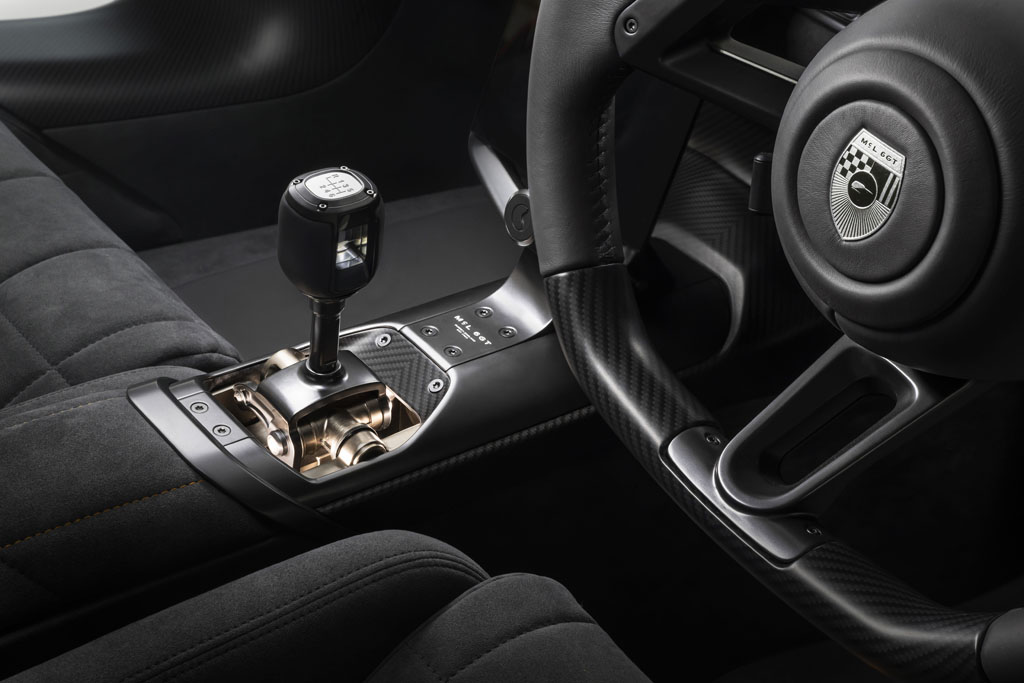
That makes the McL 6GT especially significant for enthusiasts who have watched three-pedal supercars nearly disappear. McLaren has not offered an authentic manual transmission in a road car since the legendary F1 arrived in 1992, and nearly everything that followed embraced increasingly sophisticated automated gearboxes. The McL 6GT deliberately heads in the opposite direction. McLaren says the car is built around tactility and mechanical involvement, with every shift, throttle input and steering movement intended to make the driver feel part of the process. Even the gear lever gets special attention, featuring heritage-inspired detailing and a three-dimensional Speedy Kiwi within its upright.
The philosophy goes well beyond the gearbox. McLaren has fitted hydraulic steering, tactile switchgear and machined aluminum controls instead of chasing a cabin dominated by touchscreens and layers of electronic intervention. It is an approach that feels almost rebellious in 2026, particularly in a supercar market where performance figures and software frequently take center stage. The driver-focused cockpit instead attempts to make the physical act of driving memorable. That combination of hydraulic steering, rear-wheel drive, V8 power and a manual transmission gives the McL 6GT the ingredients of something that could feel dramatically different from the rest of McLaren’s current road-car family.
The historical connection is equally important. Bruce McLaren originally envisioned the M6GT in the late 1960s as a road-going machine with strong links to McLaren’s successful Can-Am racing program. The project never became the production car he envisioned, but it established ideas that would eventually become fundamental to McLaren road cars, including extremely low weight, race-derived engineering and an intense focus on performance. McLaren Special Operations recently revisited that history with a carefully constructed M6GT at the Goodwood Festival of Speed, and the McL 6GT takes the story a step further by asking what Bruce McLaren’s original road-car concept might look like after more than half a century of engineering progress.
Visually, the McL 6GT stays remarkably faithful to the spirit of a 1960s sports prototype without turning into a retro exercise. It sits exceptionally low and wide, with a pointed nose, flowing roofline and distinctive Kammback-style tail. The cabin appears tucked into the body rather than perched above it, creating a shape that looks tightly wrapped around the mechanical components beneath. Details inspired by the M6GT appear throughout the car, including the Racing Loop lighting motif, Bruce McLaren’s signature in the engine compartment and a Speedy Kiwi etched into the fuel filler cap. Underneath that sculpted body is a modern carbon-fiber monocoque paired with carbon-fiber bodywork, continuing McLaren’s longstanding obsession with keeping unnecessary weight out of its cars.
More important than any individual styling detail, however, is what the McL 6GT says about McLaren’s future. The company is not simply building another car designed to shave tenths from an acceleration run. It is creating room for a different kind of supercar, one where involvement can matter as much as outright speed. A production version is due in 2028, and if McLaren carries the concept’s V8, rear-wheel-drive layout, hydraulic steering and, most importantly, its authentic manual transmission into customer cars, the McL 6GT could become one of the most desirable modern McLarens yet. In an era when three pedals are increasingly treated like automotive archaeology, McLaren bringing the manual gearbox back may be the most exciting part of the entire car.









More Stories
Netherlands September 2026: Tesla manages 1-2, BYD Top 10 brand
The Tesla Model Y is the best-selling vehicle in the Netherlands in September. The Dutch new car market advances by...
Why Certified Pre-Owned Is Often the Smartest Way to Buy
New cars get the spotlight, but for value-minded shoppers, a certified pre-owned vehicle is frequently the smarter choice. You get...
Tesla Model 3 Gets Bigger Screen, More Power and Quicker Acceleration
Tesla is giving the Model 3 another round of updates, and in typical Tesla fashion, the changes are arriving without...
Tesla’s Wild New Emergency Drive Away Feature Could Cause Up to $25,000 in Supercharger Damage
At first glance, Tesla’s new Emergency Drive Away feature looks almost like a joke or some kind of staged demonstration...
2027 Audi Q7 Invoice Price, Dealer Cost, and How to Get the Best Deal Near You
The 2027 Audi Q7 is a ground-up third-generation redesign arriving at US dealers in late 2026 with official pricing now...
Nissan’s U.S. Comeback Gains Momentum With 19-Month Sales Growth Streak
Nissan’s comeback in the U.S. market is becoming increasingly difficult to overlook. After spending years trying to regain momentum in...