
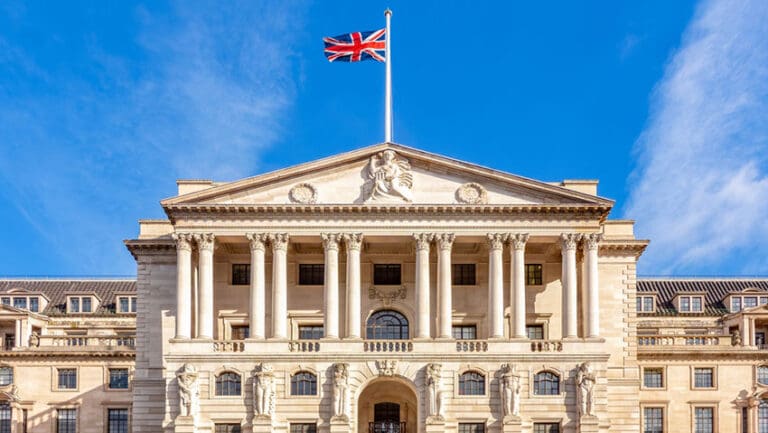
Post-2008 bank rules, not recession, throttled UK growth says former White House advisor

British small businesses are being approved for bank loans at less than half the rate they enjoyed before the financial crisis, and one of Donald Trump’s former economic advisers says the fault lies not with the 2008 crash but with the rules written in its aftermath.
Tyler Goodspeed, who chaired the White House’s council of economic advisers from 2020 to 2021 and is now chief economist at Exxon Mobil, argues that post-crisis regulation forcing banks to hold more capital, rather than the depth of the recession, is the main reason Britain’s recovery has trailed the United States.
“For 15 years, British policymakers have told themselves that a slow recovery was simply the price of a deep recession. It isn’t,” Goodspeed says in a paper for the free-market Institute of Economic Affairs.
“History shows deep recessions are usually followed by strong rebounds. Britain’s experience after 2009 departed from this pattern because regulators, with the best of intentions, made it structurally harder for banks to lend to British businesses. That was a choice, and it is still being made today.”
His central figure will sting any owner who has pitched a bank for growth capital. Credit to smaller companies in the United States clawed its way back to 2008 levels by 2013; in the UK it remains 15 per cent below pre-crisis volumes. British lenders, he says, have pulled back from the real economy and switched instead to “low-risk lending to governments”.
The consequences land hardest on the youngest, most ambitious firms, the ones the government keeps saying it wants more of.
“This matters because smaller, younger enterprises looking to expand may struggle to access credit through conventional bank loans because they lack credit history and physical assets that they might pledge as collateral,” Goodspeed says. “To illustrate this point, one might consider tech companies, whose primary assets are intangible, namely, their ideas. Without non-bank sources of credit, many such firms may be unable to access external financing, and instead be forced to rely on cash flow and retained earnings.”
That reliance is sharper here than across the Atlantic. UK firms lean far more heavily on bank funding than American peers, who can tap deeper capital markets and pools of private credit, private equity and venture capital. When the bank says no, many British SMEs have nowhere else to turn.
The picture Goodspeed paints is one Business Matters readers will recognise. Ministers have already hauled the big bank chiefs in for talks over shrinking access to credit, and the government has run a review into the supply of SME debt finance. The retreat of the high street has left challenger banks holding 60 per cent of the SME lending market, a share that was unthinkable before the crisis.
Goodspeed’s verdict is blunt. The decline in bank lending to firms is a “searing indictment of UK financial policy over the past 15 years. Before 2008, approval rates for new bank loan applications by small and medium-sized UK businesses were often 80-90 per cent. By 2024, that had dropped to fewer than half,” he says.
Some of the post-crisis architecture is now being dismantled. The Bank of England has loosened rules on banker bonuses and signalled it will ease capital requirements for lenders, the buffers of cash and assets banks must hold against their lending. The previous Labour government, under Sir Keir Starmer, said it would also relax the post-2008 “ringfencing” rules that forced banks to separate retail banking from riskier investment activity, a change the industry has long wanted.
Whether looser rules translate into more loans for the corner-shop expansion or the software start-up remains the open question. For Goodspeed, the direction of travel matters less than the admission underneath it: that Britain’s credit drought was made in Whitehall, and can be unmade there too.


More Stories
The next scientific frontier may be inside us, says Nicole Junkermann
As artificial intelligence converges with life sciences at an accelerating pace, the founder of NJF Holdings argues that the most...
Government Plans for the Shipping Industry in 2026
The UK’s position as a leading maritime nation and a key player in achieving its Net Zero obligations will be...
Tony Buzbee on the Clients Who Walk Through the Door and What They Actually Need
Tony Buzbee founded The Buzbee Law Firm in Houston in 2000. The firm takes on personal injury claims, workplace accidents,...
How to Launch a Personal Training Business Fast
Smart entrepreneurs move from initial concept to signing paying clients by following a clear, step-by-step setup framework. Secure Recognised Fitness...
What Can an iPhone Data Recovery Tool Recover? From Photos and Messages to Pages, Numbers, and Keynote
You delete a few old photos, clear some messages, or lose an important work file—and then realize you needed it...
Gallagher brothers confirm 38 Oasis dates for 2027 after $400m reunion run
Oasis have confirmed 38 dates for a global tour in 2027, including a return to Knebworth in Hertfordshire. The announcement...