
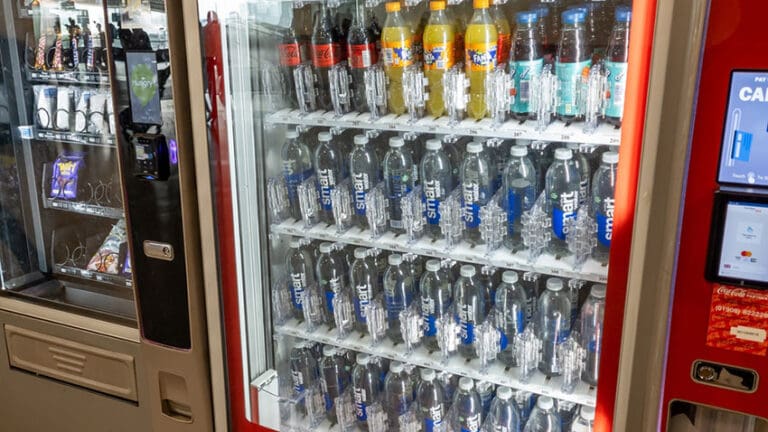
Vending ban on energy drinks to cost industry £43m a year

A blanket ban on selling high-caffeine energy drinks from vending machines will strip £43 million a year from an industry dominated by small operators, the trade body for the sector has warned, and it has been imposed on evidence the Government itself concedes is not conclusive.
The AVA, the Vending & Automated Retail Association, has condemned the Department of Health and Social Care’s decision to prohibit the sale of high-caffeine drinks from all machines, saying it will cost jobs and penalise millions of law-abiding adult consumers.
Under the consultation outcome published by DHSC, drinks containing more than 150mg of caffeine per litre will be off limits to under-16s across shops, online and out-of-home channels. Vending is the one channel where the restriction goes further: sales are banned outright, to everyone, regardless of the buyer’s age or where the machine sits.
Liability will rest with the person who controls or manages the premises where a machine is sited, an approach lifted directly from tobacco legislation. That comparison, the AVA argues, is fundamentally flawed. Tobacco is a uniquely harmful and addictive product. Energy drinks are regulated, legal beverages that are safe for adult consumption. The two cannot be equated.
The point matters commercially as well as philosophically. Any business with a machine on site, an office, a gym, a factory floor, now carries an enforcement risk it did not have before, policed by local authorities with fixed penalties of £1,500 for individuals and small firms and £2,500 for larger ones.
More than 82 per cent of vending machines sit at locations children cannot access at all: workplaces, factories, warehouses and gyms. No evidence has been presented that machines in adult-only sites are a meaningful source of underage purchases. The industry already operates voluntary restrictions limiting energy drink sales in locations regularly used by children, such as shopping centres.
Ministers rejected the targeted alternatives on the table, including age-verification technology and location-based restrictions, in favour of a blanket ban. The stated reason was ease of enforcement rather than demonstrated risk. The Government’s own consultation response accepts that the evidence linking energy drinks to the harms cited is “not definitive” and does not establish causation.
David Llewellyn, chief executive of the AVA, said: “We are incredibly disappointed by the Government’s decision to proceed with a blanket ban covering the sales of high-caffeine drinks from all vending machines. DHSC has admitted the evidence is not definitive but has chosen to punish an entire industry rather than pursue proportionate, targeted measures that would achieve the same child protection goals.
“A £43 million annual hit will cost jobs, harm businesses and strip millions of adults of the right to purchase a perfectly legal product. This is not evidence-based regulation, it is a blunt instrument applied for the sake of administrative convenience, and the industry will pay the price. AVA will continue its efforts to push back on this decision in favour of our members whose businesses are hugely impacted as a result of this decision.”
The timing is awkward. Vending has been one of the quieter success stories of the past two years, with the sector turning over £3.78 billion in 2025 and growing faster than the wider economy. Cold beverage revenues, the category the ban lands on, grew 15.4 per cent. Ninety per cent of operators, most of them SMEs, were forecasting further growth this year.
The AVA’s position is reinforced by the British Soft Drinks Association, which has committed not to market or promote energy drinks to under-16s and labels all high-caffeine beverages ‘not recommended for children’. The BSDA points out that the vast majority of caffeine consumed by children and adolescents comes from sources other than energy drinks.
For operators, this is the second policy squeeze on the drinks category in as many years, following Treasury plans to widen the soft drinks levy to milk-based products. It lands at a moment when small business confidence is already at a record low.
The AVA is calling on the Government to reconsider and engage with the industry on targeted, evidence-based measures that protect children without imposing disproportionate costs on businesses or removing consumer choice for adults.


More Stories
Tax experts call for inflation relief if capital gains tax rises
Any rise in capital gains tax (CGT) at the budget on 28 October must be accompanied by “inflation relief” on...
Tesco considers offer for 210-store Majestic Wine chain
Tesco is considering an offer for Majestic Wine Group, the UK’s largest wine retailer, which was put up for sale...
Stellantis UK finance arm sets aside £221m for car loans scandal
The UK motor finance arm of Stellantis, the carmaker behind Vauxhall, Fiat and Jeep, has set aside £221.3m to cover...
Soho Estates returns to £62.3m profit as revenues hit record £45.2m
Soho Estates, the London property group owned by the granddaughters of the late Paul Raymond, returned to a pre-tax profit...
Jeremy Hunt urges Healey not to raise bank surcharge in Budget
Jeremy Hunt, the former Conservative chancellor, has urged John Healey not to raise taxes on banks in the Budget on...
The Role of Peptides in Modern Biomedical Research
Peptides are useful in this work because they allow scientists to investigate specific parts of larger biological systems. Peptides are...