
At Cafesjian Art Trust show, new curator helps us find ourselves in abstraction

When she was around nine or 10 years old, Jill Ahlberg Yohe visited the National Gallery of Art.
She recalls staring at a painting by the abstract expressionist artist Mark Rothko, transfixed with an intensity that even the adults in the room did not fully grasp. So perhaps it makes sense that she’d go on to become an art curator — and that the first show she assembled solo since taking over last year as the curator of modern and contemporary art at the Cafesjian Art Trust in Shoreview would focus on abstract art.
“I think a lot of people who aren’t art history majors or have experience in museums can feel a little uneasy with abstraction, and I don’t think that we as curators have done the best job in bringing abstraction to everyone,” she said. “Fundamentally, abstraction is just about ideas, emotions and experiences. And as humans, we all have all of those.”
“Abstraction and Ourselves” runs at the CAT through July 31. Museum admission is free. Timed guided tours must be reserved in advance for Thursday and Friday daytime visits (10 a.m., 1 p.m. and 3 p.m.), but no reservations are required for open-browsing hours Friday evenings (5–8 p.m.) and Saturdays (10 a.m.–4:30 p.m.). More info and tour reservation information is online at cafesjianarttrust.org/abstraction.
The show contains about two dozen works, predominantly from the CAT collection but also including loaned works from the Weisman Art Museum and Bockley Gallery in Minneapolis and the Art Bridges Foundation in Arkansas. All but two or three artists in the exhibition are women, including both renowned names like Georgia O’Keeffe, Dyani White Hawk and Toots Zynsky and those like Helen Frankenthaler and Claire Falkenstein, whose contributions to 20th-century American art are more frequently overlooked.
And alongside works in glass, for which the CAT’s collection has quickly become notable, the exhibition also showcases large-scale paintings, which the museum has focused more strongly on collecting over the past year under Ahlberg Yohe, and multimedia pieces like beadwork panel “Puzzles Circles and Patterns” by South African Mpondo Xhosa artist Thando Ntobela.
“It wasn’t just one art history that developed abstraction,” she said. “Artists have had modes of abstraction for long, long periods of time, and (we need to) open up those conversations more to say that there are multiple strands of abstraction that have always existed.”
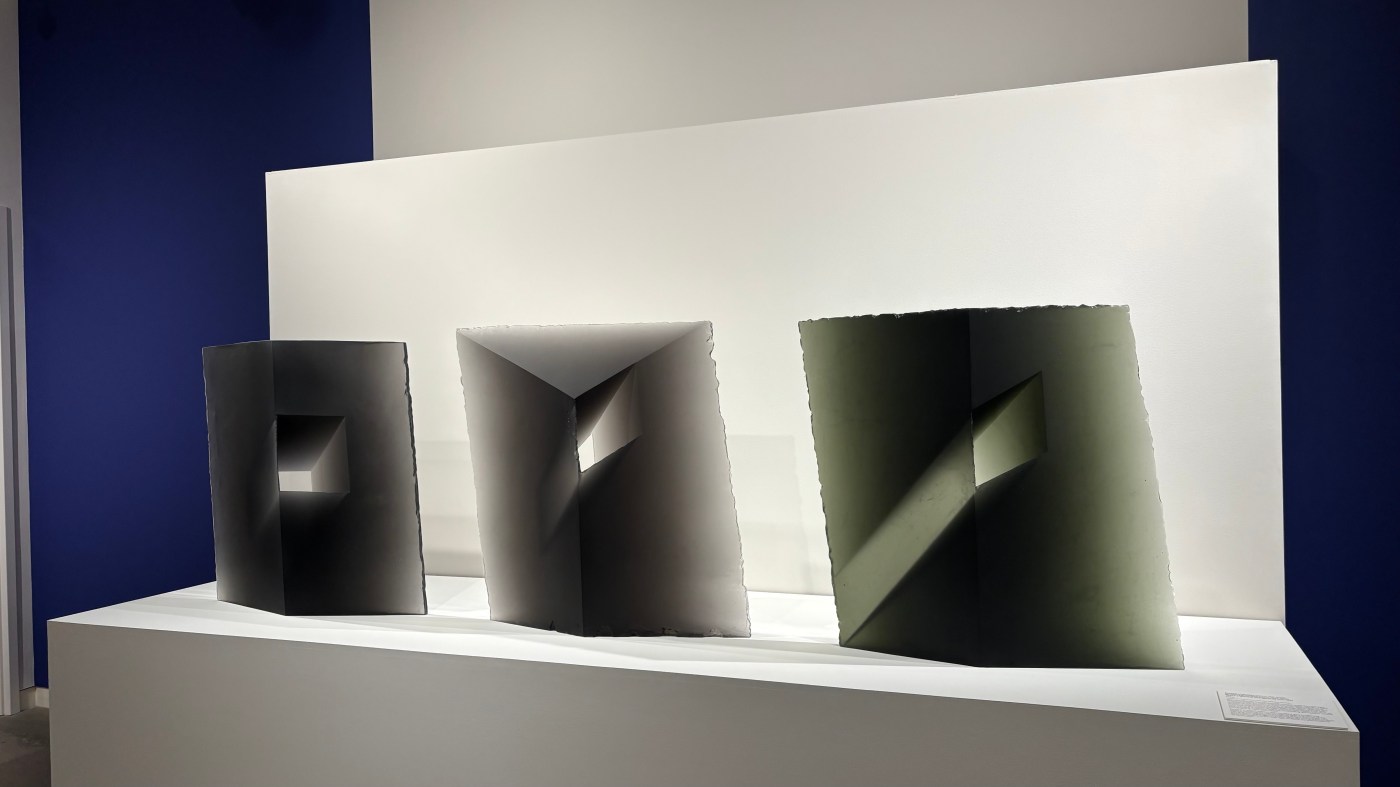
The seed of the exhibition, the discovery from which the whole show took shape, was finding the triptych of “Spaces I,” “Spaces II” and “Spaces III,” by the 20th-century Czech duo Stanislav Libenský and Jaroslava Brychtová, in philanthropist and museum namesake Gerard Cafesjian’s collection.
The works are dense smoky-gray glass blocks, each seemingly compressed at a different angle and shot through with a severe diamond-shaped tunnel. The forms create the dramatic effect of trapped light struggling to free itself before finally beaming triumphantly back out into the world.
They are, at the risk of editorializing, stunning. And as you might expect, Ahlberg Yohe thinks so too.
“Libenský and Brychtová are such exceptional abstract artists and it’s unfortunate that not enough people know about them, which is in part because they were working in glass,” she said. “It’s about where we’re lending our curatorial eye. How can we move the conversation to see glass in the context of broader art stories?”
Presenting glass well is a tricky process that requires a strong command of gallery lighting — consider what happens when you accidentally take a flash photo through a window — which the CAT has always excelled at. I’ve long thought the museum’s inaugural curator, Andy Schlauch, was one of the best in the biz, and Ahlberg Yohe has proven herself similarly deft.
“I feel very strongly about ensuring my work understands the intentionality of the artist,” she said. “What are they saying? What do they want to say? What do they want people to experience? And how do I as a curator make that happen?”
This is more easily achievable in some cases than others. Libenský and Brychtová gave some interviews and left behind written notes, Ahlberg Yohe said, from which she could extrapolate as a historian might. Other artists in the exhibition, like the late painter Edith Carlson, were loath to analyze their own work and therefore not forthcoming, whereas when Ahlberg Yohe was figuring out how to best display a work by the contemporary German artist Udo Zembok, she just sent him an email.
That work, the beguiling 2013 glass sculpture “Horizon 02,” will have a sofa in front of it, to encourage visitors to take time to sit with the art. Sure, there are text panels that explain each piece, but Ahlberg Yohe hopes visitors do more than just read the words and move on.
“It’s slowing down a little bit, being able to say, ‘I’m looking at this, and what’s emerging for me?’” she said. “It’s allowing visitors to just own abstraction for themselves. It’s not in the hands of anyone other than themselves.”
Related Articles
Triceratops skeleton ‘Trey’ to hit the auction block as dinosaur market soars
Scandia museum seeking stories about immigrants for US 250th
Celebrate Black History Month with these St. Paul events
Review: Katie Chin celebrates her mom Leeann Chin in sweet, savory and delightful show
Plans call for Science Museum’s Pine Needles land to be put in conservation easement
More Stories
Why Private Health Insurance Has Never Mattered More to UK Employees
There is a version of this conversation that HR professionals have been having for years. Private health insurance is a...
Call blocker firm fined £190,000 for making the nuisance calls it claimed to stop
A company that sold call-blocking devices to elderly people has been fined £190,000 after the regulator found it was responsible...
Karl D’Angelo Santa Rosa: Building Success Through Change
For Karl D’Angelo Santa Rosa, success did not happen all at once. It came through years of learning, hard work,...
Colman’s Mustard put up for sale as Unilever clears path for £48bn McCormick merger
Colman’s Mustard has been put up for sale by Unilever, as the FTSE 100 group moves to head off competition...
Burnham’s business rates adviser called for £9bn tax cut for high streets
Andy Burnham’s new business rates adviser has previously called for up to £9bn of tax cuts for businesses, arguing the...
Loss of cheap energy harmed EU economy – Von der Leyen
The bloc saw oil and natural gas prices soar after it drastically reduced Russian imports over the Ukraine conflict European...