
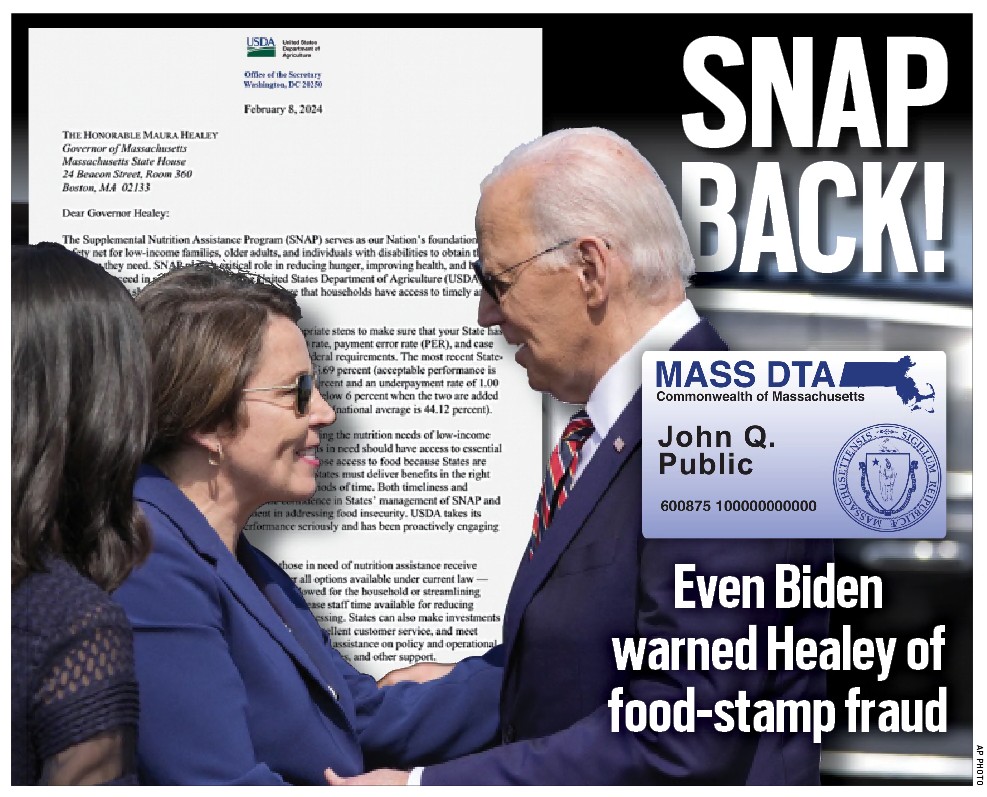
Biden Admin urged Healey to clean up state SNAP program, 2024 letter shows

A 2024 letter reveals that even the President Biden administration urged Massachusetts Gov. Maura Healey to clean up the state’s SNAP program, which was recently found by state and federal authorities, and a whistleblower report, to be the subject of tens of millions of dollars in public benefits fraud.
Healey claims that allegations of fraud in Massachusetts, labeled by President Trump during the State of the Union address as among the most fraud-ridden states, are simply a “distraction” by Trump to shift focus away from what she says are his failed policies. But a letter from the USDA, dated Feb. 8, 2024, urged Healey to improve and bring to “acceptable” levels the Department of Transitional Assistance’s payment error rate, case and procedural error rate, and its application processing timeliness, adding that all three didn’t meet “basic federal requirements” in FY22, which was under the Gov. Charlie Baker administration.
“I urge you to prioritize these concerns and take appropriate steps to make sure that your State has an acceptable application processing timeliness (APT) rate, payment error rate (PER), and case and procedural error rate (CAPER) and meets basic Federal requirements,” the letter from Biden’s USDA reads.
“The most recent State-reported data show Massachusetts had an APT rate of 95.69 percent (acceptable performance is above 95 percent), an overpayment error rate of 10.77 percent and an underpayment rate of 1.00 percent in Fiscal Year 2022 (acceptable performance is below 6 percent when the two are added together), and a Fiscal Year 2022 CAPER of 23.55 percent (national average is 44.12 percent,” it said.
The Healey administration is pointing the finger at changes made during the Biden administration for the state’s inadequate numbers.
“Nationwide, payment error rates increased during the COVID-19 pandemic because of federal policy changes,” DTA spokesperson Cecille Avila told the Herald. “The Department of Transitional Assistance has been taking significant action to lower the payment error rate, including increasing caseworkers to verify eligibility, implementing stricter reporting requirements for clients, and strengthening staff training.”
Avila went on to argue that during the COVID-19 pandemic, the federal government directed states to prioritize rapid access to benefits and implement broad waivers for verification, adding “that approach was intentional and appropriate, it prevented hunger and stabilized families.”
Massachusetts slightly improved its payment error rate in FY23, Healey’s first year in office, but still did not meet levels deemed acceptable by the federal government, improving from 11.7% in FY22 to 9.86% in FY23.
But the following year, as reported by the Herald, in FY24, the state’s SNAP payment error rate ballooned back up to 14.1%. Massachusetts received over $2.6 billion, or more than $240 million per month, in federal SNAP funding that year. That equates to $364 million in erred payments, of which $338 million was in overpayments. Only six states had higher payment error rates than Massachusetts that year. Complete data from FY25 is not yet available.
“When Massachusetts [officials] say they don’t have a problem, they clearly have a problem. Massachusetts is in the top five of the worst states in fraud detection and in payment error rate for SNAP,” Haywood Talcove, the CEO of data analytics company LexisNexis, told the Herald.
Healey continues to withhold SNAP recipient information, including immigration status, to the Trump administration and the USDA, which the agency says it would use to root out waste, fraud and abuse. Healey’s office says the Trump administration has not provided assurances the information will not be given to Immigration and Customs Enforcement (ICE).
“I might have thought differently a few years ago, but at this point, there’s so much fraud and messiness and innocent people being victimized by this theft that the state needs to turn over the information,” a mid-level DTA staffer, who blew the whistle on “rampant” fraud within the state’s SNAP program, told the Herald. “When you’ve got this kind of volume and get directives from higher-ups to avoid asking too many ‘invasive questions,’ it becomes overwhelming.”
The Herald also asked the Healey administration about the use of chip-enabled EBT cards and if there has ever been any consideration of implementing them. The DTA whistleblower told the Herald that the agency had considered implementing the chips for “around $15.5 million” in a rollout of a little over a year, but ultimately decided against the idea.
A Herald public records request for communications and records relating to the implementation and cost of the chip-enabled cards has been delayed by Healey’s office, which says it needs more time. Meanwhile, Republican gubernatorial candidate Brian Shortsleeve sent the Herald numerous public records requests for similar information that have been repeatedly pushed back for over eight months now.
“Right now, without chips on them, Massachusetts EBT cards are like glorified hotel room keys for fraudsters,” Lexis-Nexis’ Talcove said. “It’s important because criminal organizations put skimmers on point of sale (POS) terminals at EBT vendors, mostly convenience stores, and steal the information from cards used on that machine.”
Massachusetts has spent billions since Healey declared a state of emergency in 2023 to address the surge in illegal immigration, utilizing the “Right to Shelter” law to provide free housing, food, and other services to thousands of migrants to the tune of over $940 million in FY25 and $894 million in FY24. Healey ended the state of emergency in August 2025.
A Feb. 2024 letter from the Biden admin’s USDA urging Gov. Maura Healey to clean up the state’s SNAP program. (USDA)


More Stories
Hinton calls for UK ban on superintelligent AI as MPs table bill
Geoffrey Hinton, the Nobel Prize winner known as the godfather of artificial intelligence, has called on the government to prohibit...
Warmest summer on record brings mixed fortunes for South West traders
The UK’s warmest summer on record has produced mixed results for businesses in south-west England and the Channel Islands, with...
Jaguar Land Rover to cut 4,000 jobs as minister rules out bailout
Jaguar Land Rover is to cut as many as 4,000 jobs over two years as it targets about £1.7bn of...
One in five family manufacturers weigh overseas sale over IHT changes
More than one in five family-owned manufacturers are considering a sale to overseas buyers in response to changes to inheritance...
Molten Ventures raises £175m growth fund for UK tech scale-ups
Molten Ventures, the London-listed venture capital firm that backed Revolut and Zopa, has raised £175m for a new fund aimed...
CBI tells Healey £345bn business costs are holding back investment
Rising costs are damaging business investment and undermining the government’s efforts to raise living standards, the CBI has warned the...