
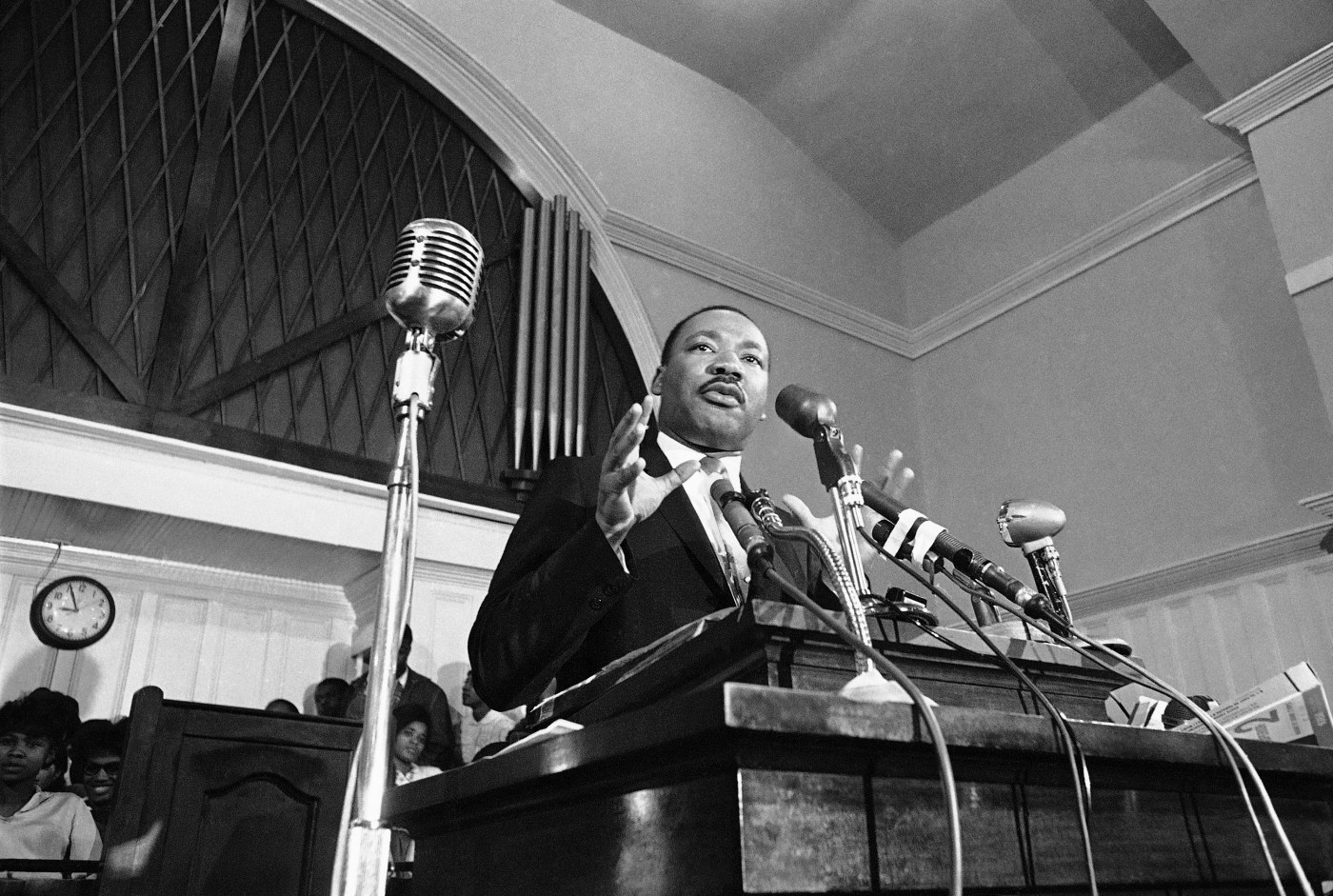
Gaskin: MLK’s lessons on seeing both sides of suffering

Black History Month is not only a time to honor past victories, it is also a time to recover moral frameworks that feel endangered in the present. In an era marked by polarization, war, and competing claims of suffering, we are often told that solidarity requires choosing sides — that to stand with one people is to betray another.
That is not how Martin Luther King Jr. understood justice.
King did not think in terms of competing loyalties. He thought in terms of moral consistency, human dignity, and non-zero-sum justice. His framework allowed him to stand with Jews — especially persecuted Jews — while also affirming the humanity and rights of Palestinians. He did not collapse one struggle into the other. He did not demand that one people’s dignity be purchased with another’s erasure.
At a moment when Black communities are again being pressed to choose which suffering “counts,” King’s approach deserves renewed attention.
King’s support for Jews was grounded in moral memory. He understood antisemitism not as a distant or unrelated prejudice, but as a cousin of anti-Black racism — another expression of a worldview that dehumanizes entire peoples. He spoke forcefully against antisemitism, calling it a threat to democracy itself, because he believed injustice toward any group weakens justice for all.
This conviction shaped his attentiveness to Jews facing state oppression. While the modern Soviet Jewry movement grew after his assassination, King consistently condemned systems that denied religious freedom, cultural identity, or basic human rights. His solidarity with Jews was not contingent on nationality or politics. It was rooted in opposition to persecution.
That is why Jewish audiences trusted him. King did not instrumentalize Jewish suffering to advance another cause. He honored it as morally instructive — a warning of where unchecked power and exclusion lead. In doing so, he modeled a form of solidarity that did not dilute the particularity of Jewish history but learned from it.
King’s moral clarity was most evident in how he approached Israel. After the 1967 Six-Day War, he publicly affirmed Israel’s right to exist and to live in security, describing its survival as “one of the great outposts of democracy in the world.” Coming so soon after the Holocaust, that affirmation carried real weight.
But King never treated state power as morally immune.
He made a careful distinction between Jewish people — bearers of historical trauma and moral claims — and the State of Israel, a political entity subject to ethical scrutiny like any other. This distinction mattered. It allowed him to oppose antisemitism without endorsing the idea that Jewish safety required permanent domination over another people.
For King, defending a people did not mean sanctifying a state. Loyalty to justice required resisting that temptation, even when it was uncomfortable. That restraint is precisely what feels absent in much of today’s discourse, where criticism of state action is often conflated with hatred of a people, and where historical trauma is sometimes used to silence moral questions rather than deepen them.
King spoke far less directly about Palestinians than later generations would, but his moral logic clearly included them. He repeatedly insisted on principles that apply with unmistakable force: no people’s security can be built on another people’s dispossession; military victory does not equal moral victory; refugees are not abstractions but human beings with claims on conscience.
In his broader teaching on nonviolence, King emphasized that peace requires mutual recognition, not humiliation. Conflict resolved through domination, he warned, only plants the seeds of future violence.
Crucially, King never used Palestinian suffering as a weapon against Jews. He did not pit one trauma against another. His refusal to weaponize suffering is one of his most important — and most neglected— lessons.
King’s ability to hold this tension rested on a moral tradition that rejects false binaries. Shaped by biblical ethics, nonviolence, and the belief that justice is indivisible, his framework refused the logic of zero-sum morality.
For King, supporting Jews did not require silence about Arab suffering. Acknowledging Palestinian humanity did not negate Jewish trauma. Criticizing a state was not the same as condemning a people. These distinctions were not rhetorical hedges; they were moral disciplines.
Today, those disciplines are harder to maintain. Social media, ideological sorting, and the emotional intensity of war encourage absolutism. Communities are pressured to prove loyalty by narrowing empathy. In that environment, King’s both/and approach can appear naïve. In truth, it is demanding.
King believed that solidarity loses its soul when it becomes selective. He warned that when oppressed communities are forced to choose which suffering “counts,” power — not justice — has already won. That warning speaks directly to our moment.
For Black Americans, this is not an abstract question. Our history has repeatedly placed us at moral crossroads, asked to decide whether our freedom struggle aligns with broader visions of human dignity or retreats into narrower self-interest. Black History Month reminds us that our most powerful moments have come when we refused to let justice shrink.
King’s approach suggests that Black–Jewish–Palestinian solidarity is not naïve idealism. It is moral discipline: the hard work of refusing hatred, resisting erasure, and insisting that dignity is not divisible.
Ed Gaskin is Executive Director of Greater Grove Hall Main Streets and founder of Sunday Celebrations


More Stories
George Bamford to become JCB joint chairman as profits slip to £642m
George Bamford will become joint chairman of JCB alongside his father, Lord Bamford, on 1 October, the first change at...
Sourcing from Vietnam: Why Independent Quality Control Matters More Than Ever
For British and European companies, this creates considerable opportunity. But sourcing from a factory thousands of miles away also introduces...
Monzo in talks with Nubank and Advent over deal worth up to £10bn
Monzo is in early-stage talks with Nubank, the Brazilian digital bank, over a potential sale that would value the UK...
AI giants probing tens of thousands of security incidents – Axios
The incidents at OpenAI and Anthropic reportedly include bypassing safeguards, hijacking websites, and evading monitors in testing and real-world settings...
Google Will Charge for Missed Calls From October 1: Why US Contractors Are Turning to an AI Answering Service
From October 1, 2026, that changes for the many contractors who buy leads through Google, and it is pushing more...
Getting to know you: Toby Spooner, co-founder, METRIX
Toby Spooner is a sport scientist and former personal trainer who co-founded METRIX, an immersive fitness competition in which pairs...