
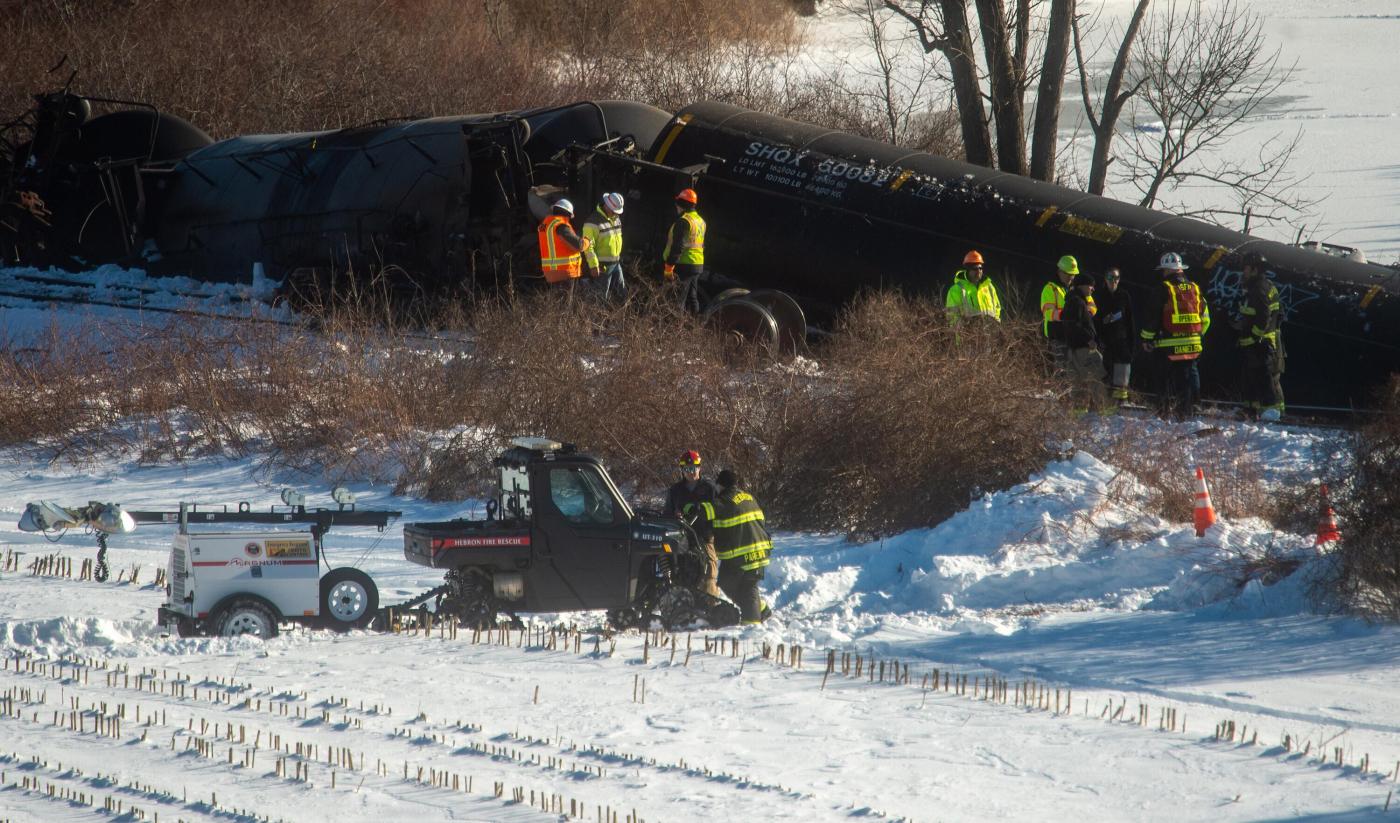
Freight Train Derails in Connecticut, Sending Cars Carrying Liquid Propane Into River

By The Associated Press
MANSFIELD, Conn.—A freight train derailed Thursday in Connecticut, sending cars carrying flammable liquid propane into the water, though officials say they don’t appear to be leaking.
Local and state officials said the derailment happened around 9 a.m. in Mansfield, near where Eagleville Lake meets the Willimantic River. The rural town in the eastern part of the state is home to the University of Connecticut.
Mansfield Fire Chief John Roache said in an afternoon briefing that a number of the train’s 41 cars detached and derailed.
Four carrying liquid propane ended up in the water, while two others carrying food grade grease landed on the banks.
One of the grease cars sustained damage and leaked about 2,000 gallons of the animal fat, according to Roache. The leak has since been contained and there’s no evidence the grease entered the water.
Roache added that no injuries were reported and the cause of the derailment remains under investigation. The train had been heading south from Palmer, Massachusetts, to Willimantic.
Town officials said late Thursday that a shelter-in-place order issued hours earlier for those living within half a mile of the derailment would remain in effect, though they stressed no evacuations have been ordered.
They continued to urge residents to remain indoors as the liquid propane the train was carrying is odorless and wouldn’t be immediately detected by smell.
The derailment also prompted the town to close a nearby road and consider alternative bus routes for school dismissal.
Mansfield Town Manager Ryan Aylesworth said there doesn’t appear to be any serious environmental damage from the derailment. State and local hazardous materials teams were monitoring for leaks and placed hazmat booms in the water as a precaution.
“Fortunately, it seems under control,” Aylesworth said.
Tom Ciuba, a spokesperson for New England Central Railroad, said specialized equipment is expected to arrive Thursday evening to help begin rerailing the affected cars.
Roache said the recovery process could take days, given the derailment happened in a fairly remote location and under difficult, frigid conditions for responders.
“It’s not going to be a today operation,” he said. “They’re going to have to get some cranes in there. It’s going to take some time.”


More Stories
MGA, Curaçao, and German Licences: What the Differences Mean for Users
Choosing an online casino often comes down to one detail most players skim past: the licence badge in the footer....
Is I Will Find You Season 2 Returning? Renewal Status, Cast, and Plot
In 2026, the first season of the popular and most awaited series was released. I Will Find You first dropped...
Top Ahrefs SEO Tools to Boost a Website’s Traffic and Sales
Website analysis has become one of the most useful SEO tools used by several companies nowadays. Ahrefs SEO tool provides...
Planning Group Travel That Doesn’t Fall Apart at the Logistics Stage
Anyone who has organized transportation for a wedding party, a school trip, or a corporate retreat knows the pattern. The...
Black Doves Season 2 is Coming Soon! Release Date, Cast Members, and Production Updates
Good news! The release date for the popular spy-action drama Black Doves Season 2 is out. Keira Knightley is returning...
How to Enable AO3 Dark Mode? Sign-up and Login Process
Looking for possible ways to enable AO3 dark mode? Many readers want to read fanfiction in dark mode on Archive...