
Opinion: Do Snowstorms Teach Us Anything About Climate Change?

“This cold weather and extreme snowstorm are not an exception to global warming, but an alarming indicator of it,” the author writes. “New Yorkers feel this global weirding phenomenon and are paying the ultimate price.”
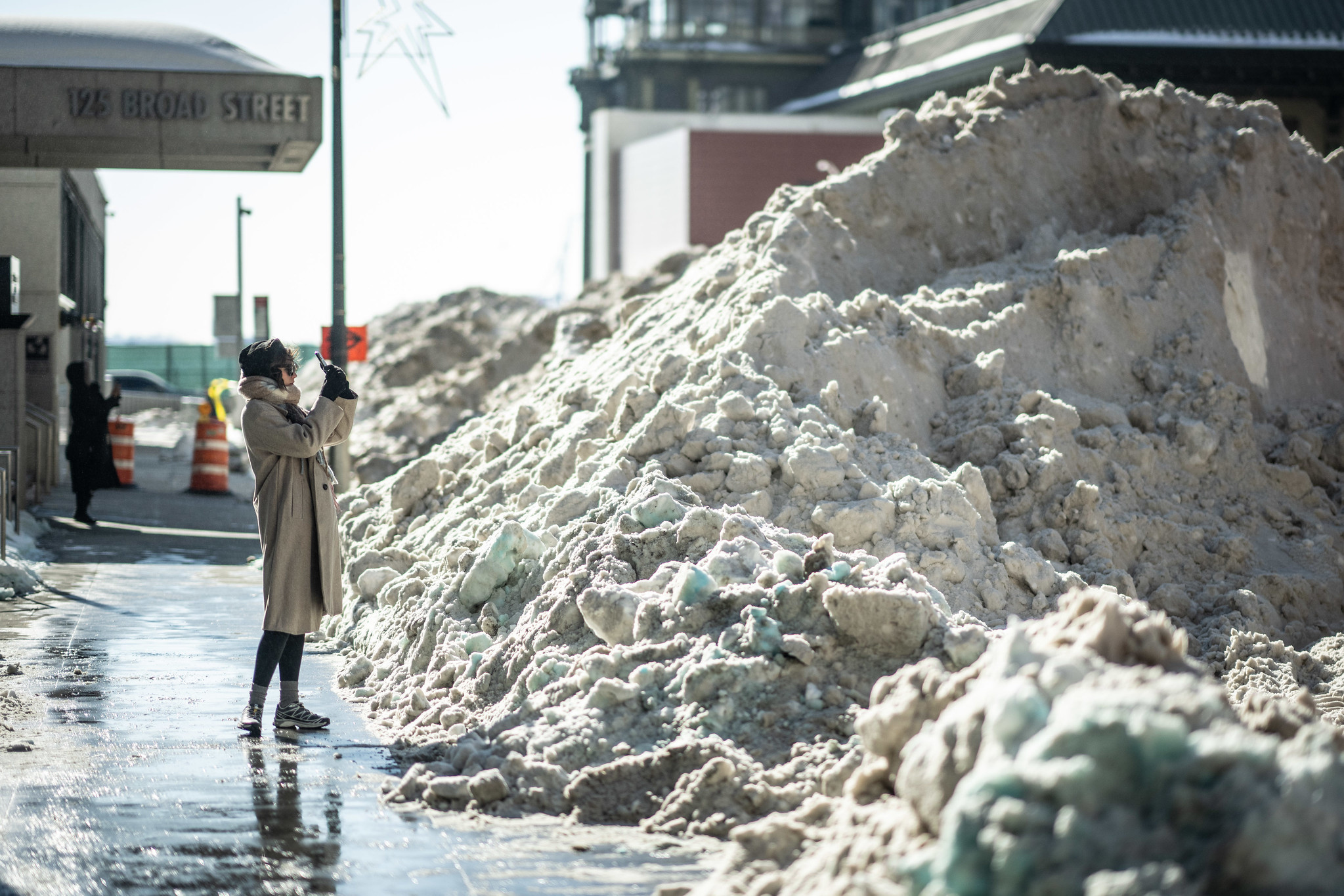
Piles of snow in lower Manhattan on January 29, 2026. (Michael Appleton/Mayoral Photography Office)
In New York City, we are seeing unusually cold weather and snow in the busy month of January. Instead of a joyous month of fresh beginnings, New Yorkers are seeing subway delays, icy sidewalks, and remote learning (or, for me, midterms are being pushed back a day). What might seem like something new from prior years of warm winters and no snow is, as counterintuitive as it may seem, just a symptom of the climate change that has been happening for decades.
In the world of social media, another talking point to exploit has fallen into the hands of climate deniers. Snowstorms are no longer just weather, but have become “proof” of climate change being a hoax. Even though 2025 was one of the top three warmest years on record per the World Meteorological Organization, climate deniers turn a blind eye to overall trends in climate and fixate instead on occasional events as if a day’s weather were the same as the climate, formally defined by 30 years of weather data. This is equivalent to saying that all films make a lot of money by pointing only to Zootopia 2.
This cold weather and extreme snowstorm are not an exception to global warming, but an alarming indicator of it. The jet stream is a narrow lane of fast-moving air, with its location depending on the boundary between hot and cold air. Its southward dip led to previously isolated polar air moving south, lowering temperatures in places like New York City. Cold air isn’t enough to create a big snowstorm, and moisture is the final ingredient. The Gulf of Mexico’s unusually warm surface temperatures fed moisture to storms in the northeast. The warmer ocean leads to more evaporation, and the warmer temperature helps the air hold more moisture, allowing for more intense snow.
New Yorkers feel this global weirding phenomenon and are paying the ultimate price. There is no reason to ignore the 17 people who have died outdoors, potentially due to the cold weather. The poorest are freezing in poorly insulated buildings or not in homes at all, essential blue-collar workers are wading through the storm, and our oldest neighbors are struggling with the cold impacting their health. The disruption of Earth’s climate systems by humans will not be easily adaptable to, with impacts ranging across extreme highs and lows of every variable.
This is not just a one-off occurrence. New York City’s Bureau of Vital Statistics states that cold and hot weather have increased in weather-related illness levels, from 475 hospitalizations in 2005 to 638 in 2022. This is strongly correlated with the warming of our planet, as the past 11 years have been the 11 warmest on record, with more days being dangerous for our health. Snowstorms are not simply a nuisance; they are a symptom of a larger problem that must be solved if we want to protect our communities: climate change.
New York was a long-standing climate leader, but Gov. Kathy Hochul is failing to uphold that responsibility, especially given her placement on the TIME 100 Climate list. The correct course of action is not to give water quality permits to fossil fuel pipelines, as Gov. Hochul’s DEC (Department of Environmental Conservation) has.
The pipeline will add gas to the fire of the affordability crisis. The pipeline will also bring toxins to New Yorkers in both their waterways and in their energy. Lives are on the line. Politicians need to stop carelessly making decisions without thinking fully about the consequences, as if we live in a fantasy world where there will always be a happy ending. This is not just what will come up in tomorrow’s newspaper headlines. Gov. Hochul needs to follow the law, as outlined in an Albany Supreme Court decision in Citizen Action of New York vs. DEC in October of 2025, stating that the DEC must put forward new regulations to reduce climate emissions in line with the state’s climate law by Feb. 6, 2026.
Politicians must do the right thing. New York State legislators must champion climate- and affordability-first bills and not bow down to the industry interests of the fossil fuel companies. The Packaging Reduction and Recycling Infrastructure Act would save billions of dollars by eradicating unnecessary plastic waste from needing to be managed, and the Community SOLAR Act, which expedites permitting and lowers costs for community-based solar projects.
If the highest political officer in New York State cannot follow the state law, New Yorkers need to think critically about who they will vote for and what they will value with their vote. Until November, New Yorkers can keep calling for Gov. Hochul and state legislators to follow the state’s own laws with aggressive climate-forward policy like approving the Packaging Reduction and Recycling Infrastructure Act.
The countdown has begun, and New Yorkers are watching.
Catherine Du is a member of Hunter College High School’s Class of 2029 with an interest in environmental science and public policy.
The post Opinion: Do Snowstorms Teach Us Anything About Climate Change? appeared first on City Limits.

More Stories
Ritika Wadhwa on why cultural intelligence is not optional for leaders
Ritika Wadhwa is the founder and CEO of Prabhaav Global, the London-based consultancy she set up in 2023 to help...
Getting to know you: Todor Madzharov, co-founder, MEAVO
Todor Madzharov is the London-based co-founder of MEAVO, which designs and manufactures acoustic phone booths and meeting pods for open-plan...
Russia-US diesel deal already having positive effect – Putin aide to RT (VIDEO)
The agreement has helped lower American fuel prices and could pave the way for broader economic cooperation, Kirill Dmitriev has...
A Practical Guide to Pricing Your First Paid Community Tier
Then launch day arrives, a number gets picked more or less on instinct, and six months later nobody can say...
A Complete Guide to IT Support for Small Businesses in Leicester
Even a minor fault can slow employees down and leave customers waiting. This is where professional IT Support Leicester businesses...
A Practical AI Video Workflow for Small-Business Marketing
A polished clip that leaves the offer unclear is unlikely to help. AI image and video tools give teams another...