
Boston Marathon training in harsh New England winter is no joke

Is this a nightmare or is this a dream?
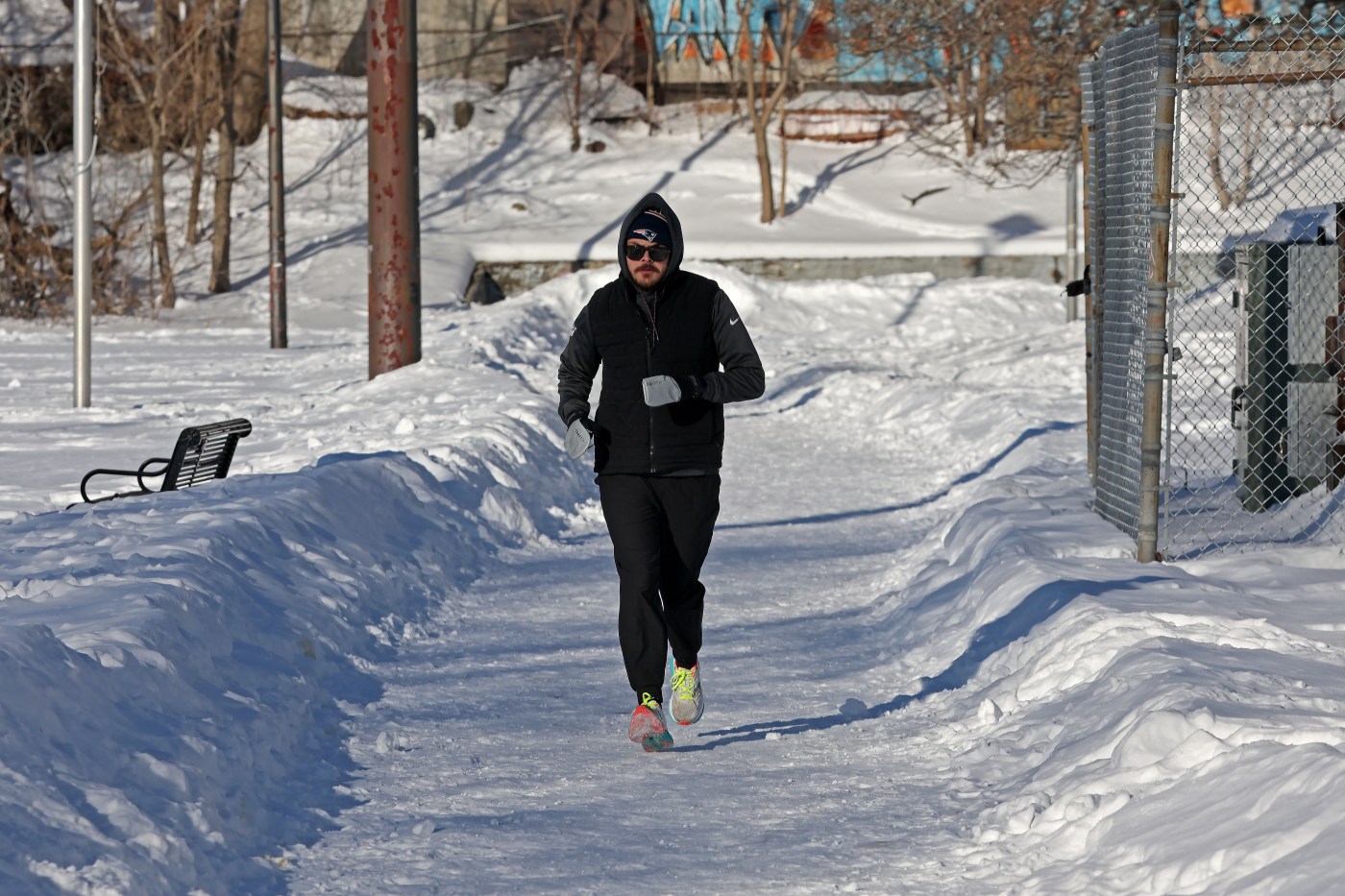
Bundled up in three long-sleeve t-shirts, two sweatshirts, two pairs of gloves, two pairs of socks, a hat and sunglasses, I feel my sweat turning into icicles in my beard and eyebrows.
I peer across the street to see how much running room I’ll have. Oh boy, the road has no shoulder to run on. The sidewalk is knee-deep in snow. Thankfully, I see footprints that can keep my balance.
I get across the street, trudge through the snow, and am finally able to run comfortably on pavement. About 30 minutes later, I finished my training for the day, with about 8.5 miles done in 20-degree weather.
Despite being well below freezing, that’s a warmer day than the conditions we’ve been dealing with this winter in the Boston area. The arctic cold, snowfall and icy roads are all creating a gauntlet for runners training for the Boston Marathon and other spring-time races.
One thing I’ve learned, though, is that runners across Boston and New England are fierce and have no quit. Throw us the harshest conditions, whether it be negative-degree temperatures and snow-and-ice-covered roads, we will still keep on pushing, no matter how much of a nightmare it may feel like now.
I have the honor of representing the Herald at this year’s Boston Marathon in April, after being fortunate to receive a media entry through the Boston Athletic Association. I will be chronicling my training journey now through Patriots Day.
This is a dream in the making, and that’s what I keep reminding myself when I am out on the roads this winter. I’ve been looking more like a bundled-up Randy Parker from A Christmas Story than an actual runner.
Training in snow
Members of the running world have shared their perspectives with me on how they’re enduring this grueling winter.
The extreme cold in Boston has forced running clubs to cancel recent training runs, including Boston Road Runners, of which I am a proud member.
BRR tries to host weekly marathon training runs on Saturdays, but as the wind chill has plummeted below zero, the club has been forced to cancel its past two weekend meetups.
BRR leader Evan LeBlanc said that the club is looking to bring back the training plan gradually when conditions are safer, temperatures warm up, and snow melts from last week’s storm, the eighth-largest in the city’s recorded history.
“Maintaining a safe running environment is paramount,” LeBlanc said. “I’ve always said cold-weather running builds character, so I’m fairly certain that the running community will be ready, having battled either the elements or the treadmill as they step on the start line at Boston.”
Callie Newton, 31, is training for her first Boston Marathon, having qualified in the Jersey City Marathon last April with a 3:15. Though the Alabama native lives in New York City, she is still grappling with harsh winter conditions.
Proper layering is crucial, Newton told me after she finished a 14.2-mile run in 21-degree weather Saturday afternoon. Three layers on top, with a vest, wool socks and gloves keep her nice and warm. Over-layering, especially if the clothing is not sweatproof, could cause issues, she said.
One sentiment most marathoners agree on is that they despise treadmill running, which Newton said she tries to avoid “at all costs.” The 10-time marathoner has only run once on the treadmill over the past eight weeks.
“The training journey is all about how you show up, no matter the circumstances,” Newton said. “Race day is the celebration of your training journey, showing up, and consistency. … The -6-degree days really do matter, and they teach you to dig deep to gain that motivation.”
Walpole resident Joe Mulligan ran 18 marathons between 1996 and 2014, including six Bostons. He said he tried to keep a low budget for his winter-training attire and would try to warm his frigid hands by covering cloth-running gloves with tube socks.
Mulligan said he trained in all kinds of wintry weather, often preferring to run from the Prudential Center in Boston and down each side of the Charles River. He tried to stay on the grass as much as possible.
“It cushions your feet a lot,” Mulligan told me. “When you’re running on the frozen ground, it really kills your legs. I always tried to mitigate that when I could, but I still ended up with shin splints a few times.”
Walpole native Liz Malone, who has run a handful of marathons, smiles when she looks back at training for Boston in 2022, the last bad winter in the northeast. Becoming involved with running clubs to have people to hold her accountable has been crucial, especially that year, she said.
She pointed to a specific training run in the winter of 2022, when it was well below freezing and sleeting, as a core memory with one of her friends.
“We still talk about the conversations that we were having because we just didn’t want to stop talking,” Malone said, “because it’s so miserable outside. You just want to keep your mind thinking about anything else other than the fact that it’s absolutely freezing.”
I have covered the past three Boston Marathons for the Herald. Nothing quite compares to the enthusiasm from runners and spectators at the finish line on Boylston Street, every third Monday in April.
Boston will mark the fourth marathon I have run. I ran in Burlington, Vt., in May 2024; in coastal Maine last May; and in San Antonio, this past December. They’ve all been journeys in their own right, but my excitement for Boston is unmatched.
I can’t wait turn a dream into reality.
Boston Herald reporter Lance Reynolds runs in snowy conditions as he prepares for the Boston Marathon. (Staff photo by Stuart Cahill/Boston Herald)

More Stories
Billionaire David Reuben leaves UK for Monaco
David Reuben, the property tycoon who shares second place on this year’s Sunday Times Rich List with his brother Simon,...
Deliveroo to roll out delivery robots in five UK locations
Deliveroo is to begin using pavement robots to deliver takeaways and groceries in the UK, with its first robot deliveries...
UAE threatens to pull billions from UK over Man City ruling
The United Arab Emirates has warned the government it could cancel billions of pounds of investment in the UK over...
Richard Megson on why people, not AI, will fix the home-moving process
Richard Megson is managing director of ASAP, the Pontefract-based business he co-founded with conveyancer Tony Hill to provide outsourced sales...
Dr Nilesh R. Parmar on the business of dentistry and delegating
Dr Nilesh R. Parmar is clinical director of Parmar Dental, the Essex dental group that the company says was founded...
Russian businessman accuses Biden of stealing his money
Moscow has opened a criminal case over the seizure of Konstantin Malofeev’s US assets and the transfer of some of...