
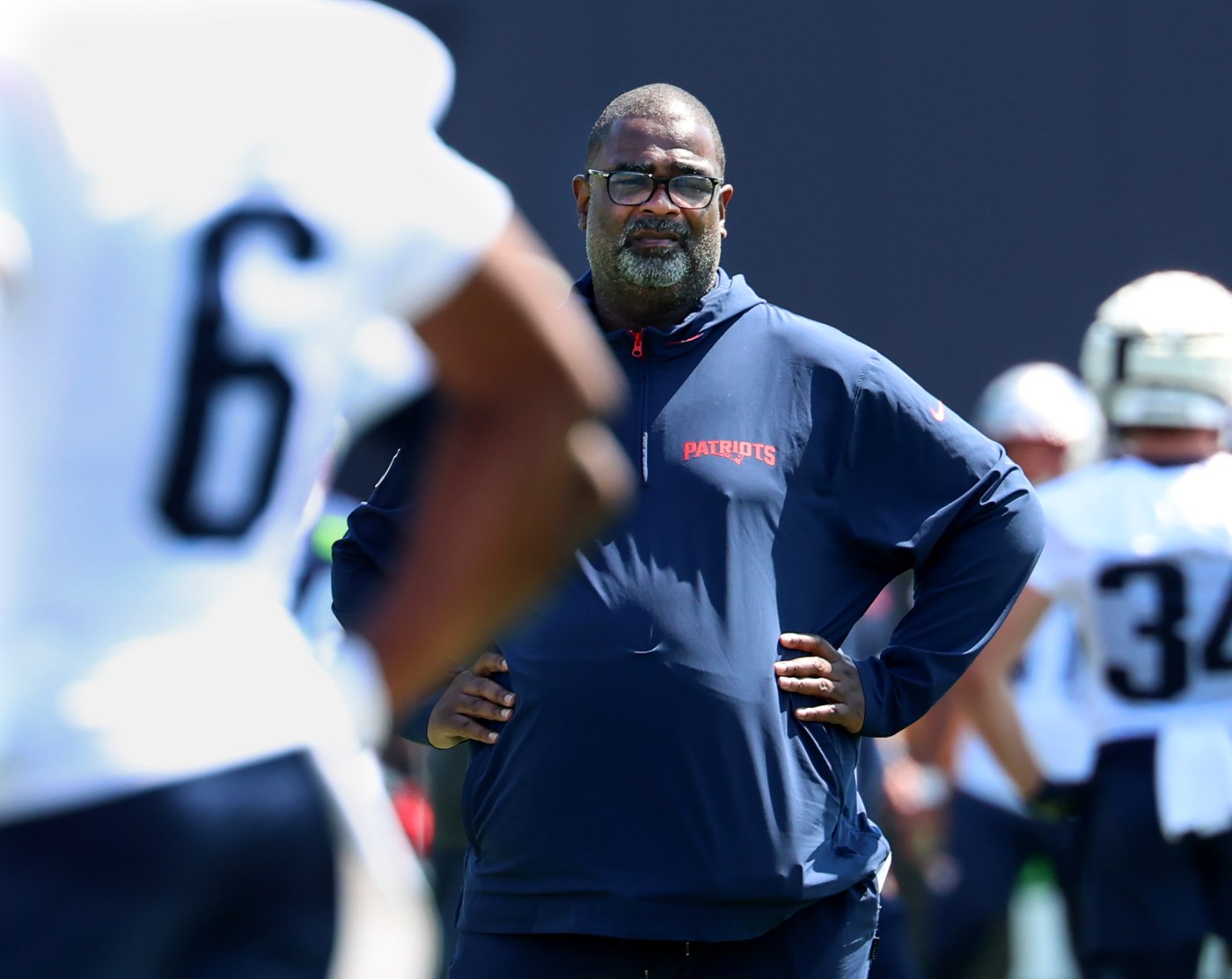
‘Possibility of death’: Patriots DC Terrell Williams reflects on cancer battle before Super Bowl LX

FOXBORO — Terrell Williams is sitting in his Gillette Stadium office late Friday afternoon, less than 48 hours before the Patriots are scheduled to fly to the Bay Area for Super Bowl LX.
A replay of a recent Seahawks game is paused on a TV mounted on a nearby wall. Papers are scattered on his dark, L-shaped desk positioned on the opposite side of the room. Twenty minutes ago, Williams moved out from behind his desk to settle into one of three large chairs positioned closer to the door, and recount his last four months as the Patriots defensive coordinator; a time when he didn’t call one play or run a single practice.
Mike Vrabel‘s name comes up.
“I know (Vrabel)’s up for these awards,” Williams says, “but when people talk about Coach of the Year …”
The 51-year-old coach pauses. A tear wells in his left eye. Williams removes his glasses, and lets the tear fall.
“It’s so much more than wins and losses,” he says, his voice quivering. “Trust me.”
Williams wipes both eyes, gratitude bubbling over. He pauses again, this time to find the words that capture what’s stirring in his heart.
“What he did for me,” Williams says, “that’s the Coach of the Year.”
Were it not for Drake Maye’s injured shoulder, the biggest story out of Foxboro this week would have been the news Vrabel broke Thursday: Williams will travel with the Patriots for the first time since the start of the regular season. Prostate cancer sidelined him every day after the team’s season opener, but it cannot keep him away now.
But, wait. There’s more.
Five rounds of chemotherapy treatments and a month-long regimen of medications eliminated all cancer from his body after it was discovered during an urgent care visit for flu-like symptoms on Sept. 8. Williams has a sixth and final round of chemo scheduled for two days after the Super Bowl, treatment he has elected to undergo while knowing he can skip it. If the Patriots win, he may need to choose between parading on duck boats and taking drugs that will ravage his body one more time. If so, Williams plans to pick the drugs.
He wants this return to normalcy, to the life he knows and loves, to last.
For himself, his family and team.
“When you go through (cancer), you realize it’s not just you going through it,” Williams says. “Everybody that cares about you is going through it with you.”
Assistant head coach/defensive line coach Terrell Williams, left, talks with head coach Mike Vrabel during the first half of an NFL preseason game between Tennessee and the Chicago Bears, Saturday, Aug. 12, 2023 in Chicago. (AP Photo/Kamil Krzaczynski)
Williams is explaining all of this while he sits with a team-issued beanie on his head, and glasses and stubble on his face. He wears an iron-colored, team-issued windbreaker and sweatpants. A Patriots logo is stitched on his windbreaker just below his left collarbone, where the cancer used to be.
“If I didn’t have a stomach (virus), I would have never known that the cancer was there,’” Williams says. “I felt a little pain in my collarbone, but you feel a little pain, you don’t think that it’s cancer. I remember telling my wife that I think I slept wrong. Because sometimes I wake up, and my neck hurts, and so that’s what I thought it was. But it was more than that.”
The night before he was diagnosed, Williams vomited at home for several hours. That illness, he realizes now, saved his life. So did a little nudging from Vrabel and Patriots head athletic trainer Jim Whalen, who the next day suggested he seek medical attention. At the Foxboro urgent care, doctors confirmed Williams was sick — but not like he thought.
“It was like, ‘Oh, by the way, you have lymphoma. Or it looks like you have lymphoma. We need to do a biopsy,’” Williams says. “It floored me.”
Williams sat with the possibility of lymphoma for three days until his biopsy results returned on Sept. 11. Williams said his doctors originally believed it was lymphoma because tests revealed the cancer had spread almost head to toe. Once his diagnosis was clarified as an aggressive form of prostate cancer, he scheduled an appointment at Massachusetts General Hospital in Boston, where he would begin treatment.
“It was tough just hearing about the treatment and the steps and how long it would take in between each chemo. And once I got to that, it was, ‘What’s that going to look like? How was I going to feel?’” Williams says. “And they can’t really give you a straight answer because they don’t know how your body’s going to react to all of these things. So, it was the unknown that was kind of scary.”
He continues: “All (the doctor) told me was, there’s a possibility of death. He didn’t think (I would die), but he can’t guarantee me that.”
New England Patriots defensive coordinator Terrell Williams, left, speaks to a trainer during the second day of training camp on July 24. (Mark Stockwell/Boston Herald)
That meant Williams couldn’t guarantee anything to anyone close to him, either.
“I thought about the people that I know that care about me and what would it be like for them if I’m not around,” he says. “You have thoughts, some of them dark, some of them positive, some of them your emotions are kind of all over the place. …There were some tough days.”
Tough days hit before the chemo did. The medications he began taking in mid-September sapped him of his strength. He was largely removed from the Patriots’ facility, his players and colleagues. He returned some weeks, usually wearing a smile he would force upon himself.
Williams also received cards and gift baskets, all the things people use to try and fill a void no one can until death no longer looms. The greatest gift Williams says he received was the one thing he fought hardest for: time.
This is what Vrabel gave him. He called Williams every day he couldn’t make it to the facility.
“When you’re going through what I went through, or when you’re going through struggles, sometimes just a phone call asking, ‘Hey, how are you doing?’ That matters more than a gift,” he says. “That is a gift.”
The Patriots also arranged for Williams and his son, a 13-year-old hockey player at St. Sebastian School, to attend a Bruins game and meet star David Pastrnak. Williams heard from former players and coaches, who broke from the unrelenting grind of the NFL season to pick up the phone.
As chemo intensified in October and November, and the Patriots built a 10-game win streak without him, Williams found himself increasingly grounded. He began to set roots, something few NFL coaches can or allow themselves to do in any one job, let alone in a year’s time. Here was a son of Los Angeles, who’s coached in Miami, Akron, Nashville, Youngstown, Detroit, Oakland and east Texas, calling New England home.
“That’s what makes this place special. It’s not winning, and all the franchises and the Patriots and Celtics and the Bruins and the Red Sox. All that stuff’s great, but that’s not what makes this place special. For me, what makes this place special is the people,” he says. “I’ve been out at restaurants, I’ve been to a bunch of different places, and just the amount of support from people that you don’t even know, all of this stuff, has been unbelievable.
“My idea of what New England has changed completely.”
When he did visit team headquarters, Williams sat in the back of meetings he used to run. He chatted with players in the hallways. He began to reacquaint himself with his own office, staying as long as he could.
Team captains, including Harold Landry and Marcus Jones, said Williams’ presence alone inspired him. The feeling was mutual.
“What guys like Harold don’t realize is seeing them is what brought the smile to my face,” he says. “Because, trust me: when you’re hurting, when you see people that you care about, that’s what brings the smile.”
But smiling, Williams learned, didn’t always serve him or his close ones. Hard talks require hard truths, something he’d like to remind anyone battling cancer today.
“I saw the look on my son’s face, and had to have conversations with a 13-year-old like, ‘Dad, how do you feel?’ And at first I would tell him I’m OK. But then I can see it in his face: he knew I wasn’t OK. So, just be honest with everybody,” Williams says. “And if you’re not OK, then don’t tell them that you’re OK, whether it’s physically or mentally.”
Related Articles
Patriots OC Josh McDaniels opens up on rejuvenating year off from coaching
First of seven Herald New England Patriots ‘Warrior Profiles’
New Patriots: Get to know unlikely hero from AFC Championship Game
Patriots QB Drake Maye among nine ‘questionable’ on bye week injury report
Patriots QB Drake Maye has Massachusetts town considering playful name change
In late December, as the Patriots made a run at the No. 1 seed in the AFC, Williams’ recovery accelerated. Doctors raved about his body’s response to treatment. The results of his fourth chemo session shattered expectations, and his fifth clinched a clean bill of health.
Williams told Vrabel he was cancer-free days after the Patriots’ regular season ended with a blowout of Miami. Vrabel told the team a week later. Once Williams returned, he welcomed every player’s embrace, but quickly diverted their attention to a Texans team visiting that Sunday in the divisional round of the playoffs.
“I shook hands and hugged the guys and then, it was like, ‘OK, thank you. Now let’s get ready to win that next game,’” Williams says. “And that’s really what the focus was, because I never really wanted the focus to be about me and my struggles. I didn’t want this to be about me, and what I’m going through. It’s about the players and trying to win.”
Williams stayed at home for the AFC Championship Game and watched the Patriots eke out a 10-7 win on TV. He’s still getting used to having a coach’s view from the couch. But he won’t need to much longer.
Williams’ family will accompany him to Santa Clara, Calif., where the Patriots will stay while they practice in nearby Palo Alto until Super Sunday. Like any good coach, Williams is looking beyond himself these days.
To the next game, the next practice, the next player who needs his help. But to those in need away from the field, those battling cancer and those fighting not for trophies but for time, as he did, Williams has a final message.
“I would tell them that they’re not alone, and just take it one day at a time. Don’t worry about the things that you can’t control, because you can’t control what might happen a month from now. You can’t control what might happen tomorrow. Just take it truly day by day, and accept support,” he says.
“It’s amazing what happens when we talk, and we’re honest and open. Usually, good things will happen. And I feel like that’s what’s happened for me.”

More Stories
Billionaire David Reuben leaves UK for Monaco
David Reuben, the property tycoon who shares second place on this year’s Sunday Times Rich List with his brother Simon,...
Deliveroo to roll out delivery robots in five UK locations
Deliveroo is to begin using pavement robots to deliver takeaways and groceries in the UK, with its first robot deliveries...
UAE threatens to pull billions from UK over Man City ruling
The United Arab Emirates has warned the government it could cancel billions of pounds of investment in the UK over...
Richard Megson on why people, not AI, will fix the home-moving process
Richard Megson is managing director of ASAP, the Pontefract-based business he co-founded with conveyancer Tony Hill to provide outsourced sales...
Dr Nilesh R. Parmar on the business of dentistry and delegating
Dr Nilesh R. Parmar is clinical director of Parmar Dental, the Essex dental group that the company says was founded...
Russian businessman accuses Biden of stealing his money
Moscow has opened a criminal case over the seizure of Konstantin Malofeev’s US assets and the transfer of some of...