
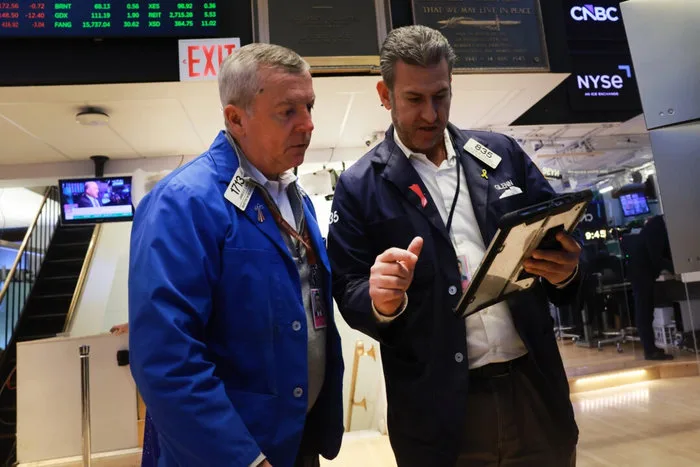
Wall Street Review: Corporate Earnings Help Support Monthly Stock Gains

By Panos Mourdoukoutas
U.S. equities finished mixed in another volatile week but managed to edge higher for the month, supported by mostly positive corporate earnings and steady interest rates.
Trading remained choppy throughout the week, driven by earnings headlines from Big Tech companies and the Federal Reserve’s monetary policy decision and press conference midweek.
For the week, the Dow Jones Industrial Average declined by 0.42 percent to 48,892, though it rose by 1.09 percent for the month. The S&P 500 gained 0.34 percent to close at 6,939, ending the month up by 0.62 percent. The tech-heavy Nasdaq Composite slipped by 0.17 percent for the week but rose by 0.18 percent for the month. The Russell 2000 underperformed for the week, falling by 2.08 percent, but outperformed for the month, rising by 3.73 percent.
Market volatility fluctuated sharply during the week. The Chicago Board Options Exchange Volatility Index rose above 17 early on Jan. 28, declined to 16 by early afternoon, then climbed again to 19.70 on Jan. 29, and finished the week at 17.44.
Stocks opened higher across the board on Jan. 26 amid optimism that Big Tech earnings scheduled for release during the week would exceed expectations and that the Federal Reserve would keep interest rates unchanged at its regular meeting, which concluded on Jan. 28.
Adding to investor optimism was a decline in bond yields. The yield on the U.S. 10-year Treasury note fell below 4.22 percent during the session, its lowest level in nearly two weeks, as concerns grew over a potential government shutdown after Democratic leaders threatened to block approval of a $1.2 trillion funding package.
The Dow, S&P 500, and Nasdaq 500 all closed in positive territory that day, while the Russell 2000 ended slightly lower.
“Earnings expectations for big tech stocks are high, and as a result, the market will punish companies for not measuring up,” Emily Bowersock Hill, CEO and founding partner of Lawrence, Kansas-based Bowersock Capital Partners, told The Epoch Times.
“Investors will be scrutinizing the company’s spending plans and 2026 outlooks. Intel is a case in point—last week its price plunged 15 percent after reporting a weaker-than-expected outlook.”
Investor optimism extended into the Jan. 27 session following strong earnings reports from General Motors and UPS.
Positive sentiment was also supported by a fiber-optic deal between Meta and Corning, as well as Micro Technology’s plans to build a $24 billion chip-manufacturing facility in Singapore.
Markets closed mixed, weighed down by health insurers’ shares after reports that the U.S. government plans to keep Medicare rates flat in 2027.
UnitedHealth Group shares fell by nearly 20 percent, CVS declined by 14 percent, and Cigna dropped by 3.68 percent.
The S&P 500, Nasdaq, and Russell 2000 finished higher, while the Dow, which includes UnitedHealth Group, closed lower.
Equities traded mixed on Jan. 28 following the Federal Reserve’s decision to leave interest rates unchanged, as expected, and ahead of additional earnings reports from Big Tech companies.
The Nasdaq rose by 0.3 percent, while the Dow ended slightly higher and the S&P 500 closed slightly lower after briefly touching the psychological 7,000 level.
During his post-meeting press conference, Federal Reserve Chair Jerome Powell said the economy remains on a solid footing, noting that the “tension between inflation and employment” is easing.
“Fed Chair Powell came out calm and confident. … He artfully dodged political questions and described an economy that has ‘clearly improved’ since December,” Heather Long, chief economist at Navy Federal Credit Union, told The Epoch Times.
“Powell’s word of the day was ‘stable.’ He sees a stabilizing labor market, stable consumption, and stable inflation.”
Lale Akoner, global market analyst at eToro, told The Epoch Times that the Fed’s decision signaled confidence that monetary policy is now close to neutral.
“With policy now near neutral, the market’s focus may shift away from the timing of the next cut and toward whether growth, profits, and productivity can continue to deliver without reigniting inflation,” she said.
Jan. 29 saw another mixed session as investors reacted to earnings reports from Meta, Microsoft, and Tesla—three members of the so-called “Magnificent Seven”—released after the previous day’s market close.
Meta shares surged by 10 percent after the company reported earnings topped forecasts and issued a strong revenue outlook. Tesla shares fell by 3.23 percent despite a slight earnings beat, as revenue missed expectations.
Microsoft shares declined by 10 percent, weighed down by heavy spending on data centers and slower growth in cloud revenues, which cast a shadow over its earnings beat.
The Nasdaq closed 0.72 percent lower, recovering from steeper losses earlier in the session. The S&P 500 slipped 0.13 percent, while the Dow and Russell 2000 posted modest gains.
The Jan. 30 session opened sharply lower for equities following a sharp drop in metals prices, with gold, silver, and copper falling sharply and giving back some recent gains.
All major indexes ended the day lower, led by small-cap and technology stocks. The Russell 2000 fell by 1.55 percent, while the Nasdaq declined by 0.94 percent.
Akoner said she remains optimistic about equities, citing easing inflation pressures and resilient corporate profits.
“Slower job growth is increasingly being interpreted as a productivity story, especially as AI adoption changes hiring patterns, rather than a signal of an impending downturn,” she said.
“That matters for markets, as productivity-led growth allows margins to hold up even as wage pressures cool.”
Chris Brigati, chief investment officer at SWBC, an investment firm based in San Antonio with more than $1 billion in assets under management, said Big Tech and artificial intelligence (AI)-related investments are likely to continue driving markets higher in the near term.
“When that happens, disciplined stock selection becomes critical,” Brigati told The Epoch Times.
“The long-term winners will be companies that execute flawlessly, protect margins, lead in innovation, and remain aligned with shifting consumer spending patterns.”


More Stories
Take Charge of My Heart: Release Date, Trailer, Plot, and More
Are you also hunting for the next Korean romantic-comedy drama? Then your search ends here. Take Charge of My Heart...
Minerva Academy: Release Date, Plot, Cast, Trailer, and More
Netflix’s latest Italian drama Minerva Academy is currently streaming online on the popular streaming network Netflix. Its original title is...
8 Best Commercial Skylight Companies for US Projects (2026)
Getting commercial daylighting wrong is expensive in a way residential work rarely is. A leaking curb on a house is...
Is Sweet Magnolias Season 6 Renewed? Latest News and Review
Netflix’s romantic drama Sweet Magnolias has finally come to an end. In September 2026, Deadline officially announced that one of...
The Inbetweeners 3: Release Date, Cast, Trailer, and Updates
The Inbetweeners 3 is finally coming back on the popular streaming Network, Netflix. The original four stars of the series,...
7 Essential Components of a Modern Corporate Training Tech Stack
What the seven components need to accomplish Your LMS isn’t obsolete. It may simply need to play one part in...