
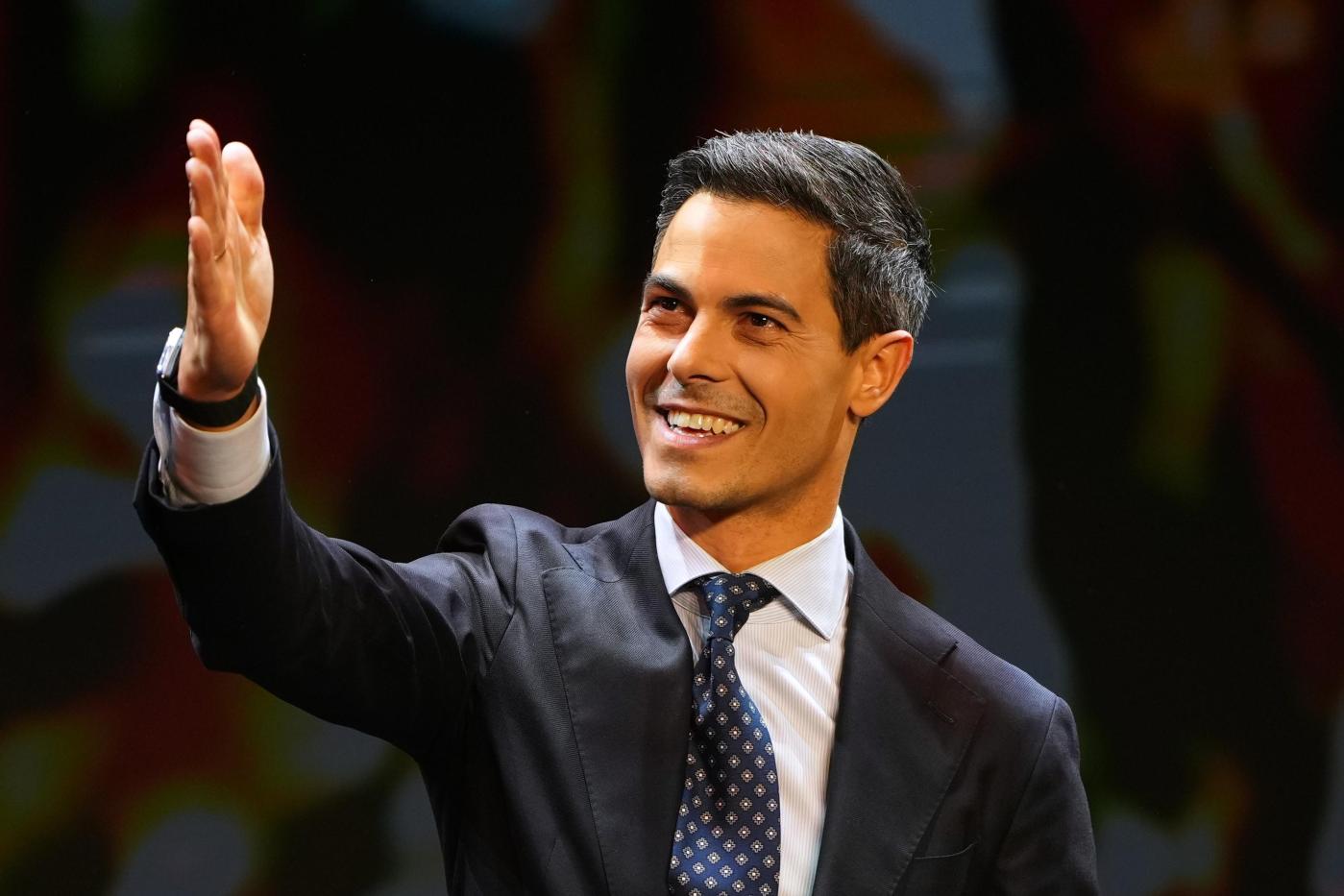
Dutch premier-in-waiting says Trump’s Greenland ambitions are a ‘wake-up call’ for Europe

By MIKE CORDER
THE HAGUE, Netherlands (AP) — The political leader in line to become the Netherlands’ next prime minister on Friday said concerns about U.S. President Donald Trump’s territorial ambitions in Greenland were a “wake-up call” for Europe at a fraught time.
Related Articles
Pushed by Trump, US allies are resetting relations with China
Israel reopening Gaza’s border crossing with Egypt on Sunday after long closure
New US sanctions against Iran target interior minister over crackdown on protesters
Panama Canal ports will keep operating after court finds concession unconstitutional, president says
Trump claims Putin agreed to temporary halt in energy attacks on Ukraine, but terms are unclear
Centrist D66 leader Rob Jetten emphasized the need for stronger European cooperation to ensure security and prosperity — rather than focusing on the United States.
“We can continue talking and complaining about the U.S., but what we should do instead is make sure that the European cooperation is strengthened — that we can guarantee security and prosperity for our own citizens,” he told The Associated Press.
Once in office, one of the first things Jetten will do is “talk to my colleagues in Europe to see what role the Dutch can play again in strengthening the European cooperation,” he said.
Still, Jetten stressed he also would seek to boost cooperation with Washington, “mainly on topics of security, the war in Ukraine, but also on an economic level, because the Dutch economy and American economy are very much, interlinked.”
Trump has repeatedly argued that the U.S. needs Greenland, a self-governing territory of NATO member Denmark, to counter threats from Russia and China. But last week he scrapped the tariffs he had threatened to impose on eight European nations — including the Netherlands — to press for U.S. control over Greenland.
Jetten was speaking to media after he and the leaders of two other parties that will form a minority coalition government following elections three months ago presented a policy blueprint Friday with their plans for the coming four-year term. The plan includes spending billions on the Dutch military and ongoing support for Kyiv in Russia’s war on Ukraine.
Jetten’s coalition holds only 66 of the 150 seats in the lower house of parliament so it will have to drum up support across the splintered political spectrum for every new law it seeks to pass. There are 16 parties and blocs in the lower house.
“The task before us is enormous, but the Netherlands has become great through collaboration,” Jetten said. “Our history shows that progress is not achieved alone, but created together.”
The coalition is made up of Jetten’s D66 together with two more right-leaning parties, the Christian Democrats and People’s Party for Freedom and Democracy. Jetten has been in the driving seat for coalition talks since his party narrowly won elections in late October.
From left, Dutch coalition partners Dilan Yeşilgöz-Zegerius of the People’s Party for Freedom and Democracy, Rob Jetten of the centrist D66 and Henri Bontenbal of the right-leaning Christian Democrats speak to reporters as they present a coalition deal in The Hague, Netherlands, on Friday, Jan. 30, 2026. (AP Photo/Mike Corder)
The 38-year-old will become the Netherlands’ youngest and first openly gay premier when he and his new Cabinet ministers are sworn in by King Willem-Alexander, likely sometime in late February.
Jesse Klaver, leader of the center-left Green Left-Labor Party that holds 20 of the lower house’s 150 seats, has called the minority coalition a “risky experiment,” but said recently he would pursue a policy of “responsible opposition” and do deals with the new government “not for ourselves, but to help the Netherlands move forward.”
However, Klaver warned the incoming administrations that if “they want our support, then the plans will have to be more social and more green.”
The far-right Party for Freedom led by veteran anti-Islam lawmaker Geert Wilders, which was a close-run second in the Oct. 29 election, has vowed not to support the coalition. Earlier this month, Wilders saw seven of his elected lawmakers unhappy with his authoritarian leadership of the party break away to form a new bloc in parliament.
More Stories
Former Hiscox chief Bronek Masojada elected City of London Lord Mayor
Bronek Masojada, the former group chief executive of insurer Hiscox, has been elected the 698th Lord Mayor of the City...
Getting to know you: Lauren Templeton, founder, Select
Lauren Templeton is the founder and director of Select School of Performing Arts, which she launched in 2019 after training...
Getting to know you: Dr Amo Raju OBE, MD, Amo Raju & Associates
Dr Amo Raju OBE DL stepped down in September 2024 after 30 years as chief executive of Disability Direct, the...
BCC says Budget is critical test after Burnham conference speech
The British Chambers of Commerce (BCC) has said next month’s Budget will be the “critical test” for Andy Burnham’s government,...
Burnham to scrap pension triple lock after next election
Andy Burnham will scrap the state pension triple lock after the next general election and use the savings to build...
OpenAI pulls GPT-6.1 Astra release after model falls short on safety
OpenAI has said it will not release GPT-6.1 Astra, the latest version of its agentic AI model, after the system...