
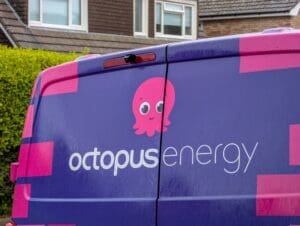
Octopus Energy strikes major China joint venture during PM visit

Octopus Energy Group has unveiled a major joint venture with PCG Power to trade renewable electricity in China, marking a significant expansion into the world’s largest clean energy market.
The deal was announced during Keir Starmer’s official visit to China, with Octopus founder and chief executive Greg Jackson joining the UK business delegation in Beijing.
The new venture, called Bitong Energy, will combine PCG Power’s position as one of China’s fastest-growing investors and solutions providers in the commercial and industrial renewable energy sector with Octopus’ proprietary software and expertise in green energy trading and optimisation.
Bitong Energy will initially focus on China’s rapidly expanding spot power markets, where electricity is bought and sold in real time to improve grid efficiency and reduce costs. China’s electricity demand is forecast to rise by around a third over the next five years, while government mandates require at least 10 per cent of power to be traded on spot markets by the end of this year.
By 2030, the joint venture aims to trade up to 140 terawatt hours (TWh) of renewable electricity a year, roughly equivalent to the UK’s current total green power output. Octopus estimates this could generate around £50 million in annual profits, with half returning to the UK economy.
Within five years, the partners believe Bitong Energy could achieve a valuation in excess of £500 million, helping to strengthen Britain’s economy by exporting UK-developed software, data and engineering capability.
The venture will launch in Guangdong province, China’s most advanced spot power market, before expanding into other regions as additional markets open nationwide. Alongside trading, Octopus will deploy its technology platform to optimise performance and maximise returns from China’s growing fleets of batteries, wind and solar assets.
Greg Jackson said the partnership highlighted how British innovation could benefit from China’s scale in clean energy manufacturing.
“China’s investments in scale and innovation have made solar, wind and batteries dramatically cheaper,” he said. “Now there’s a huge opportunity for Britain to succeed by building the smart solutions that use these technologies to cut the cost of electricity.
“Our partnership with PCG is about exporting world-class British energy capabilities, growing both our economies and accelerating the shift to cheaper, cleaner and more secure power.”
Li Wenxuan, chairman and chief executive of PCG Power, described the deal as a milestone for the company and for China’s energy transition.
“By integrating Octopus Energy’s world-leading technology and algorithmic expertise with our deep local market knowledge, we will create powerful synergies,” he said. “Together, we aim to deliver smarter, more cost-effective and reliable energy services for Chinese commercial and industrial customers, while supporting China’s green transformation.”
The joint venture builds on Octopus Energy Group’s broader strategy of exporting British clean energy technology overseas. The company has already formed international software partnerships designed to lower energy costs and improve grid flexibility, as well as expanding its electric vehicle and battery offerings.
Last year, Octopus launched its Power Pack Bundle with BYD, enabling electric vehicles to act as “batteries on wheels”. Through Octopus Electric Vehicles, the group has also helped introduce brands such as OMODA, Jaecoo, Geely and XPENG to the UK market.
The China partnership represents one of Octopus Energy’s most ambitious international moves to date, positioning the company at the heart of global renewable energy trading as spot markets expand worldwide.
Read more:
Octopus Energy strikes major China joint venture during PM visit


More Stories
Medical Tourism for Eye Surgery: How to Evaluate Laser Eye Clinics Abroad
Europe in particular has become a destination for patients seeking refractive procedures such as LASIK, PRK, and other forms of...
Minister says 32 government services offline over PHP security flaw
Thirty-two UK government services are offline and four are partially unavailable while officials address a critical security flaw in the...
Meta ordered to pay $25bn for misleading public over Facebook data
A judge in New Mexico yesterday ordered Meta, the owner of Facebook, Instagram and WhatsApp, to pay $25bn (£18.6bn) after...
Tank and artillery barrels made in UK again after 20-year gap
Large calibre gun barrels for tanks and artillery are being made in the UK for the first time in 20...
Inzynk Enters the UK Market, Challenging the ‘SaaS Tax’
Nordic B2B orchestration platform Inzynk is entering the UK market, directly challenging legacy per-seat Software-as-a-Service (SaaS) models in the enterprise...
4 Best Thermally Broken Roof Hatches for Part L Projects in 2026
For architects, building services engineers and contractors working at RIBA Stage 3 to 4, comparing thermally broken roof hatches on...