
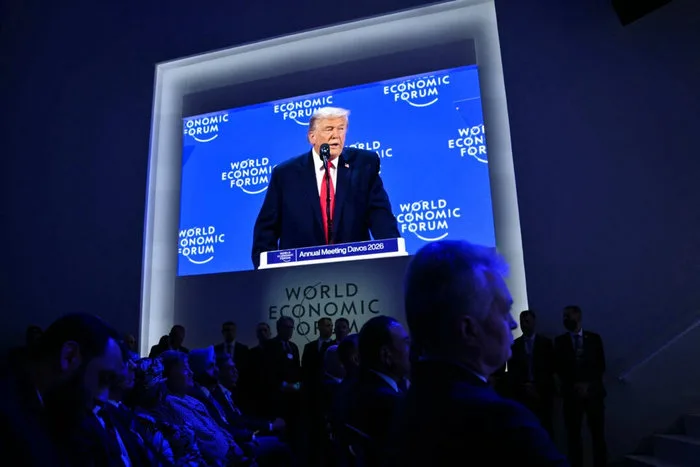
Trump Reshapes Davos as Globalism Takes a Back Seat

By Emel Akan
WASHINGTON—The World Economic Forum (WEF) in Davos, Switzerland, long known for supporting globalism, environmental sustainability, and social equity, struck a markedly different tone this year with President Donald Trump’s return to the global stage.
Topics that used to be central to the forum appeared sidelined, replaced by more urgent issues such as trans-Atlantic tensions over Greenland, tariff disputes, and growing unilateralism.
This year, Klaus Schwab did not attend for the first time since he founded the WEF in 1971. With Schwab’s absence came a noticeable decline in focus on the forum’s usual themes, such as multilateral cooperation on net-zero transitions, and initiatives such as environmental, social, and governance (ESG) and diversity, equity, and inclusion (DEI).
Swedish activist Greta Thunberg was also absent from this year’s gathering in the Alpine village. In some prior years, she had been one of Davos’s visible figures, delivering speech lines such as “Our house is on fire,” and calling for immediate divestment from fossil fuels.
This year, the forum welcomed Elon Musk as a new guest. The Tesla and SpaceX founder attended Davos for the first time after years of publicly criticizing the WEF as “boring” and calling its participants an “unelected world government.” He joined BlackRock CEO and WEF interim co-chair Larry Fink on stage to discuss how technological progress will create an “abundance of goods and services” for humanity and expressed optimism about the future.
Observers also noted a significant decline in climate discussions at Davos. The 2026 official program featured only four sessions referencing “climate change,” down from 16 in 2022. In speeches by world leaders—including French President Emmanuel Macron and Canadian Prime Minister Mark Carney—terms such as “climate change” and “net zero” were absent.
U.S. Secretary of Energy Chris Wright, a fossil fuel industry veteran, attended the WEF for the first time and spoke at a session called “Conversation on How to Fuel Our Lives,” where he argued that the world requires significantly more oil, natural gas, coal, and nuclear energy.
WEF membership is by invitation only, and companies pay annual fees ranging from $75,000 to $758,000, depending on the membership type, according to Fortune Magazine. Companies also pay a fee for each participant attending the Davos meeting, with elite badges costing up to $35,000 each.
Trump attended this year’s summit with a large delegation, and his Cabinet members used the forum to promote his America First agenda.
On Jan. 21, Trump delivered a speech lasting for more than an hour, setting the tone for the week. He criticized efforts to promote renewable energy in European countries, referring to them as the “Green New Scam” and the “greatest hoax in history.” He stated that countries that have invested most heavily in windmills have experienced greater losses over the years.
Wright told The Epoch Times that Trump was right to highlight his economic and energy policies in his speech.
“He rightfully celebrated American economic growth, the stopping of the price rise, increasing of wages of American workers, getting a commonsense energy policy so we can drive our economic growth and help support our neighbors and allies in Europe,” Wright said.
Interest in Trump was evident well before his speech. Participants began lining up more than 90 minutes in advance. The conference room was full, with some attendees standing in the aisles. Among them was California Gov. Gavin Newsom, who is widely seen as a potential 2028 presidential contender.
Trump called out Newsom during his speech, telling the audience, “Gavin is a good guy,” and that they used to get along well. Newsom was seen smiling, laughing, and shaking his head in disagreement.
On Jan. 22, Newsom participated in a discussion where he accused the Davos crowd of not standing up to Trump. He criticized law firms, universities, and corporations for “selling out” to the Trump administration.
Newsom was not the only Democratic governor in Davos. Kentucky Gov. Andy Beshear, a moderate Democrat who has won two terms in a deep-red state, and Michigan Gov. Gretchen Whitmer, another frequently mentioned 2028 contender, were also present.
Trump, meanwhile, used his time in Davos to spotlight America’s military and economic might. He framed the United States as the hottest country in the world, touting sweeping deregulation, booming stock markets, surging energy production, and robust economic growth.
His remarks on Greenland drew significant attention. Trump argued that the United States should acquire what he described as “a big piece of ice” for national security, while assuring the crowd that there would be no military takeover. His message eased concerns in the room and brought relief to investors worldwide.
Trump announced on Jan. 22 that he had reached a framework agreement with NATO regarding Greenland’s future, though he offered few details.
While many European leaders and media criticized Trump’s remarks, NATO Secretary General Mark Rutte defended his position.
On Jan. 26, speaking to the European Parliament in Brussels, Rutte cited increased activity by China and Russia in the Arctic and warned that Europe cannot defend itself without U.S. support.
“I think he’s right. There is an issue with the Arctic region,” Rutte said. “And if anyone thinks here, again, that the European Union, or Europe as a whole, can defend itself without the U.S., keep on dreaming.”


More Stories
7 Best Bespoke Smoke Vents for Large and Complex Roof Openings (2026)
Picture a main contractor in Leeds coordinating a logistics warehouse where the structural grid leaves a 2,800 mm clear zone...
6 College Football Teams Generating the Most Betting Interest in 2026
Three weeks into the 2026 college football season, several familiar contenders are already shaping national conversations. Early results have shifted...
Nobody Wants This Season 3: Release Date, Cast Members, and Episodes
Nobody Wants This season 3 is coming back soon! It is an American romantic comedy series. The series first premiered...
6 Companies Delivering Innovative Data Center Cooling Technologies
Data Center Cooling Technologies are no longer a nice-to-have. They’re what separates a facility running at peak performance from one...
Top DevOps Testing Tools for Faster Software Delivery in 2026
Most teams don’t have a testing problem. They have a speed problem. DevOps Testing Tools promise faster feedback loops, but...
Long Story Short Season 2 Is Renewed! Release Date, Plot, and More
Netflix has recently given anime fans a major reason to celebrate by renewing Long Story Short for a new season....