
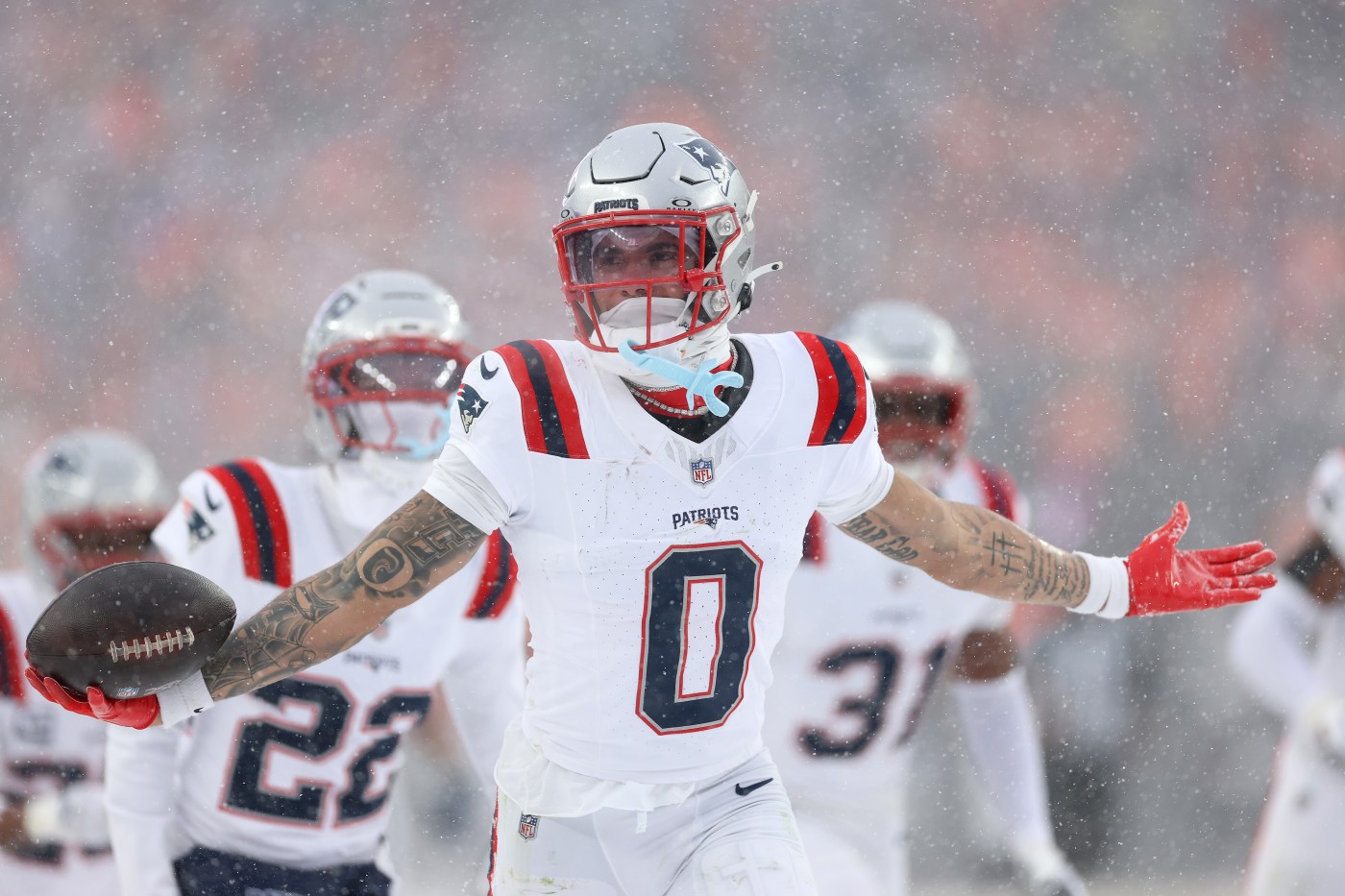
Film review: How Patriots defense picked up Drake Maye in the AFC Championship Game

Against all preseason odds, whipping winds, the worst start of Drake Maye’s career and the ghosts of Mile High, the Patriots are Super Bowl bound.
In some ways, Sunday broke new ground. It marked the Patriots’ first-ever playoff win at Denver. Mike Vrabel won his first conference championship, as did most of his players. The Pats became the first team in NFL history to finish 9-0 on the road.
In other ways, the AFC title game was a continuation of their playoff evolution. Maye, again, was more supporting actor than main character. The Patriots held an opponent to 10 points or fewer for the second time in the playoffs. For all the capable runners and pass-catchers on their roster, blitzing still remains this team’s sharpest and most effective postseason weapon.
And on the road to victory, the Pats received contributions from little-known reserves like defensive tackle Leonard Taylor, whose field goal block nuked the Broncos’ best shot at a comeback in the fourth quarter. And don’t forget defensive play-caller Zak Kuhr, who outfoxed Broncos coach Sean Payton with a surprise play-call on fourth-and-1 in the second quarter to shut Denver out deep in Patriots territory.
So as more eyes turn to Maye and Vrabel before they take the game’s biggest stage, remember them, and the truth of the AFC title game and this postseason run.
The Patriots are AFC champions for one reason: they can survive and advance without Maye leading the way.
Here’s what else the film revealed about the Pats’ conference title win:
Drake Maye
New England Patriots Drake Maye (10) run aways from a Denver Broncos defender during Sunday’s AFC Championship Game. (AP Photo/Garrett W. Ellwood)
10-of-21 for 86 yards
Accurate throw percentage: 55%
Under pressure: 2-of-4 for 9 yards, 5 sacks
Against the blitz: 5-of-8 for 45 yards, 1 sack
Behind the line: 2-of-2 for 7 yards
0-9 yards downfield: 6-of-10 for 28 yards
10-19 yards downfield: 1-of-2 for 20 yards
20+ yards downfield: 1-of-6 for 31 yards
Notes: Were it not for Maye’s running ability, the Patriots likely lose. And that loss would have been on him.
This was trending toward the least accurate game of Maye’s career even before the snow swallowed the fourth quarter. He missed a wide open Kayshon Boutte three times, including twice on intermediate routes. He overshot DeMario Douglas down the sideline and Rhamondre Stevenson in the end zone. At times, Maye struggled with ball placement even when his throws were close enough to his targets.
Until it became time to effectively sit on the ball, his decision-making was spotty, too. He tossed two deep balls to Boutte versus Patrick Surtain Jr., who allowed a single deep completion all regular season. Boutte might be one of the NFL’s more reliable downfield targete, but Surtain is an All-Pro and the reigning Defensive Player of the Year. Maye also missed a potential touchdown to Hunter Henry on third-and-goal early in the third quarter.
Maye did score the Pats’ only touchdown on a well-timed quarterback draw in the second quarter. Three of the Pats’ five longest plays were scrambles. The other two were completions to Mack Hollins, including a flea flicker in the third quarter that said everything about Josh McDaniels’ confidence in his offense’s ability to move the ball with a standard dropback passing game. Granted, that was also Maye’s best throw of the day by a wide margin, a beauty right over Hollins’ shoulder.
Earlier, a 28-yard scramble sustained the Pats’ eventual game-winning field goal drive in the second half. It converted the type of third-and-long play that otherwise was a death knell for this offense. Because when the Patriots were backed into obvious passing situations, or spread themselves out, Denver feasted.
In the pocket, Maye felt instant pressure early, almost tossed a pick and grew skittish. He ran into two of his five sacks and could have avoided another with an earlier throwaway. Ball security in poor conditions may have been his greatest feat Sunday because while Maye the passer did not put forth a winning performance, Maye the scrambler did just enough.
And let’s not forget, the gutsy call to take the game into his own hands by ad-libbing a naked bootleg on the game’s final third-down conversion.
Critical areas
Christian Gonzalez of the New England Patriots celebrates after intercepting a pass from Jarrett Stidham of the Denver Broncos during the fourth quarter in the AFC Championship Game at Empower Field at Mile High on January 25, 2026 in Denver, Colorado. (Photo by Matthew Stockman/Getty Images)
Turnovers: Patriots 0, Broncos 2
Explosive play rate: Patriots 6.3%, Broncos 1.7%
Success rate: Patriots 31%, Broncos 29%
Red-zone efficiency: Patriots 1-2, Broncos 1-2
Defensive pressure rate: Patriots 51.4%, Broncos 37.9%
Offense
Game plan
Personnel breakdown: 39% of snaps in 11 personnel, 20% of snaps in 12 personnel, 20% of snaps in 21F personnel, 20% of snaps in 22 personnel, 1% of snaps in jumbo personnel.***
Personnel production: 28% success rate in 11 personnel, 46% success rate in 12 personnel, 25% success rate in 21F personnel, 8% success rate in 22 personnel, 100% success rate in jumbo personnel`.
First-down down play-calls: 70% run (19% success rate), 30% pass (50% success rate)
Play-action rate: 17.2%
McDaniels wanted to control play early through heavy personnel groupings and a balanced run-pass approach that created easy throws for Maye and took the edge off Denver’s pass rush. He had two problems: Maye missed some layups, and the Patriots couldn’t run the ball.
Patriots gush about Mike Vrabel’s influence as head coach deflects credit from self
Once Maye took two sacks in a three-play span, McDaniels pivoted to a spread plan, which didn’t help matters. As ineffective as their personnel groupings with multiple backs and tight ends had been, the Pats found disaster with three-receiver sets, where Maye’s inaccuracy and initial skittishness were most visible. It wasn’t until the defense gifted them field position at Denver’s 12-yard line in the first half that the Patriots found the end zone.
Later, it took Maye breaking free for a long scramble and the run game finally revving its engines to score again. During that drive, McDaniels returned to his heavy groupings and persisted with a variety of man-blocked runs — duo, counter and power — to briefly crack Denver’s defense. He also hit on two draw plays, another weapon against the Broncos’ pass rush.
Once the Pats had a lead in the fourth quarter, McDaniels quadrupled his usage of outside zone runs, perhaps a way to counteract increasingly slippery conditions by emphasizing lateral blocking.
Final note: only four snaps for TreVeyon Henderson had to be a game-plan decision driven by fear of Denver’s blitz package and frustration with his vision. Henderson lost three yards bouncing the wrong way on one of his three carries and did not pass-block once. Still, his playing time was shockingly low, especially for a run-heavy plan.
Player stats
New England Patriots wide receiver Mack Hollins catches a pass ahead of Denver Broncos linebacker Dre Greenlaw during the second the half of the AFC Championship NFL football game, Sunday, Jan. 25, 2026, in Denver. (AP Photo/John Locher)
Broken tackles: RB Rhamondre Stevenson 5, WR Stefon Diggs, QB Drake Maye
Pressure allowed: C Garrett Bradbury 2 (sack, hurry), RT Morgan Moses 2 (sack, hurry), LT Will Campbell 2 (QB hit, hurry), LG Jared Wilson (hurry), RB Rhamondre Stevenson (hurry), Drake Maye (sack), Team 2 (2 sacks)
Run stuffs allowed: Team 3, RB Rhamondre Stevenson
Drops: TE Hunter Henry
Notes
For a running back with only 71 rushing yards, Rhamondre Stevenson more than earned his paycheck Sunday.
Stevenson ground out 59 rush yards after contact, protected the ball through a slot in the fourth quarter and delivered punishing blocks in blitz pickups.
After flipping the ball back to Maye on the flea flicker, Stevenson halted Broncos linebacker Alex Singleton in the backfield to give his quarterback just enough time on rip a 31-yard throw to Hollins. Stevenson also blocked up stunts with his offensive linemen on a tough day for pass protection.
Hollins’ return was a boon for the Patriots. He caught both of Maye’s explosive passes and finished with the second-most snaps played among receivers, often digging out defenders as a perimeter run-blocker.
So-so days for Kayshon Boutte and Stefon Diggs. Boutte drew more difficult matchups with All-Pro corner Patrick Surtain than Diggs did, but Diggs did not thrive against a Denver defense that majored in the types of zone coverages he’s exploited all year.
Hunter Henry’s drop was the lowlight on an iffy day for the veteran. Austin Hooper secured better run blocks, but didn’t factor as a receiver.
Up front, right guard Mike Onwenu was the only player to escape with a clean sheet, though Garrett Bradbury outshone him as a run-blocker.
Left tackle Will Campbell settled down after another rough start versus Broncos edge rusher Nik Bonitto.
Nice to see Khyiris Tonga return to the offensive huddle as a short-yardage fullback. He and fellow defensive tackle Milton Williams shared the backfield on a rare tush push that barely converted a fourth-and-1 snap deep in Denver territory.
Full-time fullback Jack Westover was not forceful enough as a lead blocker. He’s had better games.
Defense
Game plan
Personnel breakdown: 66% three-corner nickel package, 31% base defense, 3% dime.****
Coverage breakdown: 67% zone, 33% man
Blitz rate: 40.5%
Blitz efficacy: 27% offensive success rate and 0.8 yards per play allowed
The hot streak continues.
Kuhr put Jarrett Stidham in the same pressure chamber the Patriots thrust Justin Herbert and C.J. Stroud before him. To do so, he needed his defensive front to control the Broncos’ rushing attack on early downs and put the entire offense on Stidham’s shoulders. Defensive tackles Milton Williams, Khyiris Tonga and Cory Durden powered this plan from base and nickel personnel, driving back the Broncos guards and displacing their offensive line.
Kuhr then rewarded them on passing downs by often walking a middle linebacker over the center, forcing Denver to block Williams and Co. 1-on-1. The Pats survived an early bust in quarters coverage that gave up Denver’s only explosive play of the day, a 52-yarder to Marvin Mims. But once the Patriots began to cap all other deep throws, while mixing overload blitzes, with disguised versions of Cover 2, quarters and some man-to-man, Stidham couldn’t sustain any offense.
In the fourth quarter, the Pats backed into soft zone as the snow slowed the Broncos down for them. But Kuhr’s timing on a late blitz, which triggered Stidham’s interception, was perfect; another example of a changeup he threw for a strike to put the Patriots ahead for good.
And that wasn’t all: Kuhr surprised Broncos coach Sean Payton with a six-man front and combination coverage on Denver’s turnover on downs in the second quarter. Payton told ESPN the Patriots hadn’t shown that look on tape, causing his fourth-and-1 play-action pass to bust. Score another one for the rookie play-caller.
Player stats
Interception: CB Christian Gonzalez
Forced fumble: LB Christian Elliss
Pressure: DL Milton Williams 6 (2 QB hits, 4 hurries), Elliss 2 (sack, hurry), OLB K’Lavon Chaisson 4 (2 QB hits, 2 hurries), OLB Elijah Ponder 3 (QB hit, 2 hurries), OLB Anfernee Jennings (QB hit, 2 hurries), DL Christian Barmore 2 (sack, hurry), DL Cory Durden 2 (2 hurries), CB Christian Gonzalez (sack), DL Khyiris Tonga (hurry)
Pass deflections: CB Marcus Jones, S Craig Woodson
Missed tackles: Chaisson 3, LB Jahlani Tavai 2, LB Robert Spillane, LB Jack Gibbens, Jennings, Durden, Jones
Notes
Have a day, Milton Williams. His six pressures were among the best single-game performances by any Patriots pass rusher this season, especially considering the level of competition. He dominated start to finish against run and pass.
Without pressure from Williams and Co., the Patriots would have been at greater risk of allowing the explosive plays that would have cracked the door open for Stidham to lead an upset. Instead, they had him on his heels. A massive, unexpected victory for this front.
Tackling and pursuit cannot be understated for any defense, especially in the snow. The Patriots wrapped up well and limited yards after the catch, making it harder on Denver to drive the field.
The tackling especially showed up on all of the Broncos’ throws into the flat, and their screens which never broke loose for an extended play. Denver had one play longer than 12 yards.
Christian Gonzalez snatched his first interception of the season by playing top-down on an expected deep throw and saw the ball leave Stidham’s hands before the receiver did. Gonzalez has been overdue for a pick.
On the busted 52-yard completion, safety Jaylinn Hawkins appeared to rotate to his deep quarter a little too late, leaving Gonzalez vulnerable against that type of route with the type of leverage he was playing.
Hawkins and Gonzalez were also victimized on Stidham’s lone touchdown throw, where Gonzalez had his eyes in the backfield.
The Patriots did not skip a beat without captain Robert Spillane, who suffered an ankle injury. Christian Elliss and Jack Gibbens expertly handled communication, and Ellis was a nuisance as a blitzer.
Nice day for K’Lavon Chaisson as a run defender, despite the missed tackles. The Broncos targeted him on perimeter runs and he held up, unlike past Patriots games.
Anfernee Jennings continues to surge in the playoffs. What a story of perseverece and persistance for a player the Patriots put squarely on the trade block this summer.
Passing breakdown and missed tackle numbers courtesy of Pro Football Focus. Pressure stats from Sumer Sports.
*Explosive plays are defined as runs of 12-plus yards and passes of 20-plus yards.
**Success rate is an efficiency metric measuring how often an offense stays on schedule. A play is successful when it produces positive EPA (Expected Points Added).
***11 personnel = one running back, one tight end; 12 personnel = one running back, two tight ends; 13 personnel = one back, three tight ends; 21 personnel = two backs, one tight end; 21H = two halfbacks, one tight end; jumbo personnel = two backs, two tight ends, six offensive linemen.
****Base defense = four defensive backs; nickel = five; dime = six, dollar = seven.

More Stories
Carlsberg Britvic plans to close Marston’s Brewery, risking 310 jobs
Carlsberg Britvic has proposed closing Marston’s Brewery in Burton upon Trent in summer 2027, putting about 310 jobs at risk...
Virgin shows first cross-Channel train and plans 20 daily services
Virgin Group has released the first image of the high-speed train it plans to run through the Channel Tunnel and...
E.ON Next completes Ovo Energy takeover to create ‘big three’
E.ON Next completed its takeover of Ovo Energy yesterday, giving the supplier 25 per cent of Great Britain’s household energy...
Only 26 per cent of small firms forecast growth for final quarter of 2026
Just 26 per cent of UK small businesses expect to grow in the final three months of 2026, according to...
Nigella Lawson sets up drinks wholesale company with her agent
Nigella Lawson, the food writer and broadcaster, has set up a company registered as a wholesaler of wine, beer and...
From Side Hustle to Full-Time Creator What Does It Actually Take?
But, going full-time is different. Your content becomes your main source of income, so you need a plan for your...