
With Ranger Suárez signed, Red Sox boss says pitching is team’s ‘identity’

On Wednesday morning, the Boston Red Sox officially introduced left-hander Ranger Suárez, approximately the 15th starting pitcher on their 40-man roster.
“I don’t think there’s a question anymore that the identity of our team, the strength of our team, is going to be our pitching,” chief baseball officer Craig Breslow said as he, team president Sam Kennedy, Suárez, and his agent, Scott Boras, in a room overlooking Fenway Park’s facade. “There’s no such thing as too much starting pitching.”
The Red Sox are painfully aware of that. Most of their 125-year existence has been defined by a dearth of starting pitching; the homegrown variety, specifically. Their best seasons were those in which elite rotations constructed primarily via trades and free agency led them to and through the postseason. Pedro Martinez and Curt Schilling in ‘04, Schilling and Josh Beckett in ‘07. Homegrown rarities Clay Buchholz and Jon Lester headlined the ‘13 champions, but Boston’s most recent World Series squad in 2018 boasted a dazzling, but entirely outside rotation.
The organization’s newfound pitching depth finally began bearing fruit last year. For the first time in years, they were able to withstand an onslaught of pitching injuries long enough to make their first postseason berth since 2021, albeit for a single round.
Through trades and signings, the Red Sox have built up significantly more pitching depth this offseason, and thus head into their 126th season transformed, at last, into an organization armed with quantity and quality. Their 40-man roster had plenty of potential starters before Suárez agreed to his five-year, $130 million contract last week.
But there are players who get a team into October, and players who get their team through October.
Suárez has proven to be both. He owns a 3.39 ERA over 116 starts since becoming a full-time member of the Phillies rotation in ‘21. His 1.48 ERA in 11 postseason games over four separate years is the second-best mark by any of the 96 pitchers who reached 35 innings in their first 11 postseason games since the league officially recognized the metric in 1913.
“Ranger has been an excellent starting pitcher in a very tough division for a really long time,” Breslow said. “But I think what really stands out is the body of work in the postseason. When his teams needed him the most, he was at his best.”
Suárez is adept at handling high-pressure situations. In ‘21, he was having an excellent season as the Phillies’ jack-of-all-trades, saving-grace reliever when his manager asked him to move to the rotation at the end of July. Suárez, who hadn’t started a game since his rookie season three years prior, and had never thrown more than six innings in his career, readily accepted.
Flexibility and a willingness to meet challenges head-on have defined Suárez’s career trajectory from the very beginning. Growing up in Pie de Cuesta, Venezuela, he was an excellent soccer player who also made time for basketball, volleyball, and of course, baseball. He’d been putting his throwing arm to good use in center field until one day when he was 15 years old, and his team didn’t have a pitcher. Asked to change positions, he accepted. The Phillies signed him as an international free agent a year later.
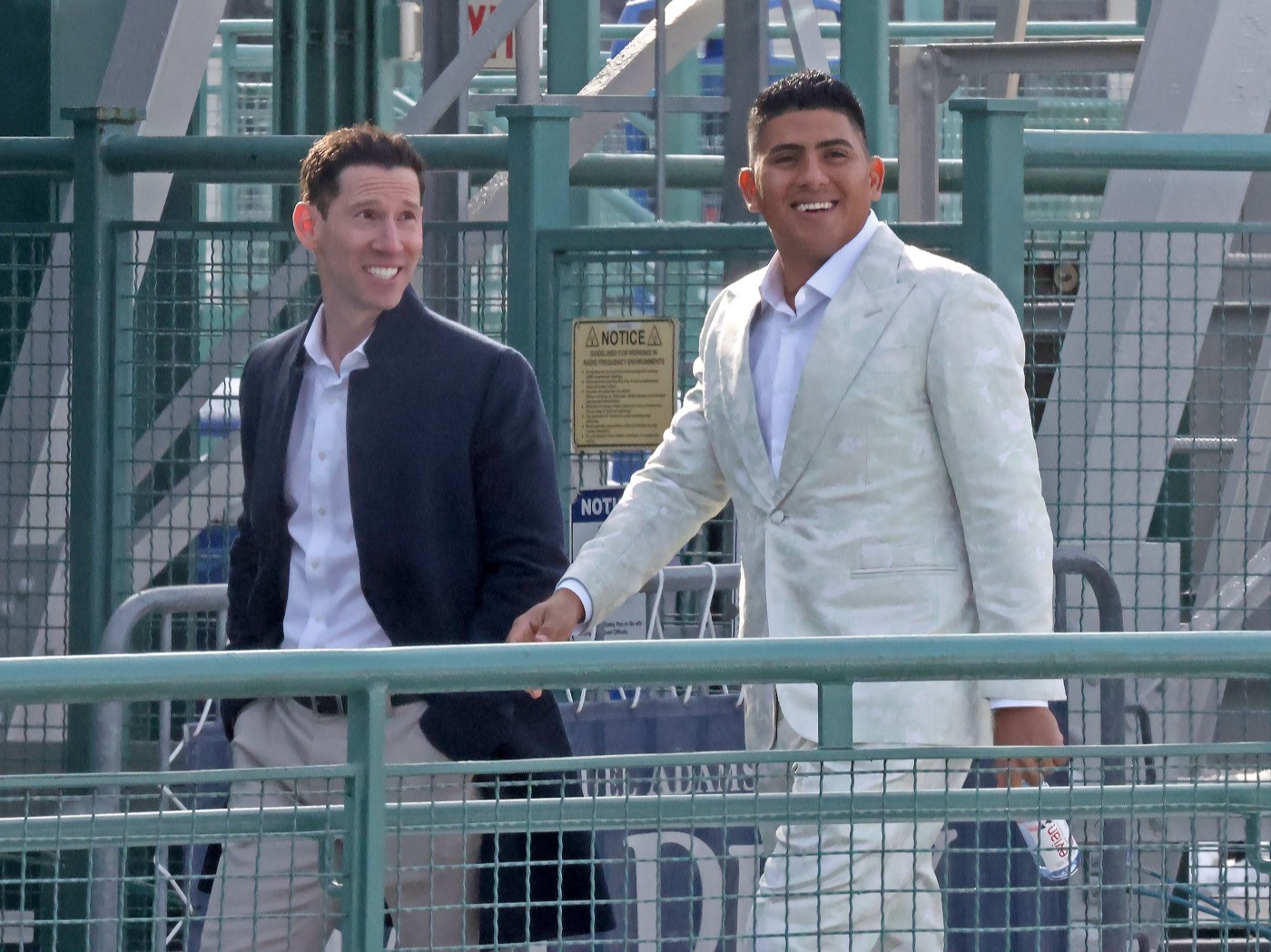
Ranger Suárez laughs during the press conference as the Red Sox introduce him to the media. (Staff photo by Stuart Cahill/Media News Group)
In the final two months of the season, he transformed from a reliever who averaged 1.5 innings and 22.1 pitches in 27 appearances, to a starter who tossed a complete-game shutout in his penultimate start of the season. A ‘Maddux,’ to be precise: a complete-game shutout on fewer than 100 pitches.
He posted a 1.12 ERA as a reliever that season, and a 1.51 ERA as a starter. Among 185 lefties with at least 30 innings of work that season, his .129 opponent slugging percentage was at least 47 points better than everyone else.
And he made all of it look easy.
“It was actually pretty easy,” Suárez said, via translator, of transitioning from the bullpen to the rotation. “Whenever I would train, it was with the mindset of a starting pitcher. Everything that I would do leading up to games would be in that way.”
“The sheer talent,” Breslow said when he recalled what stood out to the Red Sox as they gathered information from Suárez’s friends, teammates, coaches and others who know him around the baseball world. “A number of people said that Ranger was the type of guy who could roll out of bed and throw a bullpen and not miss a single spot. And I think our industry has moved away from that type of pitchability and guile.”
All of these qualities and experiences make Suárez well-positioned to handle the perennially fiercely-competitive American League East, and baseball’s most storied rivalry. When the Red Sox and Yankees meet this year, he will go up against former NL East foe Max Fried, who tossed his own Maddux within 24 hours of Suárez’s.
Suárez’s earliest baseball memories are of watching the Red Sox and Yankees on TV in his native Venezuela. All of his friends rooted for New York, but he felt drawn to their underdog rivals.
“He had told me that, ‘My friends rooted for the Yankees, but I always rooted for the Red Sox,’ ” Boras said. “So I knew that there was always an interest, an organic interest, that he had here.”
“Everyone was going for the Yankees, and I asked, ‘Why is no one going for Boston?’ ” Suárez echoed. “That’s where the interest started.”
The Red Sox were in a similar predicament this offseason. By early January, they were the only club without a dollar spent in major league free agency. Top targets kept choosing other teams. Over the last two years, the Red Sox had made multi-year offers to top free agents, including Juan Soto, Fried and Pete Alonso, and secured none of them. Alex Bregman, another Boras client, chose a five-year deal with the Chicago Cubs rather than re-signing with the Red Sox.
Then, like he had as a young boy, Suárez chose Boston.
“I was made aware of the history of the team, and hearing about how Babe Ruth pitched here and played here, and how you hear about Pedro Martinez and David Ortiz and all of the legends that have come through here,” Suárez said. “That’s what really captivated me about this opportunity.”
“When you come here to Fenway Park and you have a chance to pitch on the same mound that Pedro Martinez, Roger Clemens, Babe Ruth threw off of, you get that energy from that experience, and it’s just something that motivates you to want to give your little grain of sand into what is a bigger history.”


More Stories
Trouble brewing in global bond markets: What to know
Yields on government bonds are around multi-decade highs as investors cast a wary eye on fiscal deficits and the renewed...
World’s biggest wealth fund eyes ditching $80 bn in US Treasuries
Norway’s proposed cut comes as Washington faces rising deficits and shrinking demand for its debt Norway’s $2.3 trillion sovereign wealth...
Europe’s biggest carmaker to shed 100,000 jobs in historic overhaul
Volkswagen will cut out roughly one in seven workers and could shut four German plants German car giant Volkswagen is...
Jackdaw gas field approval expected in mid-September, sources say
The UK government is expected to approve the Jackdaw gas field off the coast of Aberdeen in mid-September, according to...
Uber launches London’s first self-driving taxis with 15 Wayve cars
Londoners can hire self-driving taxis for the first time after Uber added rides in Wayve’s autonomous vehicles to its app...
OpenAI releases Astra model and claims ‘new era’ of AGI has begun
OpenAI released its latest model, Astra, on 3 September, describing it as the “world’s most intelligent and aligned model”, and...