
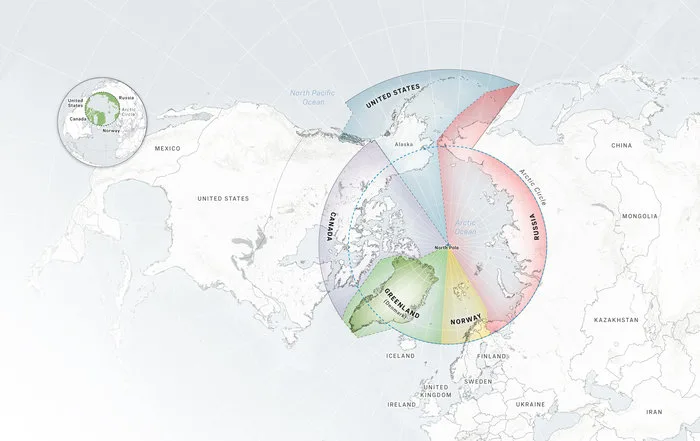
Why Greenland Is Vital for US to Counter China and Russia

By John Haughey and Autumn Spredemann
U.S. President Donald Trump has said that the United States must purchase, annex, or, if necessary, militarily seize Greenland “for the purpose of national security” before Russian or Chinese interests are entrenched in the area.
The autonomous Danish territory straddles key sea lanes, including trans-Arctic shipping corridors, and is rich in critical minerals and rare earths.
Trump has said that “whether they like it or not,” Greenland will soon belong to the United States. Possible scenarios include Greenland becoming a U.S. territory, such as the Virgin Islands, or a freely associated state in a compact with the United States.
The United States has similar compacts with Micronesia, the Marshall Islands, and Palau, granting them substantial economic aid, while the United States has authority over security and defense.
The president first expressed his intention to buy Greenland in 2019, and the second Trump administration has voiced increased urgency in incorporating the world’s largest island.
U.S. Vice President JD Vance and U.S. Secretary of State Marco Rubio met with Danish and Greenlandic officials on Jan. 14. After the meeting, Danish Foreign Minister Lars Lokke Rasmussen called it a “frank but also constructive discussion” and said disagreements remain.
The Trump administration is also backing mining projects in Greenland, focusing on the island’s rare earths.
Incorporating Greenland—nearly 50 percent bigger than Alaska and three times the size of Texas—would be the largest territorial expansion in the nation’s history.
Competing for Dominance
Trump has consistently expressed concern about the Russian and Chinese presence in the region.
In 2007, Russia planted a Russian flag on the North Pole seabed. Since that time, it has revitalized more than 50 old Soviet military installations. The Russian presence in the Arctic now includes six army bases, 10 radar stations, 14 airfields, and 16 deep-water ports.
“It is important to consistently strengthen Russia’s positions in the Arctic, comprehensively develop our country’s logistics capabilities, and ensure the development of a promising Arctic transport corridor from St. Petersburg to Vladivostok,” Russian President Vladimir Putin said in November 2025.
Russia’s coast frames more than half the Arctic Ocean, and it has more icebreakers, including nuclear-powered ice-crushers, than the rest of the world combined, according to an August 2025 report from the Atlas Institute for International Affairs.
The United States, in contrast, has no bases directly on the Arctic Ocean. It has five bases in the Arctic, four in Alaska, and Pituffik Space Force Base in Greenland.
The Russian nuclear-powered icebreaker at the North Pole on Aug.18, 2021. Russia has more than 60 icebreakers, while the United States only has two, according to Rep. Mike Waltz. Ekaterina Anisimova/AFP via Getty Images
Eric Cole, a former CIA officer and CEO of Secure Anchor, said the importance of Greenland from a national defense perspective is no small matter and will increase with time.
“Greenland’s geographic position places it directly beneath the shortest flight paths between North America, Europe, and Eurasia, making it a natural vantage point for monitoring air and missile activity,” Cole told The Epoch Times.
“Sensors based in Greenland can track aircraft, space objects, and missile launches that would otherwise go undetected until much later in their trajectory. This early detection is critical for both U.S. and NATO forces, as it expands warning times and improves coordinated response options.”
For land- and space-based defense systems, Greenland has ideal access to the polar orbit because of its geographical location.
“Polar-orbiting satellites are particularly critical for modern intelligence, surveillance, and reconnaissance capabilities because of the unique view these orbits provide of the Earth,” space operations expert Pat Jameson told The Epoch Times.
The region also serves as a hub for fusing data from satellites, radar arrays, and maritime sensors into a unified operational picture, according to Cole.
“As Arctic routes open due to climate change, Greenland’s role as a surveillance anchor only grows,” he said. “In effect, it acts as a forward lookout post for the entire North Atlantic security architecture.”
China in 2018 declared itself a “near-Arctic state,” announcing that it would be “an important stakeholder in Arctic affairs” in building what it called a “Polar Silk Road” access ramp to its global Belt and Road Initiative.
A 2024 RAND Corp. analysis highlighted that the Chinese Communist Party (CCP) has been increasing its Arctic presence since the 1990s, with state-sponsored Chinese companies investing in oil, gas, mineral exploration, infrastructure, and in developing trans-Arctic sea routes.
A map featuring Greenland, Iceland, the Faroe Islands, and Denmark is displayed inside the Greenland Representative’s office in Copenhagen, Denmark, on March 25, 2025. Greenland, which became a Danish colony in the early 19th century, was granted limited self-rule in 2009, allowing the island to run its domestic affairs while preserving Danish control over its defense and foreign policies. Leon Neal/Getty Images
Defense Strategy
Former diplomat and U.S. War Department official Armand Cucciniello told The Epoch Times that Greenland is becoming increasingly important to U.S. defense strategy.
“It has five main strategic and operational benefits to the United States: Positioning early warning radars, space surveillance capabilities, monitoring naval movements in the North Atlantic, access to new shipping routes, and deposits of critical minerals and rare earth elements used in modern technologies,” Cucciniello said.
“With polar ice caps melting, the region is becoming an arena for increased great power competition, most notably with Russia but also China.”
Greenland is framed by the only two waterways linking the Arctic Ocean to the North Atlantic: the Davis Strait on the Baffin Sea to the west, and the Greenland-Iceland-UK Gap in the Denmark Strait on the Greenland Sea to the east.
Thule—now Pituffik Space Base—remains the only official U.S. military installation in Greenland, a key early warning outpost of 150 military personnel within a strategic eye-blink of Russian airbases on Arctic Ocean islands, including Nagurskoye Airbase—where satellite imagery has shown Russian deployment of powerful MiG-31 “Foxhound” fighters.
But now Greenland may even be more important geo-strategically than it was during World War II and the Cold War, analysts say.
The Arctic landscape surrounds the nation of Greenland on May 4, 2025. John Fredricks/The Epoch Times
Trade Routes
Gaining the upper hand on Arctic expanding trade routes could have far-reaching benefits for the United States, according to Juan Carlos Lascurain-Grosvenor, CEO of Grosvenor Square Consulting Group.
Modern supply chains aren’t fragile because of distance but rather concentration, Grosvenor, a commerce and trade analyst, told The Epoch Times.
“Too much trade still depends on a handful of chokepoints and jurisdictions that can be disrupted politically, militarily, or through sanctions,” he said. “Arctic routes offer an additional axis for energy, bulk commodities, and strategic cargo, which in turn reduces systemic risk.
“For European and North American markets, this is less about shaving days off transit times and more about insurance against geopolitical shocks. From a pricing standpoint, even the existence of alternative routes lowers risk premia over time. That matters to insurers, lenders, commodity traders, and governments alike.”
The real economic impact of a U.S. acquisition of Greenland would be in “sovereign supply planning” for commodities such as liquified natural gas and critical minerals, according to Grosvenor.
Ocean trade is widely considered the backbone of the global economy because it’s the most cost-effective way to move bulk amounts of heavy goods. Cooperation or control over what are often referred to as “maritime chokepoints”—such as the Panama and Suez canals—is vital, he said, especially because hostile regimes can restrict access to these critical waterways and drive up the cost of goods or create shortages.
A Royal Danish Navy vessel prepares to dock in the city of Nuuk, Greenland, on May 4, 2025. President Donald Trump has been pushing since 2019 for the United States to incorporate the world’s largest island. John Fredricks/The Epoch Times
Should Russia or China be allowed to “set the rules in the Arctic,” the macroeconomic consequences could be negative and long-lasting, according to Grosvenor.
“Russia has already demonstrated that it treats energy, logistics, and geography as political weapons. China uses infrastructure control and financing dependency to lock in influence over decades,” he said. “Neither model produces efficient markets, transparent pricing, or legal certainty, all of which global trade and capital markets require.”
Military and commercial traffic has increased significantly in two intermittent Arctic sea lanes in the past two decades: the Northwest Passage that skirts the Canadian Arctic coast and the Northern Sea Route, which spans Russia’s vast Arctic shorelines.
The 900-mile Northwest Passage is only reliably open for short windows, but transit lanes increase as ice shields decrease.
From 1906 to 2006, there were only 69 complete transits through the Northwest Passage, according to a report from Harvard’s Belfer Center for Science and International Affairs. That number was matched in the next five years alone, with 69 full voyages taking place between 2006 and 2010.
More than a dozen ships made the passage in 2023, with a similar number in 2024, a Canadian International Council analysis reported in December 2025.
By the 2030s, commercial cargo ships may be able to reliably sail through the Northwest Passage and other parts of the Arctic Ocean without icebreaker escorts for increasingly longer spans, according to the University of Fairbanks Center for Arctic Policy Studies.
The international legal status of the Northwest Passage is disputed, the Harvard report notes. The United States asserts that it constitutes an international strait, while Canada claims sovereignty over the entire passage, which trims nearly 3,500 nautical miles off ocean cargo shipping from western Europe to Asia via the Panama Canal.
Canadian Brigadier-General Daniel Riviere, commander of the Joint Task Force North, shows the closeness between the Canadian Arctic and other northern nations in Yellowknife, Northwest Territories, Canada, on Jan. 23, 2025. The area represents 40 percent of Canada’s territory and 75 percent of its coastline. Ottawa has just announced a buildup of its military and diplomatic presence to reinforce its claim to region. It is essential for Canada to act now, because “the Northwest Passage will become a main artery of trade,” Riviere said. Sebastien St-Jean/AFP via Getty Images
Russia supports Canada’s claims, according to the report, because of its own sole-possession claim to the 3,500-mile Northern Sea Route.
Its fleet of eight nuclear-powered icebreakers is keeping the route clear for increasingly long spans, according to Russian nuclear energy corporation Rosatom.
Moscow is marketing the sea lane as a time-is-money alternative to the Suez Canal, reducing sailing time between Europe and Asia by up to 50 percent, according to a report from the Arctic Institute.
Russia and China are cooperating to develop arctic sea routes, including the development of the Transpolar Sea Route, a direct route across the North Pole that would be shorter and deeper than the Northwest Passage or Northern Sea Route. A Chinese icebreaker was one of the first ships to use this route in 2012.
Rare-Earth Minerals
While Trump has stressed Greenland’s importance to U.S. national security in the context of geo-strategic competition with Russia, analysts say its geology makes it important in the context of usurping the CCP’s dominance of global metals and minerals markets.
Investing in Greenland would perch U.S. assets near rapidly expanding sea lanes, challenging Russia’s dominance and disrupting China’s polar ambitions by placing U.S. interests on top of potentially lucrative critical mineral deposits.
China-based processors dominate the global market for critical minerals. The United States relies entirely on China for 15 of the 54 commodities on the U.S. Geological Survey’s recently updated Critical Minerals List. It relies partially on Chinese imports of at least 31 more.
China produces more than 70 percent of the world’s processed metals and 90 percent of the rare earths needed by U.S. manufacturers and defense contractors.
Greenland is rich in iron ore, graphite, tungsten, palladium, vanadium, zinc, gold, uranium, copper, and oil.
Geologist Thomas Varming show findings of rare minerals and precious metals on a survey map at the University of Greenland during an interview with AFP in Nuuk, Greenland, on March 5, 2025. Varming said that Greenland had the potential to be a player in making the world less dependent on China for these natural resources but added that climate, infrastructure, and environmental laws make it challenging. Odd Andersen/AFP via Getty Images
But the territory’s estimated 1.5 million metric tons of rare earth elements are attracting the most attention to a harsh environment that is difficult to mine.
Only nine mining ventures have been launched on the island since World War II, according to a report this month from the Center for Strategic and International Studies (CSIS). There are just two operating on Greenland now, the White Mountain anorthosite mine and the Nalunaq gold mine.
At least three planned projects have been proposed to extract rare earths from large deposits in Tanbreez and Kvanefjeld in southwest Greenland.
The Trump administration is backing one, maybe two, of those projects.
In June 2025, the U.S. Export-Import Bank sent a letter of interest to Critical Metals Corp. for a $120 million loan to fund its Tanbreez rare earth mine, according to the CSIS report. The loan, if approved, represents the administration’s first overseas mining investment.
Critical Metals Corp. bought into the project after the United States lobbied Tanbreez to prevent the sale of the deposit to a Chinese buyer.
The city of Nuuk, Greenland, on May 2, 2025. Investing in Greenland would perch U.S. assets near rapidly expanding sea lanes to challenge Russia’s dominance and disrupt China’s polar ambitions. John Fredricks/The Epoch Times
Canada-based Amaroq is negotiating with the Trump administration for U.S. investment in exploring for gold, copper, germanium, gallium, and other critical mineral deposits in Greenland.
Also in June, the European Union designated the Amitsoq graphite project as a strategic project under its Critical Raw Materials Act. In December 2025, Greenland issued a 30-year exploitation license for the Amitsoq deposit to London-based GreenRoc Mining, the third permit granted by Greenland last year.
However, development at the Kvanefjeld site, which contains significant deposits of neodymium, dysprosium, and other rare earths, has stalled since 2019 over concerns about Chinese investment in the project. Although an Australian company, Greenland Minerals, has majority ownership in the project, a Chinese rare earth company, Shanghai Resources, is the largest shareholder and strategic partner in the operation, according to an Atlantic Council report this month.
Officials have also expressed concern that, unlike the Tanbreez area, there is an estimated 270,000 tons of uranium in the Kvanefjeld deposit, making it the eighth-largest uranium deposit in the world, but illegal to mine under Greenlandic law since 2021.


More Stories
Long Story Short Season 2 Is Renewed! Release Date, Plot, and More
Netflix has recently given anime fans a major reason to celebrate by renewing Long Story Short for a new season....
MGA, Curaçao, and German Licences: What the Differences Mean for Users
Choosing an online casino often comes down to one detail most players skim past: the licence badge in the footer....
Is I Will Find You Season 2 Returning? Renewal Status, Cast, and Plot
In 2026, the first season of the popular and most awaited series was released. I Will Find You first dropped...
Top Ahrefs SEO Tools to Boost a Website’s Traffic and Sales
Website analysis has become one of the most useful SEO tools used by several companies nowadays. Ahrefs SEO tool provides...
Planning Group Travel That Doesn’t Fall Apart at the Logistics Stage
Anyone who has organized transportation for a wedding party, a school trip, or a corporate retreat knows the pattern. The...
Black Doves Season 2 is Coming Soon! Release Date, Cast Members, and Production Updates
Good news! The release date for the popular spy-action drama Black Doves Season 2 is out. Keira Knightley is returning...