
Patriots-Texans film review: How Mike Vrabel’s defense paved way to AFC title game

The only deep pass Drake Maye completed Sunday was the knockout blow with less than 13 minutes left.
This is the danger of playing the Patriots now.
Maye can wait and wait and wait, get battered and bruised and blown up. He can even turn the ball over three times. But so long as Maye has time to strike late in a close game, no defense is safe.
The Patriots are bound for the AFC Championship Game because their defense has afforded Maye enough time to work through his mistakes in the first two playoff games of his career, both battles against elite defenses. Maye eventually cracked the Texans, just as he did the Chargers, though if you only studied the tapes of those games, you might think the NFL’s best defense resides in New England.
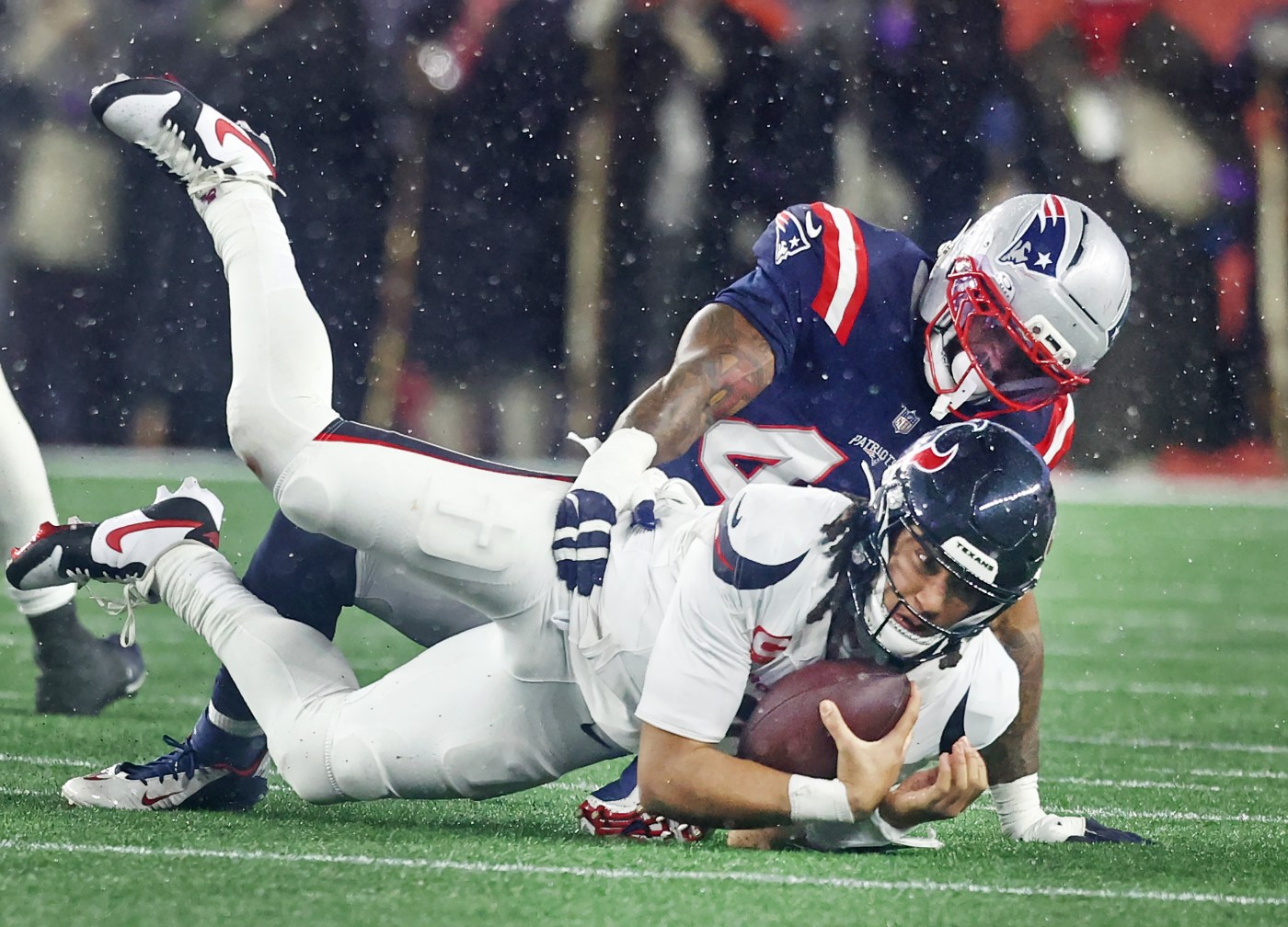
On Sunday, the Pats forced five turnovers. They allowed 3.3 yards per play. They had C.J. Stroud’s empty head spinning with yet another pressure game plan that yielded only one touchdown.
It almost feels as if Mike Vrabel and staff waited all year to spring these blitz traps in the playoffs. But the truth is their defense has been building to this, through growing pains and injuries, all year.
Now, under clever defensive play-caller Zak Kuhr, the Patriots have developed a defense that can bring virtually any kind of game plan to life. So far, a blitz-happy approach has served them well, and it may again in Denver. But if Broncos head coach Sean Payton, a future Hall of Famer and offensive whiz, burns that blitz early, Maye and the offense must patch a few holes the Texans exploited in order to play catch-up.
Otherwise, the Broncos might barrel through them and threaten to run away with an upset. The good news: Maye has the power to carry the Patriots back if need be — so long as he has enough time.
Here’s what else the film revealed about the Patriots’ latest playoff win:
Drake Maye
New England Patriots quarterback Drake Maye throws in the snow during the fourth quarter of the divisional-round game at Gillette Stadium. (Nancy Lane/Boston Herald)
16-of-27 for 179 yards, 3 TDs, INT, 5 sacks, 10 rushing yards
Accurate throw percentage: 65.4%
Under pressure: 1-of-2 for 8 yards, 5 sacks, 8 rushing yards
Against the blitz: 2-of-5 for 34 yards, TD, 1 sack
Behind the line: 6-of-7 for 15 yards
0-9 yards downfield: 7-of-10 for 100 yards, TD
10-19 yards downfield: 2-of-3 for 32 yards, TD
20+ yards downfield: 1-of-6 for 32 yards, TD, INT
Notes: A pedestrian day for Maye with big-time touchdown throws balanced by glaring mistakes.
He backed his way into a disastrous strip sack in the first quarter. He fumbled three more times, including a scramble where he failed to protect the ball after havving already lost it. He missed a few layups in the first half, throwing short of Kayshon Boutte and TreVeyon Henderson and posted his lowest accurate throw percentage of the season.
Some of that percentage was driven by repeated sideline shots against single coverage, a rare weak spot in Houston’s defense Maye was wise to pick at considering that’s how he found Boutte for the knockout score. That was one example of Maye picking the right matchups. His most frequent target was Stefon Diggs and DeMario Douglas working against Texans safeties in the slot, where Maye threw his first two touchdown passes.
It’s hard to estimate the mental toll his three fumbles took over the course of the game, and Maye admitted the snowy conditions affected his accuracy. Even so, Maye was asked to execute a straightforward game plan, and knew ball security was at a premium against this defense. Five sacks and three fumbles is not a good day at the office, but considering he ripped three pinpoint touchdown throws, it certainly wasn’t a bad one, either.
Critical areas
New England Patriots cornerback Marcus Jones celebrates his pick-six with Robert Spillane, Craig Woodson and Jaylinn Hawkins during the second quarter of the divisional-round game at Gillette Stadium. (Nancy Lane/Boston Herald)
Turnovers: Patriots 3, Texans 5
Explosive play rate: Patriots 6.3%, Texans 2.8%
Success rate: Patriots 33%, Texans 33%
Red-zone efficiency: Patriots 1-1, Texans 1-4
Defensive pressure rate: Patriots 34.6%, Texans 24.2%
Offense
Game plan
Personnel breakdown: 45% of snaps in 11 personnel, 30% of snaps in 21F personnel, 16% of snaps in 12 personnel, 5% of snaps in 22 personnel, 4% of snaps in jumbo personnel.***
Personnel production: 31% success rate in 11 personnel, 31.5% success rate in 21F personnel, 50% success rate in 12 personnel, 0% success rate in 22 personnel, 0% success rate in 13 personnel, 0% success rate in jumbo personnel.
First-down down play-calls: 76% run (37% success rate), 24% pass (75% success rate)
Play-action rate: 30.3%
Josh McDaniels hit most of the right buttons. They just didn’t budge.
He took aim at one of Houston’s few weaknesses by calling running back screens on two of the Patriots’ first four dropbacks. Those screens gained a total of seven yards.
McDaniels cranked up his play-action rate over 30%, an effort to slow down Texans Pro Bowl pass rushers Will Anderson and Danielle Hunter with play design. Maye went 6-of-8 off play-action, but only picked up three first downs and took two sacks. Even McDaniels’ attempts to wear down Houston’s pass rush by running straight at it, with a season-high 76% run rate on first down, mostly failed. Picking on Texans No. 2 corner Kamari Lassiter (one allowed catch) didn’t work, either.
Callahan: Patriots carrying dynasty-era feel on return to AFC title game
But like his players, McDaniels delivered often enough in big moments, starting with a perfect fourth-and-1 play-call that sprung Douglas for a 28-yard touchdown against man coverage. McDaniels created a 1-on-1 for Diggs on his touchdown using the same two-man route combination on Douglas’ score, slant-flat, which also yielded a 25-yard connection with Boutte. Once Boutte scored in the fourth quarter, McDaniels pivoted to the jumbo packages that have served the Patriots well since their bye week and killed clock with six straight runs on a 10-play drive.
Quibbles: Will Campbell (two sacks allowed) deserved more varied help in pass protection, the Pats should have tried a few more max-protect passing plays and no trickery?
Player stats
Broken tackles: RB Rhamondre Stevenson 6, QB Drake Maye 2, WR Kayshon Boutte
Pressure allowed: LT Will Campbell (2 sacks, QB hit, hurry), RG Mike Onwenu (QB hit), LG Jared Wilson (hurry), Maye (sack), Team (2 sacks)
Run stuffs allowed: Team 6, C Garrett Bradbury, OT Thayer Munford, FB Khyiris Tonga
Drops: WR Kyle Williams
Foxboro, MA – New England Patriots wide receiver Stefon Diggs reacts during the fourth quarter of the Divisional Round game at Gillette Stadium. (Nancy Lane/Boston Herald)
Notes
The two biggest battlegrounds of this matchup were set before kickoff: the Patriots’ offensive line versus Pro Bowl pass rushers Will Anderson and Danielle Hunter and their wide receivers against Houston’s man-to-man coverage.
The Pats lost the battle against Anderson and Hunter (see: five sacks), but overcame the Texans in man coverage. Pulling out a draw against that defense is a win.
Credit to the coaching staff for calling on DeMario Douglas (26% of offensive snaps played) on fourth-and-1 early in the game. Douglas is one of their best weapons against man-to-man, and he proved it there.
Overall, Maye went 7-of-10 for 100 yards and three touchdowns versus man, a massive improvement from the offense’s showing against the Chargers. The wide receivers accounted for four of those catches for 85 yards and all three touchdowns. Huge performance.
Kayshon Boutte’s catch was a testament to Maye’s determination to continue attacking deep, and his raw talent. Boutte’s ball-tracking is up there with almost any other receiver in the league, and his yards after catch on a slant was a nice bonus.
Rhamondre Stevenson matched a season-high with six broken tackles. His mix of patience and power, plus his patented jump cut, is driving one of the best stretches of his career.
TreVeyon Henderson, on the other hand, could learn from Stevenson’s patience. And if you’re wondering why he didn’t play more, re-watch a few of his runs and note only two of his snaps were in pass protection; a sign the coaching staff still doesn’t fully trust him there.
Quiet days for tight ends Hunter Henry and Austin Hooper as receivers, but both had their moments as run-blockers. Hooper helped spring Stevenson for an early 20-yard run with his block on the edge.
Rough, rough day for Will Campbell. Anderson is among the best edge rushers in the league, but these were instant strip sacks he allowed and hard hits. The Pats need more from their rookie left tackle.
Garrett Bradbury got blown up on his run stuff, but otherwise handled himself against an underrated group of Texans defensive tackles.
Keep an eye on Morgan Moses this week, after he briefly left the game again due to injury. Moses was outstanding against Houston, and may be their most underrated offensive player this season.
Defense
New England Patriots defensive linemen Leonard Taylor III, Khyiris Tonga and K’Lavon Chaisson celebrate sacking Houston Texans quarterback C.J. Stroud during the fourth quarter of the divisional-round game at Gillette Stadium. (Nancy Lane/Boston Herald)
Game plan
Personnel breakdown: 64% three-corner nickel package, 19% base defense, 14% dime, 3% goal-line.****
Coverage breakdown: 67% zone, 33% man
Blitz rate: 36.5%
Blitz efficacy: 22% offensive success rate and 3.8 yards per play allowed
Take a bow, Zak Kuhr.
The Patriots defense has allowed just two touchdowns in two games by opening up their playbook and leaning into their pressure packages in ways they rarely did during the regular season. On Sunday, Kuhr dialed up almost everything a play-caller can: man-blitzes, zone-blitzes, simulated pressures, zone-match coverage, regular man-to-man and traditional spot-drop zone. On separate snaps, the Patriots rushed three, four, five, six and seven defenders, using linebackers, cornerbacks and safeties as blitzers.
One of their few tendencies was playing from a five-man front on early downs and playing man coverage behind it, a way to force an overmatched O-line to block 1-on-1 and combat the Texans’ bootleg play-action passes. Kuhr spung the dial on third down without ever straying too far from his blitz package. He knew Houston quarterback C.J. Stroud would melt under pressure, and turned the heat up accordingly.
Stroud went 2-of-16 for 18 yards with an interception and three sacks under pressure. He finished 6-of-18 for 67 yards, one touchdown and two interceptions against the blitz. Late in the second half, Kuhr backed off the blitz some and called more Cover 2 to reduce the chances of a breakaway touchdown that could fast-track Houston’s comeback efforts.
But credit to Kuhr for sticking with his pressure plan most of the night, especially after Stroud beat a man-blitz for a touchdown in the first half. Clearly, he had the right idea.
Notes
Foxboro, MA – New England Patriots’ Alex Austin and Christian Elliss converge on Las Vegas Raiders wide receiver Jakobi Meyers during the third quarter of the game at Gillette Stadium. (Nancy Lane/Boston Herald)
Interceptions: CB Carlton Davis 2, CB Marcus Jones, S Craig Woodson
Forced fumbles: CB Christian Gonzalez
Pressure: OLB K’Lavon Chaisson 4 (sack, 2 QB hits, hurry), DL Khyiris Tonga 2 (sack, QB hit), OLB Anfernee Jennings 2 (sack, hurry), DL Christian Barmore 2 (QB hit, hurry), DL Milton Williams 2 (2 hurries), Woodson (QB hit), LB Robert Spillane (hurry), OLB Elijah Ponder (hurry), DL Cory Durden (hurry), S Jaylinn Hawkins (hurry), Team (hurry)
Run stuffs: Team 6, OLB Harold Landry, Barmore
Pass deflections: Davis 2, Woodson, 2, Gonzalez, Jones, Chaisson, Spillane, Elliss, S Dell Pettus
Missed tackles: Spillane 2, Barmore, Elliss, LB Jahlani Tavai
Notes
The Patriots secondary finally flexed all of its muscles with a season-high 14 pass breakups, squeezing routes in zone coverage and blanketing receivers in man-to-man. The defensive back play, combined with Kuhr’s aggressive pressure calls, explained Sunday’s dominance.
Case in point: the Pats posted a 50% pressure rate when blitzing, and that pressure was cut in half whenever they rushed three or four defenders.
After the Texans’ opening drive stalled out, the Pats allowed one of two explosive plays they gave up on a coverage bust, then forced a field goal on the next series by dropping eight on third-and-goal, which flustered C.J. Stroud. On the following drive, Carlton Davis out-foxed Stroud for his first interception of the game and season.
On a perfect rep of quarters coverage, Davis initially traveled with an in-breaking post route from outside the numbers then zipped back to the sideline while following Stroud’s eyes. There, he laid out to catch an overthrow for his first pick of the game and season.
Stroud finished the next possession, a short, 27-yard march, with a touchdown pass that beat a man-blitz. But his poor response to pressure caused most of the ensuing turnovers, starting with Marcus Jones’ interception and the tipped ball Craig Woodson snared over the middle. Davis’ tight coverage later helped him grab another pick triggered by a bad Stroud decision.
Almost equally important as the turnovers was the Pats’ ability to eliminate explosive pass plays. Unable to strike deep off play-action or run the ball consistently, the Texans played in a box they couldn’t escape except for two series.
On those drives, Houston picked up 42 yards on a checkdown against Jones’ coverage bust during the second drive. Later, on their opening possession of the second half, the Texans generated decent push in the run game en route to a field goal attempt.
Related Articles
Patriots’ Kayshon Boutte didn’t know extent of his highlight-reel TD until replay
Patriots-Broncos AFC Championship Game could have looked a lot different
Patriots, Mike Vrabel provides injury update on starting wide receiver
Callahan: Patriots carrying dynasty-era feel on return to AFC title game
Patriots’ Drake Maye has humble take on Kayshon Boutte’s highlight TD
But that rushing success was a flash in the pan against a Patriots defense that stuffed more than 36% of all hand-offs and yielded 2.2 yards per carry. Houston’s shaky and banged-up offensive line had little chance of asserting itself against Milton Williams and Christian Barmore, who controlled the middle most of the game.
The Pats didn’t even bother to meet the Texans’ packages with six O-linemen with base personnel (four defensive backs) on every snap, sometimes matching them with their preferred three-corner nickel grouping.
Their best run defenders included Christian Elliss, Milton Williams, Anfernee Jennings, Khyiris Tonga and even Davis, who contributed to one run stuff. Tonga’s return gave the Pats needed depth and a consistent push in the middle of Houston’s O-line.
Elliss was especially patient waiting for Houston running back Woody Marks to pick a lane before he crashed into the backfield. Elliss was the tip of the spear on two run stuffs. His issues overrunning plays feel like ages ago.
Christian Gonzalez allowed Houston’s second and final explosive play on a 23-yard, back-shoulder throw in the third quarter. Gonzalez allowed four total catches in single coverage, but also had a pass breakup, plus the forced fumble.
It’s hard to stress enough how poorly Stroud played. He threw an on-target pass on just half his attempts, and risked a turnover on a half-dozen plays. Sheesh.
*Explosive plays are defined as runs of 12-plus yards and passes of 20-plus yards.
**Success rate is an efficiency metric measuring how often an offense stays on schedule. A play is successful when it produces positive EPA (Expected Points Added).
***11 personnel = one running back, one tight end; 12 personnel = one running back, two tight ends; 13 personnel = one back, three tight ends; 21 personnel = two backs, one tight end; 21H = two halfbacks, one tight end; jumbo personnel = two backs, two tight ends, six offensive linemen.
****Base defense = four defensive backs; nickel = five; dime = six, dollar = seven.

More Stories
Marcos Neves Rodrigues: leading Florida’s hotel floor with a manager’s eye for detail
Rodrigues started in entry-level guest services, working front desks and reservations desks before moving into supervisory roles. From there he...
Ian Reight: bringing surgical leadership to Mount Vernon, Maine
That early work shaped how he thinks about pressure, teamwork, and staying calm when something goes wrong. Reight studied psychology...
Reed names five young founders as first entrepreneurs fund winners
Reed, the recruitment company, has named the first five winners of its All About Business Entrepreneurs Fund, with each young...
Paul Smith chairman calls Frasers’ Harvey Nichols takeover ‘dubious’
The executive chairman of Paul Smith has questioned the ethics of Frasers Group’s £43.3m takeover of Harvey Nichols, completed through...
UK business owners face fourth-highest tax bill of 13 major economies
A business owner in the UK taking £160,000 a year in salary and dividends would face the fourth-highest overall tax...
Chemify secures £22m public backing for £89.9m Glasgow expansion
Glasgow-based digital chemistry company Chemify has secured £22m of public funding towards an £89.9m expansion that it says will create...