

Letters to the editor

Martin Luther King, Jr.
In 1983, President Ronald Reagan signed a bill making the third Monday in January a federal holiday to remember and celebrate the life of Martin Luther King, Jr.
Martin Luther King, Jr. knew racism and experienced discrimination. He knew Rosa Parks, and led a year-long boycott following her arrest for refusing to give up her seat to a white man.
In 1965, King marched from Selma to Montgomery with John Lewis who was later elected to Congress. MLK led the march that is remembered as “Bloody Sunday” when state troopers brutally attacked hundreds of protesters with clubs and tear gas. Lewis suffered a fractured skull and nearly died.
The Selma march was one of many protests King led in support of desegregation, the rights of Blacks to vote, their rights in the labor force, and other basic civil rights. His efforts influenced the 1964 Civil Rights Act and the 1965 Voting Rights Act.
Dr. King was arrested 29 times for his activism. He was the victim of 4 serious assaults. One was a knife attack in which he was stabbed in the chest and spent weeks in the hospital recuperating from his injury.
Martin Luther King’s crusade against racial injustice was inspired by Mahatma Gandhi, credited with leading India’s struggle to gain independence from the British Empire in 1947. Gandhi used nonviolent protests, marches, and economic boycotts to undermine the British-installed government. Eventually, it led to British withdrawal. Martin Luther King refined Gandhi’s use of nonviolent resistance and applied them to his mission to pursue the ideals of freedom and equality in America.
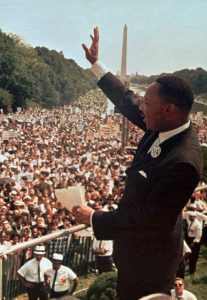
In 1963, Dr. King led 250,000 followers in a march to the Lincoln Memorial. On the Washington Mall he delivered his “I Have a Dream” speech. That day King’s words crossed racial, ethnic, and religious lines as it reached the hearts and minds of people of all colors.
Dr. King’s message of equality was taken from the Declaration of Independence which proclaims that all people are created equal and endowed by their creator with certain unalienable rights including “life, liberty and the pursuit of happiness.” His message is written in the Bill of Rights which guarantees the civil rights of all people. King’s dream is that no person be judged by the color of their skin. This is a fundamental right guaranteed by the U.S. Constitution. Martin Luther King gave his life in pursuit of these rights. He was assassinated on April 4, 1968 at the age of 39.
Like the greatest of American freedom fighters, Dr. King did not seek fame and glory, rather he sought racial equality and justice for millions of Black Americans.
King’s death came 20 years after the death of Mahatma Gandhi. It is a tragic irony that both men preached nonviolence, civil disobedience, and social justice, and both men were assassinated for their beliefs.
Donald P. Whitney
Springfield

More Stories
Why Corporate Video Production Matters More Than Ever for UK Businesses
The challenge is no longer simply whether to use video, but how to create content that feels credible, supports a...
How Gambling Affiliates Can Make Trust Part of the Business Model
For publishers and gambling businesses, the challenge is to make that relationship clear without losing the useful analysis that brought...
Getting to know you: Oliver Corrigan, managing director, WorkWell
Oliver Corrigan is the founder and managing director of WorkWell, a Yorkshire provider of serviced offices, co-working space, meeting rooms...
Getting to know you: Stefano Maifreni, founder, Eggcelerate
Stefano Maifreni is the founder and director of Eggcelerate, a London-based practice that acts as a fractional COO and CCO...
Simple Steps To Take To Make Your Business Premises More Appealing To Customers
A neglected entrance, dirty windows, or a poorly maintained exterior can make even a successful business appear less professional than...
Britain should scrutinise Gulf capital, not squander it
That ‘twitch’ became evident for the second time in a month this week, this time over the United Arab Emirates’...