
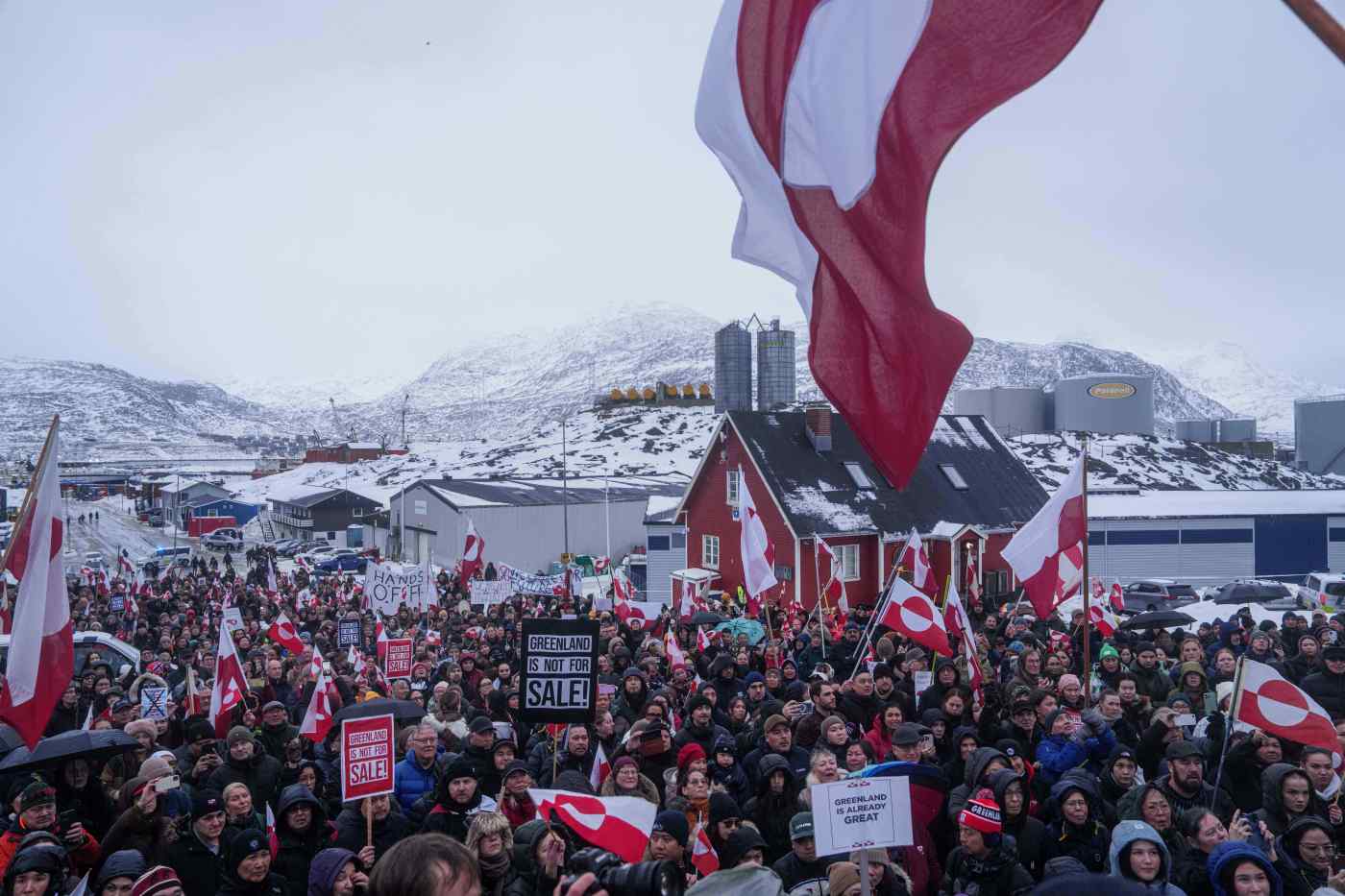
‘Downward spiral’: EU nations targeted by Trump blast Greenland tariffs

BERLIN — The eight European countries targeted by U.S. President Donald Trump for a 10% tariff for opposing American control of Greenland blasted the move Sunday, warning that his threats “undermine transatlantic relations and risk a dangerous downward spiral.”
The joint statement by some of America’s closest allies signaled a possible turning point in the recent tensions over sovereignty and security nearly 24 hours after Trump’s threat.
It was also the most forceful rebuke of Trump from the European allies since he returned to the White House almost a year ago. In recent months, Europeans have mostly opted for diplomacy and flattery, even when seeking an end to the war in Ukraine.
Sunday’s statement, as well as some European countries sending troops to Greenland for a Danish military training exercise, appeared to be a step away from that strategy.
The unusually strong joint statement from Denmark, Norway, Sweden, France, Germany, the United Kingdom, the Netherlands and Finland said troops sent to Greenland for operation “Arctic Endurance” pose “no threat to anyone.”
Trump’s tariff announcement sets up a potentially dangerous test of U.S. partnerships in Europe. He appeared to indicate that he was using the tariffs as leverage to force talks over the status of Greenland, a semiautonomous territory of NATO ally Denmark that he regards as critical to U.S. national security.
“We stand in full solidarity with the Kingdom of Denmark and the people of Greenland,” the group said. “Building on the process begun last week, we stand ready to engage in a dialogue based on the principles of sovereignty and territorial integrity that we stand firmly behind. Tariff threats undermine transatlantic relations and risk a dangerous downward spiral.”
There are immediate questions about how the White House could try to implement the tariffs because the European Union is a single economic zone in terms of trading. It was unclear, too, how Trump could act under U.S. law, though he could cite emergency economic powers that are currently subject to a U.S. Supreme Court challenge.
EU foreign policy chief Kaja Kallas said China and Russia will benefit from divisions between the U.S. and Europe. She added in a post on social media: “If Greenland’s security is at risk, we can address this inside NATO. Tariffs risk making Europe and the United States poorer and undermine our shared prosperity.”
Europe has been trying to keep Trump on its side to ensure U.S. support for Ukraine, including Washington sharing intelligence with Kyiv and its involvement in security guarantees if a peace agreement is reached with Russia.
Rasmus Søndergaard, a senior researcher at the Danish Institute for International Studies, called Trump’s announcement “unprecedented” because tariff threats normally stem from trade disagreements, not territorial disputes between allies.
“That’s of course why we’re seeing the response from European countries saying ‘enough is enough,’” he said. “I think there’s in part probably a strategic calculation, of course, from the governments in these countries that if you give in to Trump on this, what will be the next thing?”
The tariff announcement also drew blowback from Trump’s populist allies in Europe.
Italy’s right-wing premier, Giorgia Meloni, considered one of Trump’s closest allies on the continent, said she had spoken to him about the tariffs, which she described as “a mistake.”
Jordan Bardella, president of Marine Le Pen’s far-right National Rally party in France and a European Parliament lawmaker, posted that the EU should suspend last year’s tariff deal with the U.S., describing Trump’s threats as “commercial blackmail.”


More Stories
Why Private Health Insurance Has Never Mattered More to UK Employees
There is a version of this conversation that HR professionals have been having for years. Private health insurance is a...
Call blocker firm fined £190,000 for making the nuisance calls it claimed to stop
A company that sold call-blocking devices to elderly people has been fined £190,000 after the regulator found it was responsible...
Karl D’Angelo Santa Rosa: Building Success Through Change
For Karl D’Angelo Santa Rosa, success did not happen all at once. It came through years of learning, hard work,...
Colman’s Mustard put up for sale as Unilever clears path for £48bn McCormick merger
Colman’s Mustard has been put up for sale by Unilever, as the FTSE 100 group moves to head off competition...
Burnham’s business rates adviser called for £9bn tax cut for high streets
Andy Burnham’s new business rates adviser has previously called for up to £9bn of tax cuts for businesses, arguing the...
Loss of cheap energy harmed EU economy – Von der Leyen
The bloc saw oil and natural gas prices soar after it drastically reduced Russian imports over the Ukraine conflict European...