
State’s tax growth forecast barely exceeds inflation rate

State officials agreed Wednesday to build their next annual budgets on the estimate that Massachusetts will collect $44.9 billion in tax revenue, 2.9% more than is expected to come in this year, and also coalesced around a new schedule that delays elimination of the state’s unfunded pension liability.
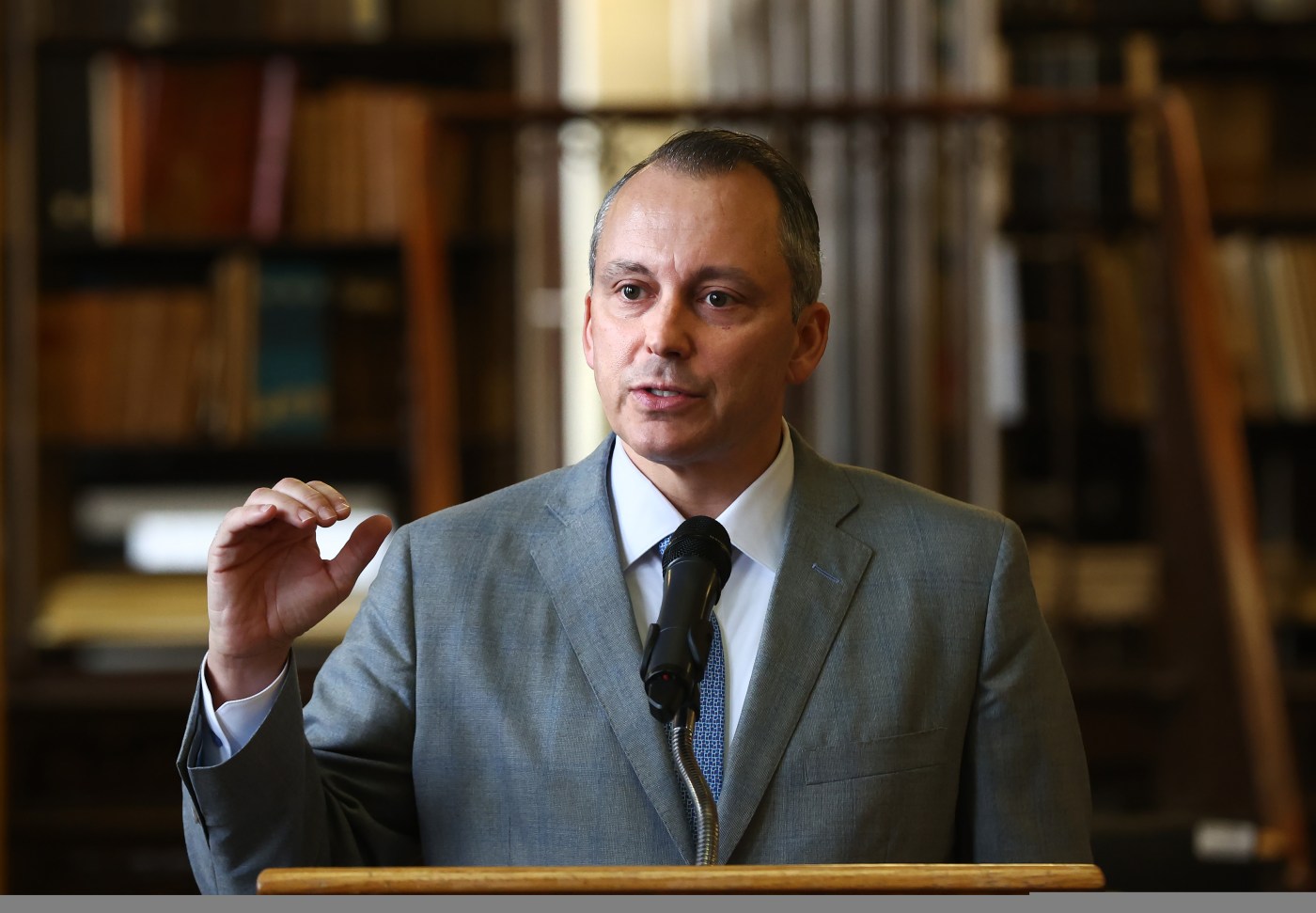
Secretary of Administration and Finance Matthew Gorzkowicz, Senate Ways and Means Chair Michael Rodrigues and House Ways and Means Chair Aaron Michlewitz said their tax estimate agreement includes money coming in from the surtax on high-earning households. Excluding surtax revenue, the agreement foresees $42.2 billion in tax revenue for fiscal year 2027, an increase of 2.4% over the current fiscal 2026 benchmark. The most recent national measure of inflation showed prices rose at an annual rate of 2.7% as of the end of 2025.
The estimate “represents a responsible and sustainable projection for revenues, including the income surtax, that captures growth in our economy as well as the underlying uncertainty caused by actions at the federal level,” Gorzkowicz said. He predicted the agreement would “enable us to present a thoughtful budget that protects key investments and priorities, while also confronting the real challenges of controlling inflation-driven spending growth and putting state finances on a structurally sound path forward.”
Budget managers also agreed to assume $2.7 billion in surtax revenue will come in during fiscal 2027 and to cap surtax revenue spending at the same amount. That would make $300 million more in surtax revenue available for spending compared to the current budget, they said. Massachusetts collected $3 billion from the surtax in fiscal 2025 and that revenue by law is supposed to only be spent on education and transportation.
The consensus revenue agreement was due by Thursday and its architects said it “assumes the full impact of the tax cuts” associated with the federal One Big Beautiful Bill Act, while noting that conversations “continue” about how the state will handle the major tax provisions impacting collections.
Gov. Maura Healey is expected to open the fiscal 2027 budget cycle by releasing her plan by Wednesday, Jan. 28. The House and Senate will redraft Healey’s spending blueprint and debate their own versions, likely in April and May. Fiscal year 2027 begins July 1, 2026, but Massachusetts usually misses its annual budget deadline.
Last year at this time, budget officials agreed on an overall fiscal 2026 consensus tax revenue estimate that anticipated a 4.8% increase above fiscal year 2025, with non-surtax tax revenue growth of 2.2%. Midway through fiscal 2026, tax revenues are up by about 1.9%.
The average projection for revenue growth in fiscal 2027 from experts who testified at a December hearing was 3.9%, according to the Massachusetts Taxpayers Foundation, which estimated that over the last 10 years, excluding two pandemic years, non-surtax budgeted operating tax revenues have grown by an average of 3%.
“An FY 2027 state budget that is built on a revenue base growing at 3 percent will require substantial spending restraint,” the think tank wrote in a December report. “Cost pressures related to health care will require a coordinated state approach to keep spending within reasonable levels of growth, and policymakers must avoid temptations to use one-time reserves to backfill ongoing operating expenses.”
The Massachusetts Budget and Policy Center said the agreement “assumes modest revenue growth (which is a good thing)” but not enough growth to fill gaps left by federal funding cuts and state tax revenue losses.
“Today’s news should create even greater urgency among state lawmakers to close corporate tax loopholes and eliminate other costly tax giveaways to corporations and millionaires,” the organization said. “Lawmakers will need every available dollar to help keep Massachusetts communities and families afloat during the fiscal storm that is gathering.”
Of the $44.9 billion the state expects to rake in during fiscal 2027, an estimated $2.506 billion is projected to come from capital gains taxes. Officials said that would result in $724 million being transferred, as statutorily required of capital gains revenues above a certain threshold, to the Stabilization Fund, pension costs and retiree health insurance expenses.
Gorzkowicz, Michlewitz and Rodrigues also confirmed Wednesday the amounts that will be transferred to entities that have dedicated budget carve-outs. The MBTA will get $1.445 billion ($19 million more than in the fiscal 2026 agreement), the Massachusetts School Building Authority will get $1.284 billion (an increase of $19 million), and $27 million will flow to the Workforce Training Fund (same as in the fiscal 2026 agreement).
There will also be a $5.131 billion transfer to the state pension fund — an increase of $198 million over the fiscal 2026 contribution as originally announced a year ago. The consensus revenue announcement said the fiscal 2027 contribution “keeps the Commonwealth ahead of its statutory obligation to fully fund its pension liability by 2040.”
In every consensus revenue announcement since at least January 2017, budget officials said Massachusetts was “on schedule to fully fund its pension liability by 2036.” After the News Service inquired about the new triennial pension funding schedule that was also due by Thursday, Gorzkowicz’s office provided the new plan, which now puts the state on a path to fully fund its pension liability by 2038 instead.
The triumvirate agreed also on a 3.6% rate of potential gross state product growth for calendar year 2026. That figure is used to set up a health care cost growth benchmark under the 2012 cost containment law.
In an analysis of the state budget challenges of 2026, The Pew Charitable Trusts said Monday that budget decisions states make this year “are likely to be defined by an increasingly perilous long-term fiscal outlook.”
“For some states, the coming year might represent their last opportunity to prepare before budget stress begins in earnest. For others, budget shortfalls have already begun, and lawmakers will need to contend with short-term problems and get ready for long-term ones,” Pew wrote. It added, “State policymakers have been in information-gathering mode for months … Now come the tough decisions about how to bring state budgets back into balance.”
Colin Young is the deputy editor for State House News Service and State Affairs Pro Massachusetts. Reach him at colin.young@statehousenews.com. [Michael P. Norton contributed reporting.]


More Stories
Getting to know you: Toby Spooner, co-founder, METRIX
Toby Spooner is a sport scientist and former personal trainer who co-founded METRIX, an immersive fitness competition in which pairs...
Getting to know you: Conor McKenna, co-founder and CEO, Go Swag
Conor McKenna is co-founder and chief executive of Go Swag, a Glasgow company that sources, stores and ships branded gifts...
Sovereignty concerns raised as Saudi-Sudan maritime delimitation push gains momentum
Sudan has been at war since April 2023, when fighting broke out between the Sudanese Armed Forces (SAF), led by...
Getting to know you: Barry Leahey MBE, president, Playdale Playgrounds
Barry Leahey MBE is President of Playdale Playgrounds, the Cumbrian manufacturer that has designed and installed more than 25,000 playgrounds...
Getting to know you: Paul Corcoran, founder and CEO, Agent
Paul Corcoran is the founder and CEO of Agent, a full-service marketing agency and certified B Corp with studios in...
Getting to know you: Peter Nailer, managing director, CloudCoCo
Peter Nailer is managing director of CloudCoCo Group plc, the AIM-listed IT procurement and e-commerce business. In August 2026 the...