
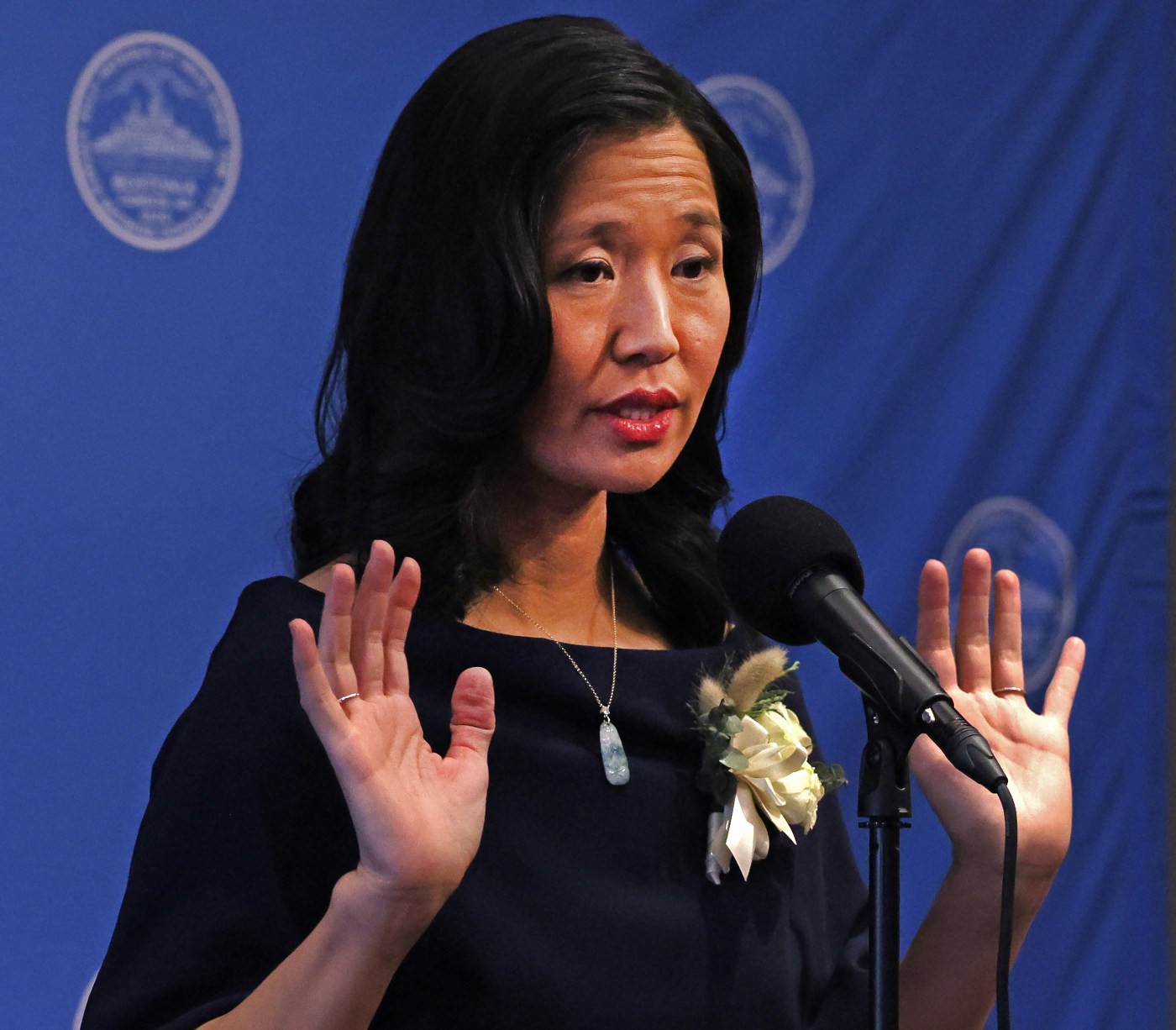
Boston Mayor Wu’s pitch to raise commercial taxes to be voted on by Massachusetts Senate

Familiar battle lines were drawn around Boston Mayor Michelle Wu’s contentious push to raise commercial tax rates to provide residential relief, as the state Senate prepares to take up Wu’s proposal for the first time since killing it in late 2024.
Wu’s tax shift legislation was not advanced by the state Senate, but will be taken up Thursday as an amendment to competing Senate-led tax shock legislation filed by state Sen. William Brownsberger, who helped to kill the mayor’s bill in 2024.
The proposed amendment to Brownsberger’s bill was filed by state Sen. Michael Rush, a Boston Democrat, following a request from the mayor for her “residential tax relief language” to be included in the bill, per Wu’s office. A vote is expected.
“Property tax relief is a pressing issue for my constituents — and residents throughout the state,” Rush said in a statement to the Herald. “On behalf of the people of Boston, I have filed the home rule petition passed by the Boston City Council to provide property tax relief for Boston residents.
“As the Senate considers several worthy proposals designed to address affordability in the Commonwealth, I am glad this proposal will be part of the discussion.”
Boston City Councilor Enrique Pepén, an ally of the mayor, issued a statement Wednesday urging his constituents to reach out to their local senator “to support Senator Rush’s amendment.”
“Over the past week, my office has received a number of alarming and disheartening calls from residents in fear of their rising property taxes,” Pepén said. “This hopelessness has come after months of continual denial of the city’s collaborative proposals from a few lawmakers.
“At a time when we are facing higher costs for housing and everyday necessities, it is critical that our legislators prevent additional financial burdens wherever possible,” the councilor said, adding that Rush’s amendment would “help protect homeowners from a continual property tax increase.”
The mayor’s home rule petition was passed by the City Council and state House of Representatives three times, but was killed by the state Senate in late 2024 and stalled there again all last year.
Senate President Karen Spilka ultimately killed the mayor’s bill due to a lack of support, after state Department of Revenue-certified numbers of city assessing data showed residential tax increases were lower than projected by the city that year.
The mayor’s bill has proven to be unpopular with the business sector, due to concerns that an increase in commercial tax rates would further burden a struggling sector dealing with a post-pandemic decline in property values tied to remote work and empty office space.
The Senate has remained frosty to the mayor’s proposal since Wu renewed her push for the chamber to pass it last month amid a projected 13% tax increase this year for the average single-family homeowner.
Wu’s proposal seeks to shift more of the city’s tax burden from the residential to commercial sector beyond the 175% limit allowed by state law for three years.
Rather than advance the mayor’s bill for debate, the Senate opted this month to advance two alternative tax relief bills filed by Brownsberger and Collins, who co-led the push to kill Wu’s tax shift legislation in late 2024.
The Collins and Brownsberger bills will be voted on during Thursday’s Senate session, along with a number of amendments.
Collins suggested that there’s not much of a path in the Senate for the Rush amendment that mirrors the mayor’s tax shift legislation.
“I think anything that involves a tax increase is going to be difficult,” Collins told the Herald this week. “Especially when the city is sitting on $552 million of what they consider to be free cash, it’s hard to make the case that tax increase is necessary.”
Collins said the city’s decision to hike residential property taxes by double-digits “with so much in the city’s surplus fund” was “unnecessary, unfair and clearly inequitable.”
“To cancel out that tax increase, my legislation would authorize the city to issue direct rebates to homeowners,” Collins said.
Collins said he’s also concerned that the language in Rush’s amendment would make the mayor’s tax shift bill applicable statewide, rather than just in Boston.
While he opposes the tax shift element of the mayor’s proposal, his bill and amendments include other aspects of her stalled legislation.
Collins is pushing for tax rebates for low- and middle-income homeowners who already receive the residential exemption by using surplus funds, along with senior, veterans and small business tax relief provisions.
The mayor added tax rebates to her legislation as a fall-back option last year.
Collins is also a co-sponsor of Brownsberger’s bill, which seeks to shield homeowners from double-digit tax bills, by phasing in increases or offering targeted tax credits in years when property tax hikes are projected to exceed 10%.
The Small Property Owners Association of Massachusetts issued a statement Wednesday calling Wu’s tax shift proposal bad policy, and urged the Senate to approve the alternative tax relief bills and amendments proposed by Collins and Brownsberger.
Related Articles
Boston City Hall agrees to stop inflating commercial property taxes amid lawsuit
It wasn’t me!: Mayor Wu denies influencing Boston City Council president vote
Massachusetts Senate to finally debate Boston Mayor Wu’s contentious tax shift bill
Boston City Council president drama continues as allies of Mayor Wu tapped for key leadership posts
Flynn files resolution on meeting violations during City Council president election, seeking AG’s guidance
The SPOA said the 13% residential tax hike is driven by the city’s assessment practices, saying the “property valuations coming out of City Hall are unjustifiable and pose serious risks to sound fiscal policy and equitable treatment of taxpayers.”
“The high value residential properties are being under-assessed and commercial properties are being over-assessed,” the SPOA said. “This vertical inequity means middle-income homeowners pay a larger share of their home’s value in taxes than those who own Boston’s most valuable properties.
“We commend Senator Collins for offering a bill and solution that delivers real tax relief to families and homeowners while not harming small businesses.”
City officials said the 13% tax spike is driven by a 6% drop in commercial property values, coupled with a 2% increase in residential values.
If the Senate-led bills, and any related amendments, are approved, they will move onto the House of Representatives, which is more aligned with Wu than the Senate, for consideration.


More Stories
EU faces worst energy crisis since 2022 – Brussels
The bloc’c energy chief sounded the alarm as European gas prices nearly tripled from this year’s lows The EU could...
Gary Lineker nets £1m payout as Goalhanger profits more than double
Gary Lineker has received a payout of more than £1m after Goalhanger Podcasts, the company behind The Rest Is Football...
Dmitriy Misarenko: Building Consulting Practices That Outlast Any Single Market
Misarenko started his career in the financial sector with institutions such as Raiffeisen Bank, before moving into entrepreneurship and consulting...
The Story Behind INEZ: Where New York Design Meets Spanish Craftsmanship
That idea sits at the heart of INEZ. Founded in New York City in 2018 by Hannah Spinelli and Tony...
David Beckham nets almost £38.5m as World Cup deals lift profits
Sir David Beckham’s share of dividends from his brand business has reached just under £38.5m, after DRJB Holdings, the umbrella...
Designers Guild closes after 56 years with 93 jobs lost
Designers Guild, the luxury home decor company founded by Tricia Guild in 1970, is closing after 56 years. Administrators from...