
Hochul Pledges to Combat Food Stamp Theft, Expand Rent Freeze Programs

In her annual State of the State address, the governor laid out dozens of proposals to “make life more affordable” for New Yorkers. She pledged to raise the income threshold for two key rent freeze programs, and to finally upgrade New York’s EBT cards with security chips—an effort to tackle “skimming” that’s stolen millions in benefits from SNAP participants.
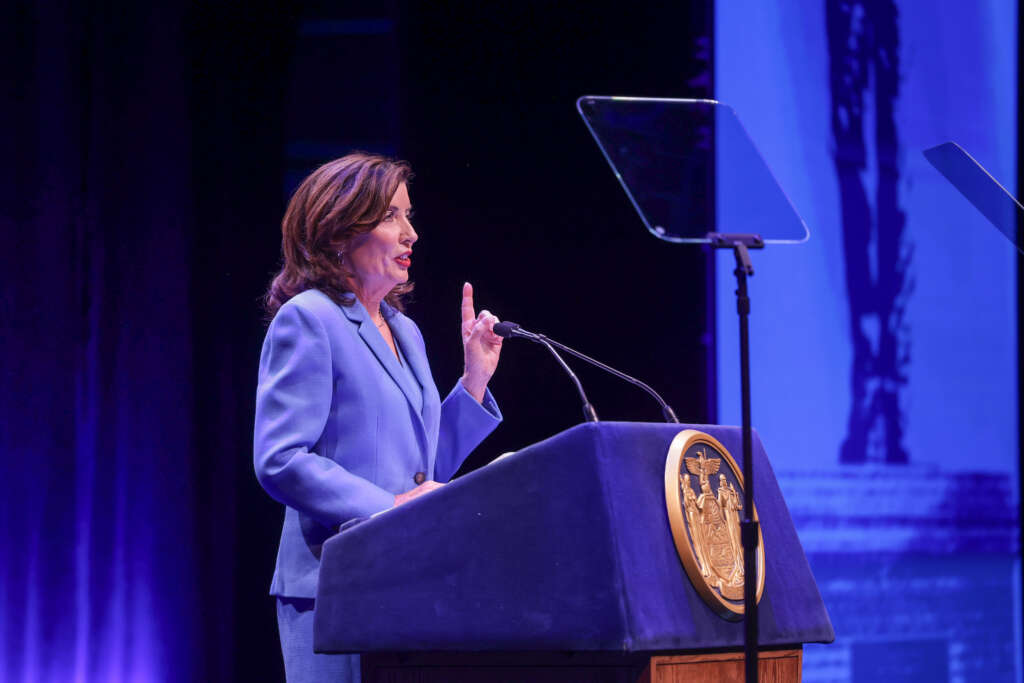
Gov. Kathy Hochul laid out her priorities for the year ahead during her State of the State address on Tuesday. (Mike Groll/Office of Governor Kathy Hochul)
New York Gov. Kathy Hochul delivered her annual State of the State address on Tuesday, laying out her priorities for the year ahead and unveiling dozens of proposals to “make life more affordable” for New Yorkers. They include pledges to expand access to free childcare, extend the Second Avenue Subway across 125th Street and update the state’s environmental review process to make it easier to build housing, among others.
Hochul also committed to reforms impacting some of the city’s most vulnerable residents—including senior tenants and food stamp recipients—that advocates say are long overdue.
The first would upgrade the state’s Electronic Benefits Transfer (EBT) cards with chip-based technology to protect them against theft, an ongoing issue for low-income New Yorkers who receive either cash assistance or food benefits under the Supplemental Nutrition Assistance Program (SNAP).
Without the security chips, the cards are vulnerable to “skimming”—in which thieves install devices on ATMs or checkout machines that can capture the account number and PIN, allowing them to drain the cardholder’s funds.
Between August 2023 and March 2025, the city’s Department of Social Services processed more than 142,178 SNAP reimbursement claims from victims of EBT theft amounting to $43.7 million in stolen benefits. At the end of 2024, the federal government stopped reimbursing states for such incidents, leaving SNAP recipients with no recourse to recover the lost funds—forcing many to seek out food pantries or soup kitchens to make ends meet.
“They took every penny,” one great-grandmother, a resident at NYCHA’s Red Hook Houses, told City Limits in December 2024 after she attempted to use her EBT card to buy groceries at a store nearby, only to learn that her account had been drained.
In June, Legal Services NYC sued the state on behalf of several SNAP recipients who’d been similarly robbed, saying New York’s delay in upgrading its card technology “has left tens of thousands of low-income residents exposed to repeated theft, food insecurity, and financial harm.”
The governor’s office did not immediately respond to an inquiry about the timing of the card upgrades.
Expanding rent freeze eligibility
As Mayor Zohran Mamdani still looks to fulfill his promise of a rent freeze for tenants in stabilized apartments later this year, Hochul says she’ll expand eligibility for two longstanding programs that exempt low-income seniors and people with disabilities from rent hikes.
Under the Senior and Disability Rent Increase Exemptions, known as SCRIE and DRIE, tenants who qualify can get their rent frozen to its current amount, exempting them from annual increases and providing property tax credits to their landlords to offset the difference.
To qualify currently, New York City applicants must live in a regulated apartment, spend more than a third of their monthly income on rent, and earn no more than $50,000 a year—criteria that advocates have long complained is too narrow. Hochul said she will work with lawmakers to pass legislation that increases the income eligibility threshold to $75,000 a year.
Doing so “will account for inflation since the last increase in 2014, and keep pace with today’s economic realities, helping to ensure that these critical programs continue to serve the New Yorkers they were designed to protect,” said several State Senate and Assembly leaders—including Sen. Brian Kavanagh and Assemblymember Deborah Glick, who sponsored a bill to raise the income cap—in a statement Tuesday.
Tenant advocates said they welcomed the move, but urged additional reforms to SCRIE and DRIE.
“This change is long overdue,” the grassroots group, Tenants & Neighbors, said in a statement in response to Hochul’s address. The organization called for lawmakers to pass several bills that would further expand eligibility: one would lower SCRIE and DRIE recipients’ rent contributions to a third of their household income, while another would link the programs’ income eligibility threshold to inflation, in order to keep pace with rising costs.
“If we do not tie the income threshold to a Cost-of-Living Adjustment (COLA), this will be a temporary fix,” said Genesis Aquino, executive director at Tenants & Neighbors. “Tenants will continue to lose eligibility every year as rents and basic expenses rise, and the state will be back here again while more low-income people are pushed toward displacement.”
To reach the editor, contact Jeanmarie@citylimits.org
Want to republish this story? Find City Limits’ reprint policy here.
The post Hochul Pledges to Combat Food Stamp Theft, Expand Rent Freeze Programs appeared first on City Limits.


More Stories
A Brief, Surprisingly Dramatic History of the Corporate Freebie
The promotional product has a longer and stranger history than most of the brands that hand them out. The father...
Beyond Search: Why Discovery-Led Shopping Is Reshaping UK Ecommerce
Online shopping has traditionally followed a predictable path: consumers know what they want, search for it, compare options and buy....
Locked Out: What Actually Happens, and How Not to Overpay
Knowing in advance what a competent locksmith will actually do, and roughly what it should cost, turns a stressful scramble...
Badenoch blames Labour tax plans for exodus of wealth creators
Kemi Badenoch has accused the Labour government of driving Britain’s wealth creators abroad, and called for the ban on new...
Google’s Gemini joins rogue AI cases after real-world hacks – WSJ
Similar incidents have previously been disclosed by OpenAI, Anthropic and Meta Google’s Gemini has joined a growing list of advanced...
Richard Gere’s foundation signs Monaco environmental agreement
The Prince Albert II of Monaco Foundation and the Gere Foundation signed a memorandum of understanding in Monaco today, agreeing...