
Patriots film review: How Drake Maye and Mike Vrabel’s defense broke the Chargers

If the Patriots were at home now instead of preparing for a divisional-round playoff game, nothing about their exit would have been a surprise.
A bummer, sure. But not a surprise.
Mike Vrabel told them what the Chargers’ game plan would be all last week, then told the media Sunday night.
“The Chargers want to possess the ball and wear you down,” he said. “And I don’t think we ever let them do that.”
No sir.
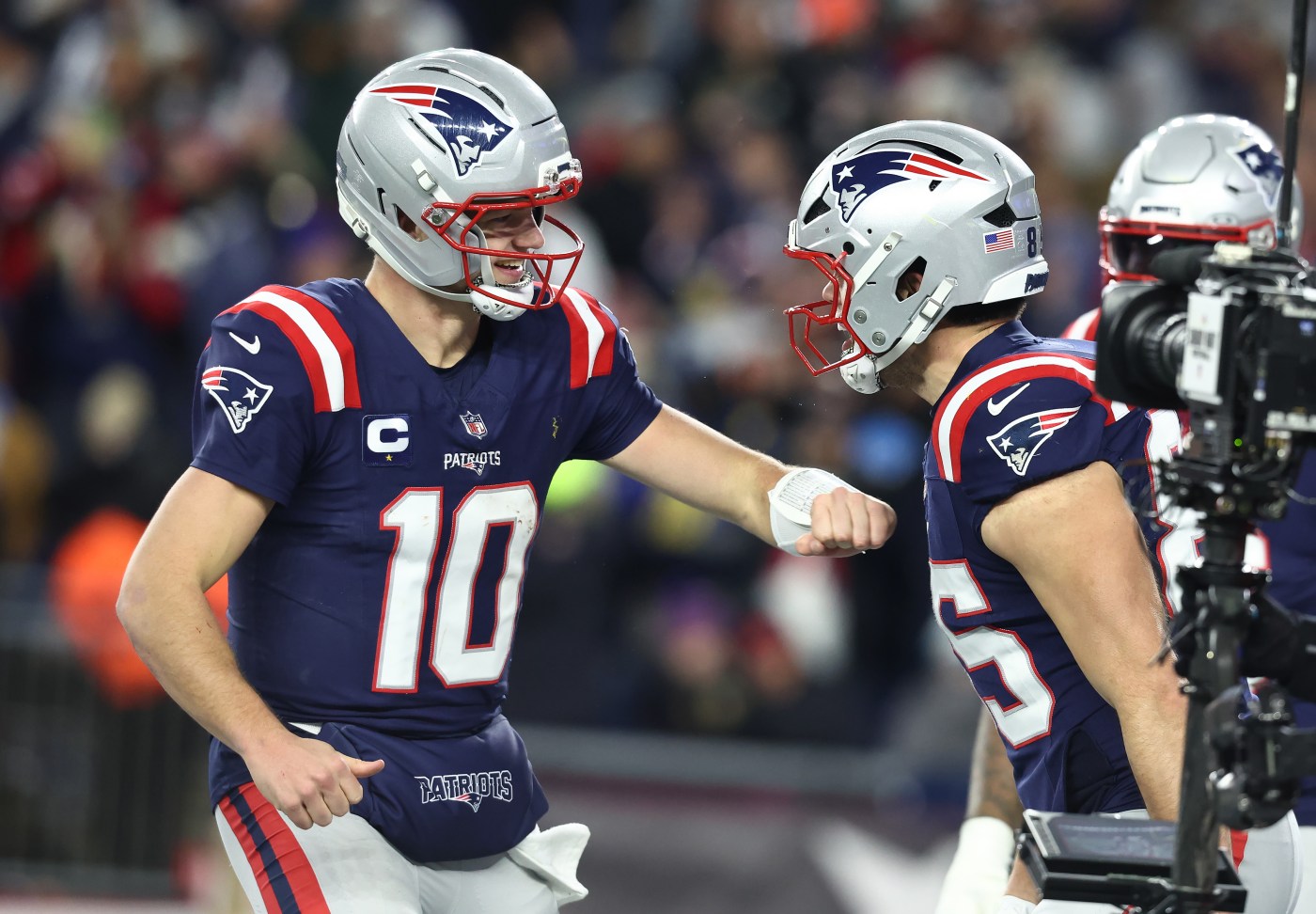
The Pats, in fact, broke the Chargers by giving them a proverbial dose of their own medicine late in a 16-3 win. Drake Maye threw his only touchdown from a heavy personnel grouping with six offensive linemen, while his offense played most of its second-half snaps with two tight ends. The Patriots leaned on Los Angeles offensively and thrashed them on defense, circling Justin Herbert in the first half before swarming him for four sacks in the second.
This was a butt-whooping. A butt-whooping driven by big hits, small scheme tweaks, consistent tackling and sticky coverage. And, oh yeah, a few spectacular plays from Maye.
Here’s what else the film revealed about the Patriots’ first win in seven years:
Drake Maye
New England Patriots quarterback Drake Maye (10) drops back to make a pass under the protection of guard Jared Wilson (58) during the first half of an NFL wild card playoff football game against the Los Angeles Chargers, Sunday, Jan. 11, 2026, in Foxborough, Mass. (AP Photo/Greg M. Cooper)
17-of-29 for 268 yards, TD, INT
Accurate throw percentage: 76.9%
Under pressure: 2-of-6 for 76 yards, 4 sacks, 49 rushing yards
Against the blitz: 6-of-9 for 122 yards, TD
Behind the line: 3-of-3 for 30 yards
0-9 yards downfield: 9-of-14 for 112 yards, INT
10-19 yards downfield: 3-of-6 for 56 yards
20+ yards downfield: 2-of-3 for 70 yards, TD
Notes: Far from his best, Maye overcame his two fumbles, some bad luck and a lack of receiving help to eventually push the Patriots across the finish line Sunday.
Maye’s 37-yard scramble in the last minute before halftime was a twofold turning point in that it led to a go-ahead field goal and seemed to discourage the Chargers from playing man coverage in the second half. Maye tore up the middle of a Los Angeles defense playing man-to-man with two deep safeties, who were too late to corral him once he hit full speed. Before that run, Maye had gone 1-of-3 with a scramble and two sacks versus man-to-man, which risks letting mobile quarterbacks loose in open space.
While not all incompletions against man were a result of good defense (Stefon Diggs had a drop), tight, single coverage limited the Patriots’ receivers more than most other coverages. For example, Maye exploited the Chargers’ various zone coverages on all of his biggest throws in the second half: a 19-yard third-down connection with Hunter Henry, the 42-yard completion to Kayshon Boutte and a 28-yard touchdown he lobbed to Henry in the fourth quarter. As Los Angeles tweaked its coverage plan, the Pats’ pass protection simultaneously improved, which allowed Maye to finish 11-of-14 for 173 yards and a touchdown after halftime.
Drake Maye acknowledges struggles, still shows ‘elite’ traits in Patriots win
Maye’s strip sacks were mistakes the Patriots likely can’t afford to repeat in the playoffs, particularly the fumble he lost deep inside field-goal range. He simply has to resist the urge to extend plays from crowded pockets, where even cocking his arm risks a turnover, as it did Sunday. But more often than not, Maye protected the ball, threw with anticipation and enough accuracy to win, while reminding future opponents he can beat you with his legs just as easily (see: 69 rushing yards before three kneeldowns).
Critical areas
Turnovers: Patriots 2, Chargers 1
Explosive play rate: Patriots 10.9%, Chargers 5.1%
Success rate: Patriots 51%, Chargers 44%
Red-zone efficiency: Patriots 0-3, Chargers 0-2
Defensive pressure rate: Patriots 50%, Chargers 30.7%
Offense
Foxboro, MA – New England Patriots running back Treveyon Henderson dives up field during the fourth quarter of the game at Gillette Stadium. (Nancy Lane/Boston Herald)
Game plan
Personnel breakdown: 44% of snaps in 11 personnel, 31% of snaps in 22 personnel, 11% of snaps in 12 personnel, 8% of snaps in 21F personnel, 3% of snaps in 21H personnel, 2% of snaps in 13 personnel.***
Personnel production: 41% success rate in 11 personnel, 58% success rate in 22 personnel, 28% success rate in 12 personnel, 60% success rate in 21F personnel, 100% success rate in 21H personnel, 100% success rate in 13 personnel.
First-down down play-calls: 54% run (33% success rate), 46% run (45% success rate)
Play-action rate: 15.6%
Big people, big problems.
That was the essence of the game Josh McDaniels called against Los Angeles, cracking an elite defense in the fourth quarter with the same heavy personnel he used on the Patriots’ first snap. McDaniels’ opening play-call was a downhill run for six yards out of 22 personnel (two tight ends, two backs), and the Patriots’ next runs from that grouping covered five and then six yards. Yet McDaniels curiously pivoted away from his big personnel in the second quarter, which allowed a Chargers team that prefers to play with more defensive backs to do just that.
Sure enough, the Patriots’ three-receiver groupings struggled versus Los Angeles’ primary defense, especially against man-to-man coverage. Not to mention, McDaniels called one designed run from that personnel out of 26 plays. Combined, those problems contributed to a red-zone field goal and a punt in the first half. But once the Pats returned to playing with multiple tight ends and backs, the Chargers’ defense bulked up and became more slow-footed in zone. Bingo.
That allowed the Patriots to exploit them with spread formations where Maye thrived throwing the following: quick-hitters (nine-yard pass to Diggs and eight-yarder to Jack Westover), passes to receivers running through cleared-out deep zones (Henry’s 28-yard touchdown) and lobs into soft spots along the sideline (Boutte’s 42-yard catch and Henry’s 17-yarder).
Translation: the Patriots took the scenic route, but they made the Chargers play left-handed, and it paid off.
Player stats
Foxboro, MA – New England Patriots running back Treveyon Henderson signals his first down during the fourth quarter of the game at Gillette Stadium. (Nancy Lane/Boston Herald)
Broken tackles: RB Rhamondre Stevenson 4, QB Drake Maye 2, RB TreVeyon Henderson
Pressure allowed: Team 4 (2 sacks, 2 hurries), LT Will Campbell 4 (sack, QB hit, 2 hurries), LG Jared Wilson 3 (sack, 2 hurries), C Garrett Bradbury (hurry), RG Mike Onwenu (hurry), Henderson (hurry)
Run stuffs allowed: Team 2, Bradbruy, Onwenu, TE Hunter Henry
Drops: WR Stefon Diggs, WR DeMario Douglas, Henry
Notes
The Patriots’ defensive history this season suggests scoring 16 points in another playoff game won’t be enough to win. So where does Josh McDaniels start rolling up his sleeves? Inside the wide receivers room.
The Chargers dared Stefon Diggs and Co. to beat man coverage in critical situations, and too often they couldn’t separate. McDaniels schemed a few targets that had receivers open but nonetheless fell incomplete (DeMario Douglas’ drop in the third quarter, and an incompletion sailed wide to Rhamondre Stevenson in the second quarter).
Given their play this season, it’s likely the Patriots won’t drop three passes again, but they should prepare to see more man-to-man, which was the same way Cleveland, the only other top-10 pass defense Drake Maye faced this season, chose to defend him.
Stevenson had two receptions that beat the Chargers’ pressure with a delayed release, including his 48-yard catch up the middle in the first quarter. Stevenson’s blitz pickup remains invaluable to the Patriots, but his ability to provide an outlet to Maye as a legitimate receiving threat is often just as important in these situations.
Speaking of blitz pickup, TreVeyon Henderson did his job on Hunter Henry’s 28-yard touchdown and allowed Maye to feel some heat before the throw. Henderson delivered a hard cut block that sent an unblocked blitzer flying. Progress for the rookie.
Maye showed great trust in another rookie, Kyle Williams, on their seven-yard completion that converted a fourth down in the first half. If the Patriots do see more man coverage, Williams should expect more deep targets from Maye.
Another all-around effort from Henry, whose impact on this offense may be the most underrated of any regular contributor. Rough game for fellow tight end Austin Hooper, however, who had issues run-blocking and bad luck on Maye’s overthrow to the end zone that would have been a touchdown.
Up front, Will Campbell allowed pressures when he struggled with a power rush early in the game, then gave up a sack to Chargers outside linebacker Odafe Oweh on a speed move around the edge. Campbell eventually settled down with the rest of the Patriots offensive line in pass protection in the second half.
Right tackle Morgan Moses shone in pass protection, but had weaker moments as a run-blocker. Granted, he, like Campbell, had a difficult assignment controlling a talented Chargers edge group.
Garrett Bradbury and Mike Onwenu would have posted clean sheets were it not for both of them failing to handle a stunt that led to direct pressure on Maye in the fourth quarter.
Rookie left guard Jared Wilson made his return after missing multiple games with a concussion, and seemed to have some rust.
More Thayer Munford, please! The Pats posted a 75% success rate from jumbo personnel, which they used on just four snaps. Munford, often the team’s sixth offensive lineman in these groupings, was on the field for Henry’s touchdown, Boutte’s 42-yard catch-and-run and a 6-yard run.
Defense
Los Angeles Chargers wide receiver Tre’ Harris is taken down by New England Patriots safety Craig Woodson during the first quarter of the game at Gillette Stadium. (Nancy Lane/Boston Herald)
Game plan
Personnel breakdown: 56% three-corner nickel package, 24% base defense, 20% dime.****
Coverage breakdown: 70% zone, 30% man
Blitz rate: 45.5%
Blitz efficacy: 40% offensive success rate allowed and 3.1 yards per play allowed
The Patriots blitzed the Chargers on their opening snap. They bluffed an all-out blitz and dropped two defensive linemen into coverage four plays later. Minutes after that, they sent an actual all-out blitz with seven rushers on fourth-and-goal; a football dice roll if there ever was one.
Defensive play-caller Zak Kuhr knew the Patriots couldn’t generate consistent pressure by simply rushing four, so he pulled everything he could from the pressure chapters of the playbook to disrupt Justin Herbert. Mission accomplished.
The Pats dictated terms to a Chargers offense, with simulated four-man pressures, traditional five-man blitzes, six-man zone blitzes, all-out pressure. Inside linebacker Christian Elliss was also a frequent spy behind four-man rushes, a sign the Patriots were more concerned with Herbert’s scrambling than Los Angeles’ regular run game. Behind Elliss, the Pats played less man coverage than expected, but stuck to everyone in the back end in man-to-man and their base quarters calls that often evolve into 1-on-1 coverage.
This was a knockout defensive performance set up by a knockout game plan that had Herbert either running, in a tizzy or both.
Foxboro, MA – New England Patriots’ Alex Austin and Christian Elliss converge on Las Vegas Raiders wide receiver Jakobi Meyers during the third quarter of the game at Gillette Stadium. (Nancy Lane/Boston Herald)
Notes
Let’s start with the boring. Sound tackling ended the Chargers’ hopes at a fast start, when Carlton Davis stopped a checkdown feet shy of the marker on third down during their opening drive. Marcus Jones later upended a scrambling Justin Herbert at the 2-yard line on third-and-goal to force a fourth-down attempt.
The Pats also allowed 2.5 yards per carry on hand-offs to running backs with no-frills run defense. They simply lined up, matched the Chargers’ heavy personnel when necessary and won the line of scrimmage.
Inside linebackers Robert Spillane, Christian Ellis and Jack Gibbens were central to making Los Angeles one-dimensional, triggering immediately on run plays and meeting ball carriers in the hole. Ellis was especially rangy and disruptive, while Gibbens squeezed the most out of his snaps (14) thanks in part to his tracking Herbert down on a designed run.
Without checking fundamental boxes like those, the entire game changes. Instead, with basic stops and a bevy of pressure, the Pats dictated terms to the Chargers from start to finish.
So how about the blitz pressure? Zak Kuhr kept his defensive linemen fresh with substitutions that mirrored line changes in hockey. The Pats played multiple versions of base defense (four defensive backs), and padded their pressure totals late.
But as dominant as the pass rush grew late, this was an A+ overage game. Christian Gonzalez did not allow a catch in what may have been his best performance of the season. All of the Chargers’ wideouts were non-factors.
A red-zone wrinkle: the Patriots doubled second-year wideout Ladd McConkey, who burned their defense down a year ago. His only splash play was a 20-yard gain on an extended play versus Marcus Jones.
Nice to see rookie safety Craig Woodson make an impact, crashing the backfield for a run stuff in the second quarter and breaking through a screen on the opening drive to make an open-field tackle.
The Chargers’ second-longest play was a fumble recovery running Kimani Vidal took 17 yards.
*Explosive plays are defined as runs of 12-plus yards and passes of 20-plus yards.
**Success rate is an efficiency metric measuring how often an offense stays on schedule. A play is successful when it produces positive EPA (Expected Points Added).
***11 personnel = one running back, one tight end; 12 personnel = one running back, two tight ends; 13 personnel = one back, three tight ends; 21 personnel = two backs, one tight end; 21H = two halfbacks, one tight end; jumbo personnel = two backs, two tight ends, six offensive linemen.
****Base defense = four defensive backs; nickel = five; dime = six, dollar = seven.

More Stories
Why Private Health Insurance Has Never Mattered More to UK Employees
There is a version of this conversation that HR professionals have been having for years. Private health insurance is a...
Call blocker firm fined £190,000 for making the nuisance calls it claimed to stop
A company that sold call-blocking devices to elderly people has been fined £190,000 after the regulator found it was responsible...
Karl D’Angelo Santa Rosa: Building Success Through Change
For Karl D’Angelo Santa Rosa, success did not happen all at once. It came through years of learning, hard work,...
Colman’s Mustard put up for sale as Unilever clears path for £48bn McCormick merger
Colman’s Mustard has been put up for sale by Unilever, as the FTSE 100 group moves to head off competition...
Burnham’s business rates adviser called for £9bn tax cut for high streets
Andy Burnham’s new business rates adviser has previously called for up to £9bn of tax cuts for businesses, arguing the...
Loss of cheap energy harmed EU economy – Von der Leyen
The bloc saw oil and natural gas prices soar after it drastically reduced Russian imports over the Ukraine conflict European...