
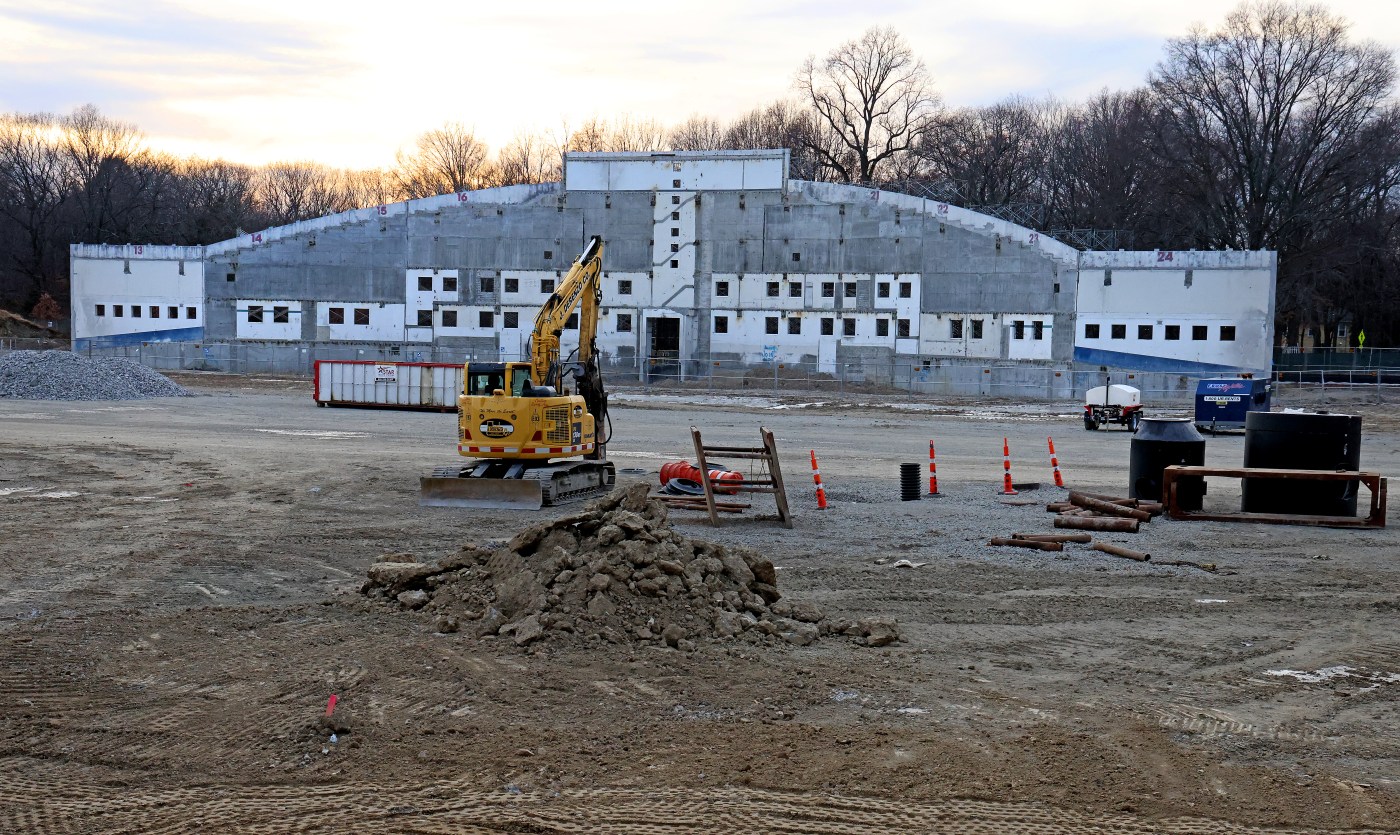
Gaskin: White Stadium a lesson in oversight failure

A former board member once told me he counted 22 construction cranes when he was downtown. Later that same day, standing in Grove Hall, he saw none and asked a question that still hangs over Boston: “Where are our cranes?”
That question cuts straight to the reality of unequal development in this city.
Over the past two decades, Boston’s Seaport has absorbed an estimated $40–$50 billion in public and private investment. What was once a parking lot is now a city within a city. Meanwhile, in Roxbury —one of Boston’s most historically disinvested Black neighborhoods — we are finally seeing a major public investment: the $200–$300 million renovation of White Stadium, located in the heart of Franklin Park.
This should have been our crane — our economic catalyst, our opportunity to build durable, local wealth. Instead, it is becoming a case study in what happens when a megaproject proceeds without independent oversight.
Boston already has a nationally respected model for equitable development: the Massport Model. That model works because it is not based on trust or goodwill. It is based on structure — clear goals, binding requirements, transparent reporting, and independent accountability.
When White Stadium was first proposed, equity questions were raised early. We were told the project would follow the Massport Model. We were told that Richard Taylor was involved in the project and would help hold the process accountable.
Instead, the project moved forward without an independent oversight body, without binding Minority Business Enterprise (MBE) participation requirements tied to contractor selection, and with MBE goals under 14%. One white general contractor controls both major scopes of work.
Black construction firms in Boston are fully capable of delivering a stadium. As one experienced Black contractor told me plainly: “We’re not building a nuclear reactor. The problem isn’t ability. The problem is structure.”
Boston has seen this movie before. The Big Dig began with a projected cost of roughly $2.5–$2.8 billion and ended somewhere between $14.6 and $24.3 billion, depending on how long-term debt and mitigation are counted. It remains one of the largest public works projects in American history.
And what did Black Boston receive?
MBE participation estimates range from 1% to 2.5%, though no one knows for certain because equity tracking was so poor. What is known is that no new Black millionaires emerged, and fewer Black construction firms existed after the project than before it.
That failure was not accidental. It was the predictable result of no independent oversight, no transparency, and no enforcement. White Stadium is following the same trajectory — just on a smaller scale, with the same risks and the same excuses.
We recently saw the agreement Everett signed with the Krafts and ours falls woefully short. Who negotiated the City of Boston’s agreement? The mayor. Oversight has effectively been centralized in the mayor’s office — an office already responsible for the entire city, every agency, and every crisis. That is not oversight; it is diffusion of accountability.
Ask a simple question: Who outside the mayor’s office and the general contractor knows the current full cost estimate of this project? The answer is no one. That is how megaprojects go off the rails. That is how inequities get locked in. And that is how public trust erodes.
Today, there is no independent body empowered to track MBE participation in real time, demand procurement transparency, review cost overruns, protect Boston Public Schools students, safeguard Franklin Park, or ensure that promised community benefits actually materialize.
Across the country, cities routinely establish stadium and megaproject oversight boards. Los Angeles, Chicago, Seattle, Atlanta, Minneapolis, and Providence all do this. These boards are not symbolic. They are empowered to receive documents, review contracts, require reporting, and create a public record.
Boston’s failure to do the same for White Stadium — especially given its location in a historically disinvested Black neighborhood — is not normal. It is a governance failure.
When Worcester built Polar Park, it planned an entire district around it — restaurants, mixed-use development, housing, tourism, and small businesses. Everett’s mayor has explicitly framed their proposed stadium as a regional economic engine, with careful planning to match. Patriot Place reshaped Foxboro’s economy.
White Stadium has none of this. There is no publicly released economic impact study, no environmental, transportation, or parking impact analysis, no transparent procurement process, no long-term operations plan accessible to the public, and no independent entity empowered to demand answers. That is how infrastructure investments fail to produce wealth — and how missed opportunities harden into permanent inequities.
The current City Council has the opportunity — and the responsibility —to require the establishment of a legally mandated White Stadium Oversight Committee with real authority, consistent with what other cities already do and what this moment demands.
That committee must be large and multidisciplinary, include community stakeholders, elected officials, and subject-matter experts, and be empowered to demand documentation rather than rely on voluntary disclosures. It must require full procurement transparency, including who bid, who won, and why. It must mandate immediate release of the current full project cost estimate and require quarterly public reporting modeled on Massport’s transparency practices. It must enforce binding— not aspirational — MBE participation requirements, require a clear economic opportunity plan for local businesses and non-game uses, and ensure that Boston Public Schools students, surrounding neighborhoods, and Franklin Park benefit rather than bear the costs.
White Stadium is the first major public investment in decades in the heart of Boston’s Black community. It should have been a model of equitable development. Instead, we are dangerously close to repeating history. But history is not destiny — unless we allow it to be.
Ed Gaskin is Executive Director of Greater Grove Hall Main Streets and founder of Sunday Celebrations


More Stories
Top 6 AI Infographic Generators (Ranked & Reviewed)
Late last year, a marketing strategist in my network needed to turn a research-heavy briefing into a visual asset before...
When SMEs scale connected services: how to keep ownership and avoid rebuilding the platform every time the business pivots
Most connected services start with a narrow business problem. A manufacturer may add remote monitoring to reduce support calls, give...
6 Ways a Car Cover Can Save You Money on Vehicle Maintenance
A car parked in the driveway may look perfectly safe, but every day it sits outside, it is exposed to...
Applied Nutrition closes in on £1bn valuation after raising guidance for third time this year
The sports supplement maker Applied Nutrition has raised its annual sales and profit guidance for the third time this year,...
One of Britain’s oldest family firms to save £250,000 a year as energy scheme opens to forges
One of the UK’s oldest family-owned companies has praised the government’s decision to include forges in its energy subsidy scheme...
Burnham signals more energy bills support in budget as price cap rises 4 per cent
Andy Burnham has signalled that there will be more support to help people with their bills in the budget, as...