
How rodeo clowns have evolved, from funnymen to bullfighters — with lives on the line

DENVER — From the time he was in fifth grade, Richie Harris aspired to be a rodeo clown.
For Harris, who was raised in Westminster, Colorado, going to the National Western Stock Show in Denver with his grandparents was family tradition as far back as he can remember. During one formative trip as a kid, he met legendary rodeo clowns Leon Coffee, Rick Chatman and Tom Feller. The allure of the arena was inescapable.
“Ever since that day, I said, ‘This is what I want to be,’” he said.
Coloradoan Richie Harris (pink shirt) has been a rodeo clown since he was 16 years old. Now, at age 49, he spends more time perfecting his comedic acts and less time fighting bulls. (Provided by Lexi Christopher Photography)
Harris followed his ambitions and, at age 16, attended a multi-day clinic where he learned tricks of the trade. He has been performing at rodeos in some capacity in the 30-plus years since, including appearances at the National Western Stock Show in the early 2000s, which Harris affectionately calls the biggest moments of his clowning career.
“(My) hometown rodeo and there being 14,000 people in the arena surrounding you and walking into a place that kind of was the start for me,” Harris said. “That feeling, that opportunity was something that will always stick with me.”
Funnymen, barrelmen and bullfighters have been integral parts of rodeo for almost as long as these competitions have existed. Historically, “rodeo clown” was a catch-all moniker for the folks who performed essential functions from entertaining crowds to protecting cowboys in bullriding competitions. In the latter half of the 20th century, however, the profession began to splinter into distinct roles. The titles of rodeo clown and bullfighter, once interchangeable, are less so today, with men typically working as one or the other — or both at different points of their career.
“I would consider myself both just for the fact that as a kid going to rodeos and watching rodeos, that’s kind of what it was,” said Harris, who now at age 49 spends less time as a bullfighter and more time as a barrelman. “As time has gone by, it has evolved, but as a kid, that’s what I grew up watching and wanting to be.”
Since the start, the rodeo clown’s job has changed alongside the rodeo itself. According to historian Megan Winterfeldt, clowns were part of the Wild West entertainment shows that predated the formalized competitions we know today. These were similar to the circus in that they featured myriad entertainers, but the concept was all about celebrating the new American frontier with bronc riding, steer wrestling and battle reenactments. Clowns were largely animal trainers at that time who performed acts with dogs, donkeys and more, Winterfeldt said.
As the rodeo developed to become its own unique attraction in the late 1800s and early 1900s, clowns were woven into the format and tasked with keeping butts in seats between events.
“The clowns provided entertainment between the different rodeo events because if you’re switching from one end of the arena, say from a timed event to a roughstock event, there’s a little bit of switch over,” said Winterfeldt, who serves as the exhibitions and collections coordinator at the ProRodeo Hall of Fame and Museum of the American Cowboy in Colorado Springs.
When a new, disagreeable breed of cattle called the Brahma bull was introduced into bull riding in the 1920s, rodeo clowns had a new job: To distract the animals and lead them away from fallen riders, a skill that would come to be known as bullfighting.
Rodeo bullfighter and clown memorabilia at the Pro Rodeo Hall of Fame in Colorado Springs on Wednesday, Nov. 12, 2025. (Photo by AAron Ontiveroz/The Denver Post)
Those cattle “tend to keep their heads up when they charge, and so they became more dangerous for the fallen cowboys when they’d fall off the back,” Winterfeldt said. “So that’s where clowns stepped in and started to become more of the bullfighters.”
Some clowns brought large barrels into the arenas, both to help grab the bull’s attention and to use as a safe haven. The barrels were often painted and outfitted with some sort of padding to soften the blows for both the animals and performers. In 1957, rodeo clown Jimmy Schumacher patented the design for a “walking barrel” that left both ends open so someone could move it while inside.
Gail Woerner, who wrote “Fearless Funnymen: The History of the Rodeo Clown” and hosts modern-day rodeo clown reunions, said most clowns first got involved with the rodeo as cowboys. However, the pop culture perception that they were broken-down riders or drunks who couldn’t make any money is “the farthest thing from the truth.”
“Up until about the ‘50s, they had to do everything,” Woerner said, whether that meant bullfighting or hauling animals and other props for their acts. “And it wasn’t easy.”
Bullfighting blossoms
In the 1950s, bullfighting started to earn its own acclaim thanks to a Washingtonian named Wick Peth. Peth came from a ranching family, and though he competed in the rodeo for a time, he quickly made his way into clowning. But there was just one problem: “Wick was not funny,” Woerner said. “One time, an announcer said he was about as funny as a funeral in the rain.”
Still, Peth’s athleticism and bullfighting ability made him popular. Eventually, he was contracted exclusively to fight bulls without being made to perform clown acts – a first in rodeo history, Woerner said.
By the 1970s, many rodeos would end with feisty “fighting bulls” that chased clowns or barrels around the arena — and audiences loved it, Woerner said. Eventually, American bullfighting carved out a niche, with some organizations hosting competitions in which that was the main attraction.
Contrary to Spanish or Mexican traditions, fighters did not aim to injure or kill the animal. Instead, they used their physicality to outsmart and outrun them. The first Wrangler Bull Fights World Championship took place in 1981 and similar so-called freestyle events have been booming ever since.
As rodeo clowning and bullfighting have diverged, perhaps the most obvious difference now is the attire. Typically, clowns wear face paint and oversized denim pants called “baggies” with bandanas tied to them to both deceive bulls with extra movement and to look kind of silly. (They are clowns, after all.) Meanwhile, bullfighting has honed a new style. Many freestyle competitors today wear pullover jerseys and athletic shorts decorated with logos from their sponsors.
Allan Dessel, a rodeo clown and bullfighter, said that’s reflective of how the business side of the profession has changed. In the early days, rodeo clown was a full-time career, but now most men do it as a side gig and spend their vacation time on the road because they are passionate about it. As bullfighters have risen to the level of other professional athletes, sponsors have come on board to support them and market to their social media followings.
Rodeo bullfighter and clown memorabilia at the Pro Rodeo Hall of Fame in Colorado Springs on Wednesday, Nov. 12, 2025. (Photo by AAron Ontiveroz/The Denver Post)
“If you look at it financially, it makes no sense,” laughed Dessel, who will be the rodeo clown for the upcoming National Western Stock Show. “We all make money, but there’s not a real great retirement in what we do, and you’re gonna be beat up and you’re gonna be busted when all is said and done. We do it because we love it. But if you can do better along the way, it makes it that much sweeter.”
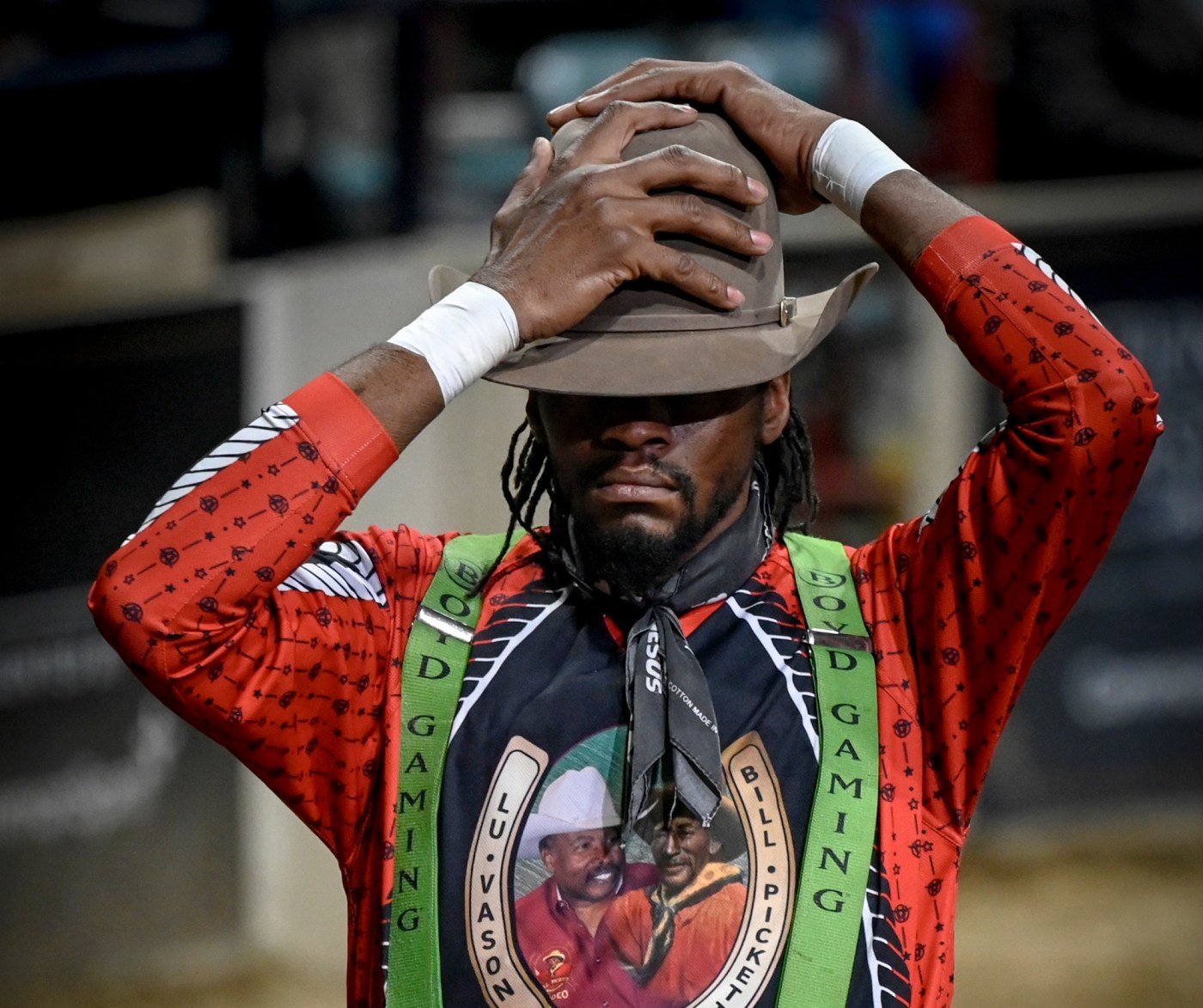
Despite the increased popularity of freestyle bullfighting, some athletes prefer their job protecting cowboys. That includes Johnny Yates, a bullfighter with the Bill Pickett Invitational Rodeo, an African American rodeo founded in Denver in 1984.
Yates, a Houston native, grew up in a rodeo family and started riding bulls as a kid. Once he got to high school, he traded bucking for buckets and attended college on a basketball scholarship. After an injury took him out of the game, Yates returned to rodeo life and started a bullfighting company, BTBBullfighters, with his cousin in 2017.
Rodeo clowns Wayne Rogers, right, and Johnny Yates, left, listen to the singing of the national anthem before taking part in the MLK Jr. African-American Heritage Rodeo at the National Western Stock Show in Denver on Jan. 20, 2025. (Photo by Helen H. Richardson/The Denver Post)
Yates, who stands 6-foot 9-inches tall, said his background in sports prepared him for what he considers the most important part of his job: saving lives.
“I just feel like there’s more meaning to saving a cowboy than to just be out there freestyling the bull that’s trying to hurt you,” Yates said. That’s why there’s also more longevity in a career saving cowboys, he added. “Them bulls try to hurt you.”
“Those bullfighters are what we call ‘cowboy lifesavers,’” said Valeria Howard-Cunningham, owner and president of the Bill Pickett Invitational Rodeo, “because without them there would be tons of deaths. But they prevent that from happening. So they ought to receive the attention, appreciation and spotlight that they deserve.”
For the love of a laugh
For all the ways rodeo clowning and bullfighting have evolved, one thing that remains consistent is the risk. Injuries are par for the course in this line of work, which is why some bullfighters transition to become funnymen later in life.
“As a bullfighter, to stand there and not move when you know you’re going to take a hit for a guy, that’s the hardest part,” Dessel said. “Police, first responders, firefighters, they all have that same thought process — when you should be running away, you’re running to it.”
Of course, not all men aim to fill both roles. Avery Ford began his rodeo clown career 11 years ago at age 53. The Wisconsin native first began attending the rodeo to support his stepdaughter and one day, a rodeo clown invited him into the arena to help with an act. Ford took to it naturally and spent a year thereafter conceiving his character before being hired by the Bill Pickett Invitational Rodeo.
For the last decade, his alter ego, Spanky the Funny Man, has been a beloved fixture of the rodeo, making audiences laugh with acts he says come to him in his dreams. In one skit, he plays a character named Aunt Beta, an older, “robust” lady who flirts with the rodeo announcer. When Ford says a code word, the DJ plays a pre-selected song and “I do a very clean, seductive dance in front of the announcer, flirting with him, and the people just love it,” he said. “I even twerk up there. That’s what gets people.”
As the rodeo continues to progress, it’s likely the clowns will have to adapt. For example, more rodeos are being broadcast on TV, which means a clown’s acts are largely dictated by the scheduled commercial breaks and how long they are, said Dessel. Clowns are also expected to be more like stand-up comedians these days than in decades past, said Harris. Ford also mentioned that rodeos are booking more live entertainment, such as bands, to engage audiences throughout the event, potentially cutting into a clown’s time.
Whatever the future holds, most in the rodeo world believe clowns are as essential to the event as they have ever been. “You have to have the love and desire to want to do it, and not just go out there looking for a paycheck. To me, that’s the least of my worries,” Ford said. “My worry is making sure those people laugh, because you never know who needs that laughter for that day, that show, that moment.”

More Stories
Lidl to open more than 50 stores after sales rise to £13bn
Lidl GB increased turnover by 10.8 per cent to £13bn in the financial year ended 28 February 2026, with operating...
Nandy intervenes in BT’s TalkTalk deal, citing risk to life
The government has intervened in BT Group’s acquisition of TalkTalk, with Lisa Nandy, the Secretary of State for Digital, Culture,...
Getting to know you: Professor David Keene MBE, CEO, Aurrigo
Professor David Keene MBE is the founder and chief executive of Aurrigo International plc, the AIM-listed Coventry company that builds...
Getting to know you: Malcolm Seagrave, CEO, Hedgehog Lab
Malcolm Seagrave is chief executive of Hedgehog Lab, the Newcastle upon Tyne digital product studio that designs and builds software...
Tax experts call for inflation relief if capital gains tax rises
Any rise in capital gains tax (CGT) at the budget on 28 October must be accompanied by “inflation relief” on...
Tesco considers offer for 210-store Majestic Wine chain
Tesco is considering an offer for Majestic Wine Group, the UK’s largest wine retailer, which was put up for sale...