
Beijing Invokes ‘Make America Great Again’ in Rare Bid to Ease US Tensions

By Michael Zhuang
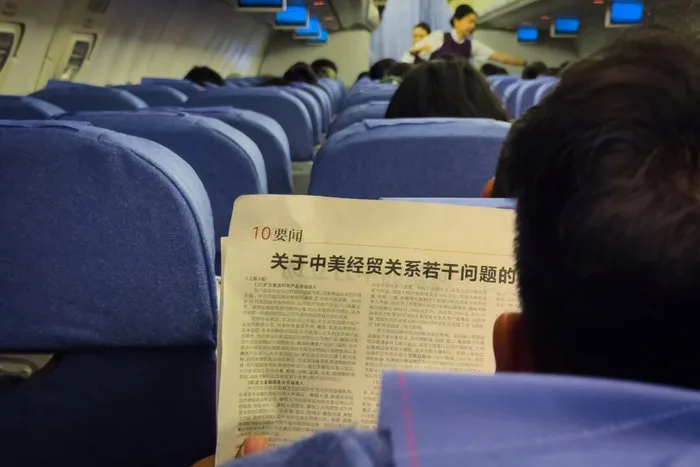
From Dec. 26 to 29, Chinese state media published a rare series of editorials striking a conciliatory tone toward the United States, repeatedly suggesting that China’s development and President Donald Trump’s slogan “Make America Great Again” are not mutually exclusive.
The four articles, released in quick succession by the CCP mouthpiece “People’s Daily,” emphasized dialogue, cooperation, and mutual prosperity—a notable departure from the confrontational rhetoric that has dominated Chinese Communist Party (CCP) messaging in recent years.
However, analysts say the softer language reflects not a strategic reset, but a tactical pause driven by mounting pressure on Beijing. They argue that the clash between the two countries—rooted in opposing political systems and ideologies—remains unresolved and, ultimately, irreconcilable.
State Media Invokes MAGA
The commentaries, published under the name “Zhong Sheng,” were framed as an opinion series titled “Lessons for China–U.S. Economic and Trade Relations in 2025.” The articles called for pragmatic engagement, managing differences, and expanding cooperation.
Absent were phrases once common in Chinese state media, such as “fight to the end.” Instead, the series stressed restraint and stability.
One article quoted Chinese leader Xi Jinping as saying that China’s “development and rejuvenation” run parallel to Trump’s Make America Great Again (MAGA) vision, and that the two countries could “prosper together.”
The formulation appeared twice in the four-day span, drawing attention for its unusual invocation of a core American political slogan in the CCP’s official discourse.
A Gesture of Weakness: Analysts
Shen Ming-Shih, a research fellow at Taiwan’s Institute for National Defense and Security Research, said the opinion pieces signal Beijing’s desire to slow the deterioration of bilateral ties.
“This rhetoric shows the CCP wants to project that it has no intention of challenging or replacing the United States,” Shen told The Epoch Times.
“But this is still a form of [the CCP’s] United Front messaging, coming from a position of relative weakness.”
Feng Chongyi, an associate professor in China Studies at the University of Technology Sydney, offered a similar view.
“‘Zhong Sheng’ represents the voice of the central CCP leadership—essentially Xi Jinping’s voice,” he told The Epoch Times.
“Right now, Xi is facing serious internal and external pressures. He’s extending an olive branch to the United States because he wants breathing room.”
Feng said that Beijing’s long-term objective—challenging the U.S.-led international order—has not changed.
“The confrontation spans everything—military power, geopolitics, values, national interests, and visions for the future world order,” he said.
“On nearly every front, the two sides are fundamentally opposed.”
2 Dreams, 2 Worldviews
Two of the four commentaries explicitly argued that China’s rise and America’s resurgence could coexist. Nevertheless, Feng dismissed that premise outright.
He described Xi’s “China Dream” as a project centered on preserving the CCP’s one-party rule and total control over society, rather than the individual well-being of the Chinese people.
“The American Dream begins with the individual—people pursuing life, liberty, and happiness,” Feng said. “That’s the essence of America.”
By contrast, he said, the CCP’s model places the party-state above the individual, reducing citizens to expendable resources in service of the regime’s interests.
“The value systems are diametrically opposed,” Feng said. “The ‘American Dream’ and the ‘China Dream’ are not compatible, and they cannot coexist.”
Strategic Reality Undercuts Beijing’s Messaging
Shen noted that Trump’s MAGA agenda has increasingly focused on preventing China under the CCP’s rule from surpassing the United States in military and technological power.
“The United States now treats the CCP as its primary strategic competitor and is pursuing comprehensive containment,” he said. “I don’t believe a few People’s Daily editorials will change that.”
Recent Chinese military activity also undercuts Beijing’s conciliatory messaging, Shen added. Large-scale military drills near Taiwan—announced right after the People’s Daily editorials—mirror or exceed military exercises conducted in 2022 and 2024.
“On the one hand, Beijing talks about cooperation with Washington,” he said. “On the other hand, it escalates pressure in the Taiwan Strait. It’s all contradictory.”
A Tactical Adjustment in a Long Rivalry
Shen said the invocation of “parallel” American and Chinese dreams is designed to encourage Washington to focus inward and shift attention away from the Indo-Pacific.
Nevertheless, he cautioned that Beijing itself understands that the rivalry is far from over.
“The CCP knows that conflict with the United States in the Indo-Pacific is still likely,” he said. “This is not reconciliation—it’s a tactical adjustment in the Indo-Pacific.”
Xia Song and Luo Ya contributed to this report.
More Stories
Jessica Biel Bio: Net Worth, Career, and Personal Life
Jessica Biel has built a notable career in Hollywood. She began as a teenage television star and has since moved...
Why the Bakken Remains One of America’s Most Important Oil-Producing Regions
When most Americans think about domestic oil production, Texas probably comes to mind first. But more than a thousand miles...
Is A Different World Season 2 Renewed? Release Date, Episodes & More
Finished watching the first season of A Different World! Now searching for the renewal status and more details about A...
The Gentlemen Season 2 is Airing: Know About the Plot, Episodes, and Cast
Eddie has returned with season 2 of The Gentlemen. This time, his appearance and costumes reflect his new life as...
LEGO ONE PIECE is Live! Where to Watch and Full Cast Updates
Good news for Straw Hats fans who were waiting for the release of LEGO ONE PIECE Season 3. No, its...
Rebel Moon 3: Release Date, Cast Members, and Production Details
Zack Snyder has finally spoken about the release of Rebel Moon 3 after the release of the second sequel in...