
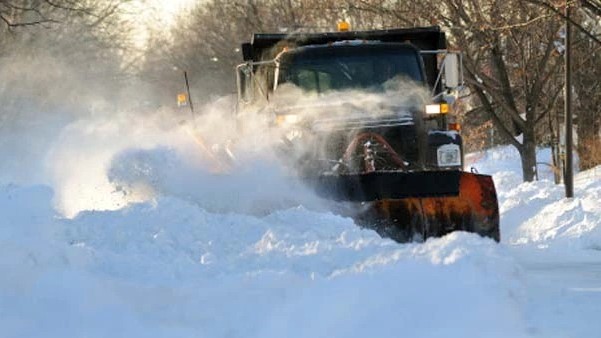
Why doesn’t St. Paul call snow emergencies sooner?

Wind-swept snows barely began to fall on Sunday when the cries went out on social media channels across St. Paul. From Facebook to NextDoor, homeowners demanded to know why Minneapolis had called a snow emergency but the capital city had not.
St. Paul did activate its 24-hour snow emergency protocol, but not until the next day, with some 60 snow plow drivers scheduled to focus on designated “Night Plow” routes beginning at 9 p.m. Monday. A winter story dropped up to 6 inches of snow on the Twin Cities Sunday and slippery roads and windy conditions made for tricky travel into Monday’s commutes.
A snow emergency sign in St. Paul. (Andy Rathbun / Pioneer Press)
Why the 24-hour delay for St. Paul?
For St. Paul Public Works Director Sean Kershaw, it’s a familiar question. The answer is “more art than science,” acknowledged Kershaw, who confers with the National Weather Service and works with a team of city officials to weigh forecasted snowfall volume, the type of snow and temperatures before and after an expected storm.
Then there’s special events to consider, such as the 29-game World Junior Ice Hockey Championships bringing visitors from 10 countries into town for the next week, as well as upcoming New Year’s Eve festivities.
Timing
St. Paul officials usually wait until the day of a snow emergency to declare one based on the latest information, while trying to avoid announcing an emergency after 3 p.m. or so to give residents time to move their cars.
Minneapolis maintains a three-day approach toward snow emergencies that sends plows to designated routes after 9 p.m. on the first night, the even sides of non-snow emergency routes the next morning and the odd sides on the third day.
With St. Paul snow emergencies are technically 96 hours long, the capital city tries to accomplish the same push in just the first 24 hours, Kershaw explained. That means plowing on major thoroughfares dubbed arterial and collector streets even before the first phase of a snow emergency is called, and then hitting designated snow plow routes — which constitute about half the city’s north-south residential corridors — beginning at 9 p.m. of Day 1.
In short: the two cities will overlap and align in their approach, more or less, right around Monday night.
In Minneapolis, “their first phase is the same as what we were doing last night — the arterials and collectors,” said Kershaw on Monday morning. “They called there’s first, but in practice we were both doing the same thing. We will each be on residential streets starting tonight.”
New Year’s Eve, staffing
Kershaw noted that Minneapolis officials took care to not to schedule their snow emergency into Wednesday, which is New Year’s Eve, to avoid confusing visitors. With its three-day system, waiting longer than Sunday would have done exactly that.
“If they had started tonight, they would have completed their’s on New Year’s Eve,” said Kershaw on Monday.
In St. Paul, staffing poses another constraint. Kershaw pulls plow drivers from city forestry teams, sewer teams, and anywhere else he can find a trained and credentialed plow driver. It’s still not enough.
“With the staffing we have, we couldn’t simultaneously stay on the arterials and collectors and then quickly bring those snow plow drivers back to begin the night phase,” said Kershaw, on Monday morning. “The night phase is half the north-south residentials, and then the arterials and collectors (again).”
Tickets, tows
The city has attempted to get residents to move their cars a variety of ways, including traditional media to social media, opt-in emails and text messages in multiple languages, and robo-calls using Everbridge Resident Connection, which combs through publicly available phone numbers within the city boundaries.
Still, plenty of residents complain that towing is lax along certain streets, making it impossible to fully plow them.
The court system was overwhelmed entering handwritten parking tickets into its system after record snowfalls in 2022-2023, so St. Paul this year switched to electronic tickets issued from police squad cars, utilizing civilian “runners” to distribute printed copies. That seems to be increasing tow volumes.
During the first snow emergency of the season, which ran from Nov. 30 to Dec. 4, the city issued more than 3,200 tickets and 900 tows — a record during Kershaw’s time as Public Works director, and possibly for the city.
“We’re doing as many tickets and tows as we have in the past,” Kershaw said. “It’s working better.”
Testing odd/even parking
Still, Kershaw said he’s the first to acknowledge that St. Paul’s snow emergency system is far from perfect.
This is the second consecutive year in which the city will be testing out an even/odd winter parking system in two parts of the city — a designated area surrounding Snelling and University avenues and another around Selby and Western avenues. Beginning Sunday, residents will be expected to move their cars to one side of the street, alternating back and forth weekly into April.
City officials rolled out the pilot parking program in two parts of Highland and Payne-Phalen last year, and reported promising results. This year’s designated areas are, by design, more densely populated, heavily trafficked or just plain hairier, and city officials have already gotten an earful from some residents opposed to the changes.
Kershaw remains optimistic. With cars parked on alternate sides of the street but never both sides at the same time, plows would have easier access to the other side of the street throughout the season. In theory, a snow emergency might never have to be called.
Even/odd parking also will boost plow access in situations where snowfall continues or resumes after the first two phases of a traditional snow emergency are done, which was the case with a storm that arrived just after Thanksgiving Day.
For more information on how to sign up for the city’s snow emergency alerts, visit stpaul.gov/snow.
Snowfall, accidents
As of late Sunday night, a total of 5.8 inches of snow had fallen at the Minneapolis-St. Paul International Airport from this storm system, with the highest amount — 9 inches — falling in Haugen, Wis., according to the National Weather Service.
Related Articles
John Mannillo: Some friendly advice for St. Paul’s new mayor
Letters: Overfed on materialism, starved for enchantment …
Longtime fine art destination Grand Hand Gallery moving down Grand Avenue
Evie electric carshare seeks to expand, despite loss of federal grant
St. Paul poised to end 2025 with half the homicides of 2024
The Minnesota State Patrol reported as of Monday morning there were 134 crashes, 13 involving injuries and 15 spin outs across the state due to weather conditions. A total of 128 vehicles were off the road and nine jackknifed semis.
Meanwhile, some roads in Minnesota remained closed Monday due to conditions. Iowa transportation officials said they were planning to re-open Interstate 35 from Ames to the Minnesota border Monday afternoon.

More Stories
Getting to know you: Melissa Snover, founder and CEO, Rem3dy Health
Melissa Snover founded Rem3dy Health in 2019 and built it around Nourished, a seven-layer gummy vitamin stack 3D-printed to order...
Putin approves takeover of French and Swiss giants’ Russian assets. Why now?
Moscow has linked the move to Western support for Ukrainian strikes on Russian infrastructure President Vladimir Putin has ordered the...
Saudi Arabia cuts off October oil supplies to Europe – Bloomberg
The reported extension of supply disruptions follows a Houthi attack that knocked out a key export pipeline Saudi Arabia’s state-owned...
JPMorgan throws in towel on forecasting oil price
The bank no longer knows how to model the market, given the lack of a clear endgame in the US...
Getting to know you: Neeral Shah, founder and CEO, YardLink
Neeral Shah launched YardLink in 2018 to move construction buying off the phone and onto a platform. It now lists...
Getting to know you: James Cobb, CEO and founder, Crowd Connected
James Cobb founded Crowd Connected at the Surrey Technology Centre in Guildford in 2013, after years as a tour manager...