
Sturgeon may aid in Duluth Aquarium’s resurging popularity

DULUTH, Minn. — Since its own rocky start and near closure shortly after opening a quarter-century ago, the Great Lakes Aquarium has proven a model of resiliency, drawing ever-larger crowds to its doors in recent years.
Now, the facility is laying plans to assist in another sort of comeback as a partner in an effort to restore lake sturgeon to the St. Louis River, a waterway that once teemed with the bony behemoths.
But development fouled the water and deprived the species of critical habitat, causing its population to plummet, according to GLA executive director Jay Walker.
Today, Walker and his team aim to invest about $1.5 million in an initiative to return lake sturgeon to their rightful home. In so doing, staff also expect to provide visitors with yet another reason to add the aquarium to their travel itineraries.
Aquarium staff are working in concert with the U.S. Fish and Wildlife Service, Fond du Lac Resource Management experts and the Minnesota Department of Natural Resources to raise lake sturgeon near the mouth of the St. Louis River.
Come March or April, plans call for USFWS to bring a trailer specially equipped to rear sturgeon from spawn on site. The fish would be hatched and the fry raised in water drawn from the neighboring St. Louis River, so that the waterway’s chemistry makes an imprint.
Lake sturgeon may not reach sexual maturity until between 13 and 25, and may only spawn intermittently, according to the USFWS. But when they do begin to reproduce, the fish are driven to return to the waters from whence they came.
The project aims to assist in the development of a naturally reproducing and self-sustaining population of sturgeon in the St. Louis River.
Local water quality has dramatically improved in recent years, as the management and treatment of effluent into the St. Louis River has grown more rigorous, thanks in large part to the work of Resource Renew, formerly known as the Western Lake Superior Sanitary District.
Prior efforts to reintroduce a self-sustaining population of lake sturgeon to the St. Louis River have met with limited success to date.
“This is an opportunity for the aquarium to do more than educate people about the situation,” Walker said. “This project will enable us to make a real and direct impact beyond our walls.”
Aquarium guests will be able to watch sturgeon eggs hatch and the fish develop until the fingerlings are about 7 inches long. At that time, a few thousand of them will be released into the river. But Walker said the aquarium likely will hold back about 100 sturgeon for the following year, so they can reach greater maturity, increasing their anticipated survival rate.
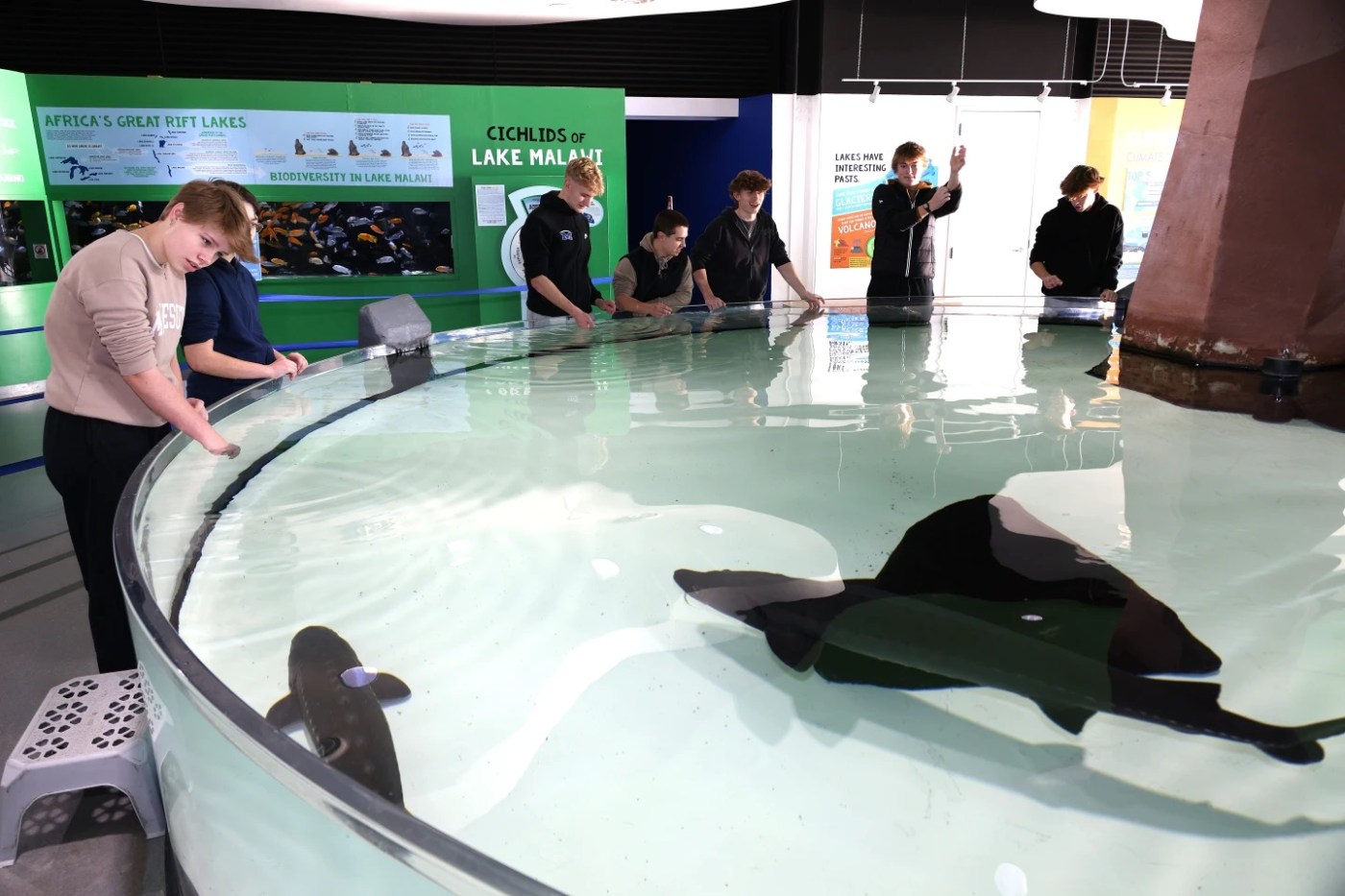
In the meantime, aquarium guests will be able to monitor the development of the remaining year-plus-old sturgeon group in an 800-gallon tank.
Eventually, Walker hopes some of the released sturgeon will be implanted with chips that allow visitors to track the movements of released fish as they fan out into Lake Superior to forage most of the year and then return to the St. Louis River in the spring to spawn.
Biologists from the Fond du Lac Band of Lake Superior Chippewa, as well as the state and federal governments, will be involved in the restocking effort every step of the way.
Walker said the band’s engagement is crucial not only because of the expertise they will bring to the reintroduction initiative but also because of their ability to provide visitors with a greater appreciation for lake sturgeon, their environmental role and the cultural significance of this fish to Indigenous residents of the region.
“We want to connect with band members who can share that knowledge, and we hope to provide a conduit for their stories,” Walker said.
Eric Torvinen, an inland fisheries biologist for the Fond du Lac Band, said tribal efforts to reestablish sturgeon in the upper reaches of the St. Louis River have been in progress for about 30 years now, and he welcomes the aquarium’s plan to support that ongoing work.
He said sturgeon — or “name” (pronounced nah-may) in the Ojibwe language — occupy an important role in the Fond du Lac Band’s culture. The fish — which can live for more than a century, reaching lengths of up to 7 feet and weights in excess of 200 pounds — are revered for their strength, longevity, knowledge and wisdom. Indeed, one of the band’s clans draws its name from the lake sturgeon.
The fish is also credited with teaching Baaga’adowewewin, an Indigenous predecessor of lacrosse, to the Ojibwe people.
So far, the aquarium appears on track to secure about $950,000 for its sturgeon initiative, and Walker expressed optimism that the rest of the needed funds can be raised through additional grants and public donations.
While still short of its goal, the project has adequate support to launch its initiative, with the help of the rearing trailer the USFWS plans to deliver this spring.
By 2027, Walker expects to see a new addition tacked on to the aquarium, boosting space next door to a sturgeon “touch pool” by about 1,200 square feet and allowing the exhibit to take full shape.
Related Articles
Your guide to ringing in 2026 with New Year’s Eve in St. Paul
2025 St. Paul restaurants in review: Openings, closures and coming soon
Five Weeknight Dishes: Beef biryani, green chile bean bake and sheet-pan lemon turmeric chicken
Downtown St. Paul festival will give hockey fans a place to gather between championship games
Readers and writers: Great fiction and a primer on AI
Consistently adding fresh new attractions to the mix has been one of the key strategies Walker credits for the aquarium’s continued ticket sales growth in recent years.
Most recently, as the aquarium celebrated its 25th anniversary this year, it opened the “Lava to Lakes” exhibit, delving into the origins of the Great Lakes.
From 2024 to 2025 alone, the aquarium’s attendance grew by nearly 4.3%, with this year’s visitor count expected to top 235,000.
The long-term picture is even more impressive. Since 2012, the aquarium has enjoyed pretty steady growth — with the exception of 2020, when the pandemic forced a five-month temporary closure.
Walker said the aquarium aims to continue that upward trajectory in 2026, and he’s betting on the lake sturgeon initiative to help take the facility to the next level.

More Stories
Is Fishing VR’s Next Breakout Opportunity?
As the industry balloons, it will open a vast number of opportunities for development studios that identify trends early. One...
The new sick man of Europe: Could France trigger a new sovereign debt crisis?
French bond yields are surging as the country’s political deadlock over its debt shows no sign of abating The euro...
Living Streets calls for ban on delivery robots as trials spread
Living Streets has called for an outright ban on delivery robots on UK pavements, as London, Stockton-on-Tees and Nottingham prepare...
Invest NI to host GB firms in London after £764m investment year
Invest Northern Ireland will make its case to British companies at a business reception in London on 15 October, after...
Lidl cuts prices on more than 1,200 products in £400m investment
Lidl GB has invested £400m in price cuts and promotions on more than 1,200 products so far this year and...
Friends of the Earth calls Tory environment plans ‘dangerous’
Friends of the Earth has accused the Conservatives of offering “free rein to polluters” after the party used its conference...