
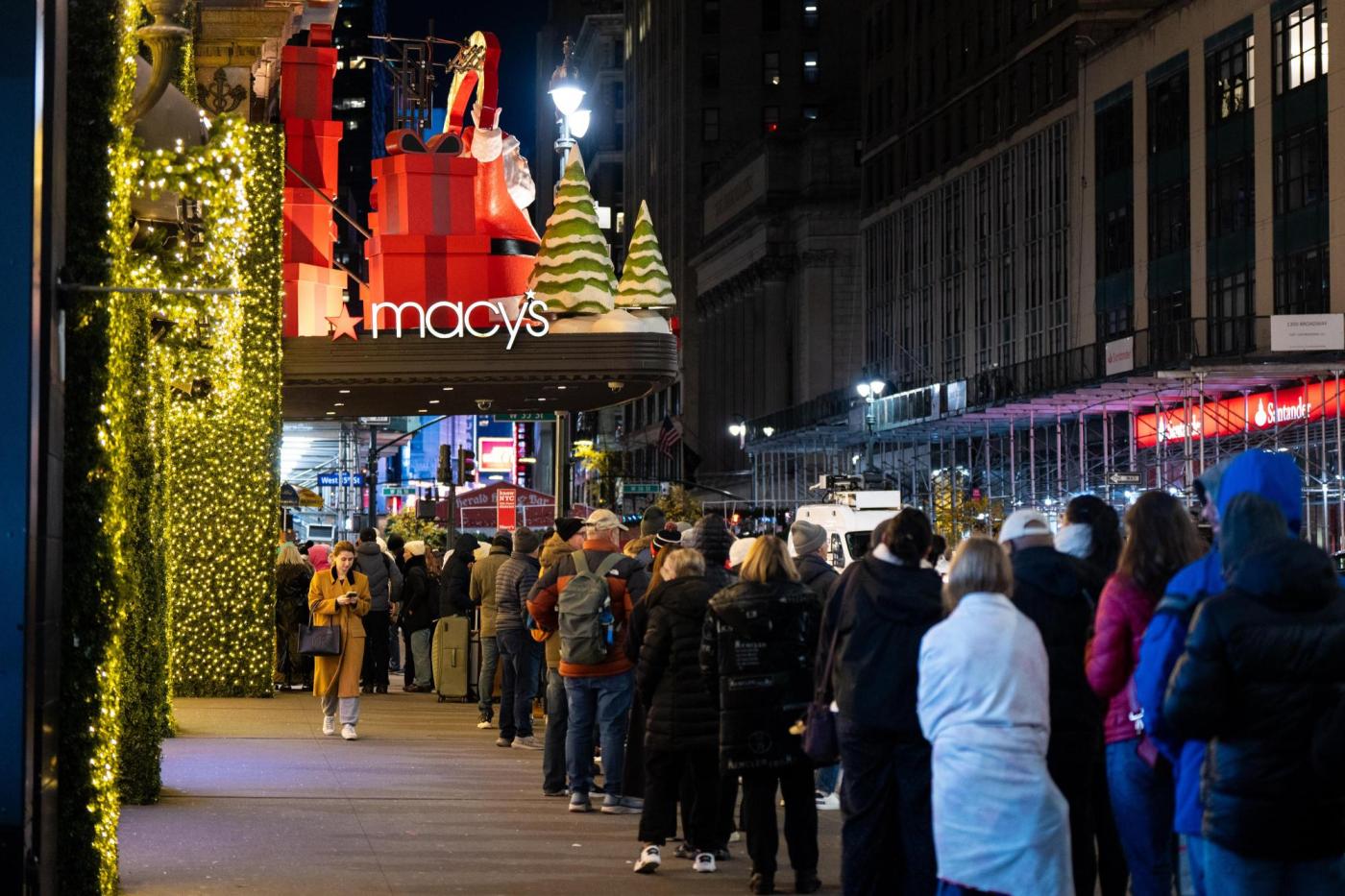
Editorial: Will pricey holiday gifts restrain urge to splurge?

Even though inflation has cooled, the cost of living’s floor remains high
Given that reality, the Retailers Association of Massachusetts expects shoppers to curb spending this holiday season.
The statewide trade association predicts a modest 1.7% increase in local holiday sales. That estimate, based on an annual survey of Massachusetts small businesses, compares to the 3.7% to 4.2% increase projected by the National Retail Federation, which accounts for businesses of all sizes.
RAM’s sales forecast signals a distinct departure from recent holiday seasons.
Sales in 2024 increased 4% in both Massachusetts and nationally, and by 3.8% locally and 5.3% nationwide in 2023.
“We are asking Massachusetts’ holiday shoppers to remember that how they invest their dollars makes a big difference for the local economy,” RAM President Jon Hurst said. “We know consumers today are cautious, and they are spending increased portions of their holiday spending budget online, but we ask them to commit to investing a good portion of their purchases right here in our communities.”
Though year-to-date sales for RAM members have risen by 2%, cost-of-living constraints on families and sellers threaten to negatively impact small businesses’ bottom lines.
That’s because costs continue to outpace sales. RAM members said payroll costs rose 2.6% this year, while fourth-quarter inventories posted a 2.4% increase over the same period last year.
RAM’s membership has begun to embrace Internet commerce; about 60% of the association’s members now sell online, compared with 26% during the 2019 holiday season, Hurst said.
Internet sales now make up 5% to 15% of the smaller RAM members’ holiday sales. Nationally, it’s estimated online sales will account for 40% of retail activity.
Locally, the holiday season makes up 20% of annual retail sales — with some stores posting 25% to 30% gains during the period.
So, how have RAM’s perceptions squared with reality?
Anecdotally, the trade group’s estimates initially seem to align with consumer sentiment, albeit derived from a small sample size.
Nationally, despite the widespread economic uncertainty, shoppers turned out in droves on Black Friday — spending billions of dollars in stores and online.
Adobe Analytics, which tracks e-commerce, said U.S. consumers spent a record $11.8 billion online on Black Friday, marking a 9.1% jump from last year. Traffic particularly spiked between the hours of 10 a.m. and 2 p.m. local time nationwide, when $12.5 million passed through online shopping carts every minute.
Consumers also spent a record $6.4 billion online on Thanksgiving Day, per Adobe. Top categories that saw an uptick in sales across both days included video game consoles, electronics and home appliances.
E-commerce platform Shopify said its merchants raked in a record $6.2 billion in sales worldwide on Black Friday. At its peak, sales reached $5.1 million per minute.
Mastercard SpendingPulse, which tracks in-person and online spending, reported that overall Black Friday sales, excluding automotive, rose 4.1% from a year ago.
No matter the degree of economic uncertainty or the differences in local and national buying habits, it’s difficult to suppress that urge to splurge on holiday gifts for friends and loved ones.
Sentinel and Enterprise
Editorial cartoon by Chip Bok (Creators Syndicate)


More Stories
Top 6 AI Infographic Generators (Ranked & Reviewed)
Late last year, a marketing strategist in my network needed to turn a research-heavy briefing into a visual asset before...
When SMEs scale connected services: how to keep ownership and avoid rebuilding the platform every time the business pivots
Most connected services start with a narrow business problem. A manufacturer may add remote monitoring to reduce support calls, give...
6 Ways a Car Cover Can Save You Money on Vehicle Maintenance
A car parked in the driveway may look perfectly safe, but every day it sits outside, it is exposed to...
Applied Nutrition closes in on £1bn valuation after raising guidance for third time this year
The sports supplement maker Applied Nutrition has raised its annual sales and profit guidance for the third time this year,...
One of Britain’s oldest family firms to save £250,000 a year as energy scheme opens to forges
One of the UK’s oldest family-owned companies has praised the government’s decision to include forges in its energy subsidy scheme...
Burnham signals more energy bills support in budget as price cap rises 4 per cent
Andy Burnham has signalled that there will be more support to help people with their bills in the budget, as...