
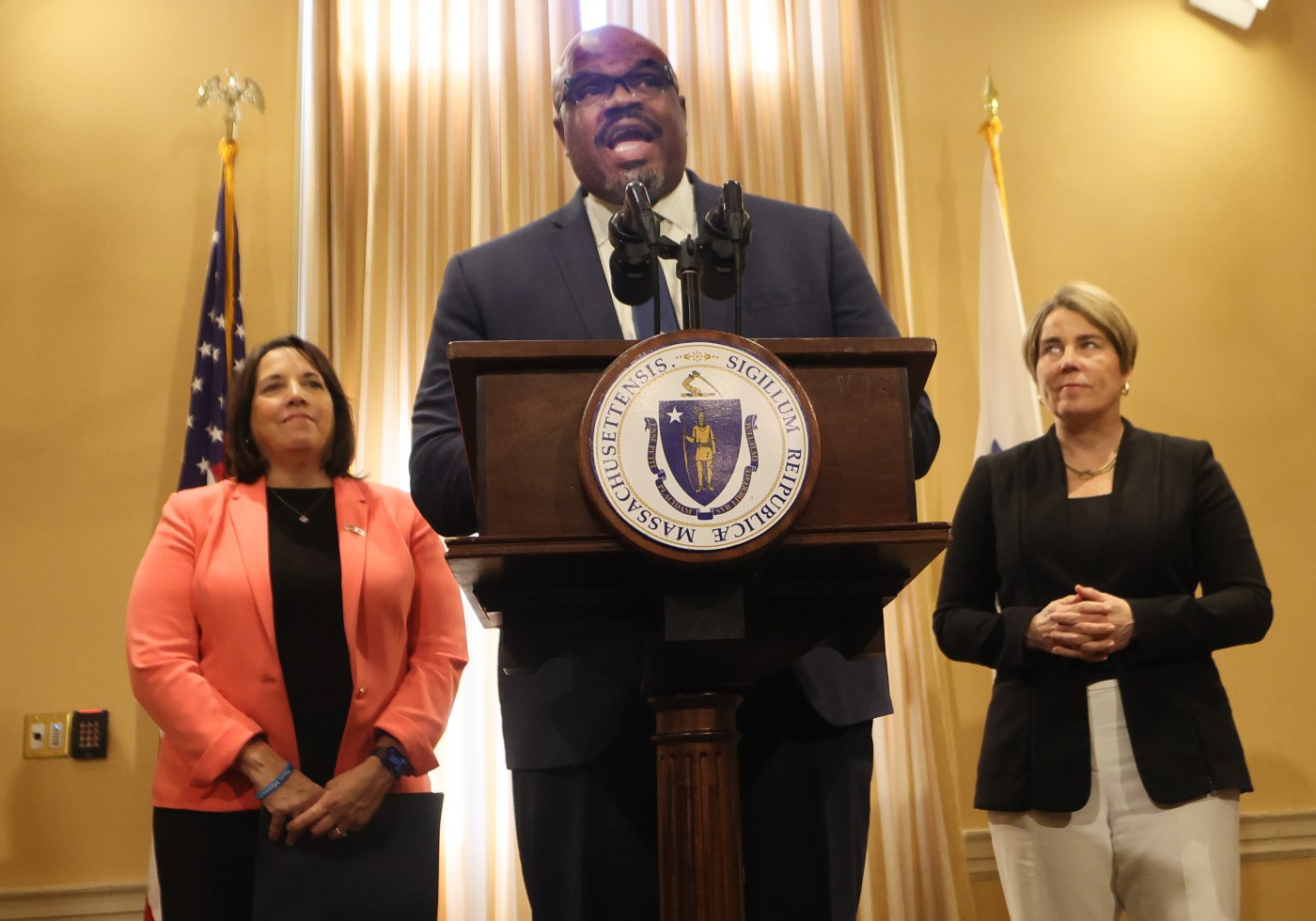
State council recommends new high school graduation framework, includes testing component

The K-12 Statewide Graduation Council released its interim report with new graduation requirement recommendations following voters’ overturn of the MCAS standard last year — including controversial state-run end-of-course exams.
“No other state will have implemented such a comprehensive approach to setting such high standards in education, and it does this without relying on high stakes testing,” the Healey-Driscoll administration said in a release Monday. “No single test will represent a barrier to graduation for any student, and the 10th Grade MCAS exam would be phased out as part of this new framework.”
The framework released Monday is a “first step” towards a final set of requirements for high school graduation in Massachusetts, state education officials said. The announcement comes just over a year after voters approved ballot Question 2, overturning the MCAS standardized testing graduation requirement.
Education Secretary Patrick Tutwiler and DESE Commissioner Pedro Martinez will “refine” the recommendations with further community input and issue their final report in June 2026.
The initial recommendations released Monday, which line up with many included in a draft version released in October, feature “end-of-course assessments” designed, administered and scored by the state for select courses like “Algebra I, English Language Arts, Science and Social Studies.”
The recommendations also include a curriculum requirement based on the current MassCore standard; a capstone or portfolio requirement defined by the state but administered locally; and future-focused requirements related to career and academic plans, financial literacy, and FAFSA.
The testing assessments have “gained attention as an alternative to exit exams,” the over 100-page interim report states, and are used by seven other states.
The new testing requirement has been staunchly opposed by the Massachusetts Teachers Association, which also led the ballot question campaign against the MCAS requirement.
“Including state-developed and graded end-of-course exams in a set of new proposals for high school graduation requirements poisons a once-in-a-generation opportunity for stakeholders to come together and remake the high school experience for our students,” MTA President Max Page and Vice President Deb McCarthy said, arguing the state standardized test requirement “defies the will of voters who made clear their wishes in the 2024 Question 2 referendum, which passed by nearly 60 percent in favor.”
The state graduation council did not vote on the initial recommendations, the statewide teachers union said, noting the education secretary and commissioner issued the interim report.
“Whereas the program of study leverages high-quality, statewide curriculum standards, EOC assessments in a select number of courses with that program of study support a common definition of mastery of standards across those courses,” the report states. “The uniformity of EOC assessments allows for dependable and reliable comparison of results across classrooms, schools and districts, which is one component for promoting equitable access and outcomes.”
The report notes several considerations for the determination of the exams, including how they fit into a variety of high school programs like CTE and Early College and appropriate accommodations and supports for students like those with disabilities or English Language Learners.
“It is not the intention for any student to be denied a diploma because of EOC assessments,” the report states, noting the need to examine the “weight and role” of the assessments for graduation.
The report summarizes “stakeholder voices” on the testing requirement, including a “desire for a standardized measure of mastery” and “consistency across districts.”
The council said they incorporated feedback from more than 400 people who attended listening sessions on the recommendations, over 6,000 who participated in a statewide survey, and over 100 administrators.
The MTA leadership said they “strongly support” many of the other provisions in the framework but urged the education officials to “withdraw the proposed end-of-course exams from their final report and refocus the council’s advisory role in developing those elements in their report that have real merit.”
The report included a detailed outline for the six other recommendations, beginning with the coursework requirements.
“I want every parent to know that when your kids go to a Massachusetts school, they are getting the best education that prepares them for success – whether they choose higher education, a trade, skills-based employment or the military,” Gov. Maura Healey said Monday. “That’s what today is about.”
Under the recommendations, Massachusetts students would be required to complete “rigorous program of study.” The report notes that “MassCore, the existing state-recommended program of study, can, with modifications, serve as a foundation for a statewide requirement regarding coursework,” providing for the exploration of changes like expanded flexibility and alternatives for certain student populations.
The portfolio or capstone requirement would work in a “hybrid model” with the end-of-course assessments, allowing “customized opportunities for deeper demonstration of students’ knowledge and skills.”
The remaining recommendations aim to promote “self-direction and future-readiness,” including the completion of a career and academic plan (MyCAP), financial literacy training, FAFSA or MAFSA financial aid applications, and options for state-designated seals of distinction.
The Massachusetts Association of School Superintendents said they “look forward to engaging with Superintendents across the Commonwealth to gather their perspectives and suggestions about the Council’s preliminary recommendations.”
“M.A.S.S. continues to believe it is critical for Massachusetts to have a statewide standard for students to earn a high school diploma,” MASS Executive Director Mary Bourque stated. “We also believe that the number and scope of new requirements must be manageable for students, families, educators, and administrators, and that full consideration be given to the resources necessary to implement these new measures. ”
The council will engage on the initial framework recommendation with “students, families, educators, LEA leaders, advocacy groups and other key stakeholders” over the next several months before issuing a final report in June 2026.
“Our aim is to develop a graduation framework that honors the diversity of our students and schools, supports innovation, upholds Massachusetts’ legacy as a national leader in education, and keeps all postsecondary doors open for our graduates,” Tutwiler and Martinez wrote.

More Stories
Hate the new Jaguar? Good. That’s rather the point
Most Sunday mornings in winter, I can be found in a cold garage doing what owners of classic cars do...
Beyond the Microphone: British Comedians Who Became Directors and Presenters
Stephen Merchant co-created The Office and went on to write and direct for the cinema. Simon Amstell writes and directs...
Top 10 Best Hair Transplant Doctors in Turkey: A 2026 Guide to Surgeons
This guide names the top 10 best hair transplant doctors in Istanbul for 2026 and explains, in plain terms, how...
How to Choose an HR System for a Growing UK Business
For a while, email and spreadsheets seem good enough. Then managers start asking where the latest file is, staff have...
Top 10 Best Hair Transplant in Turkey
Turkey has become one of the world’s most familiar destinations for hair restoration, with Istanbul attracting patients from Europe, the...
How to Register a Company in Hong Kong in 2026: A Guide for UK SMEs
You can register a company in Hong Kong remotely, but plan tax, banking and compliance before you start. Why UK...