
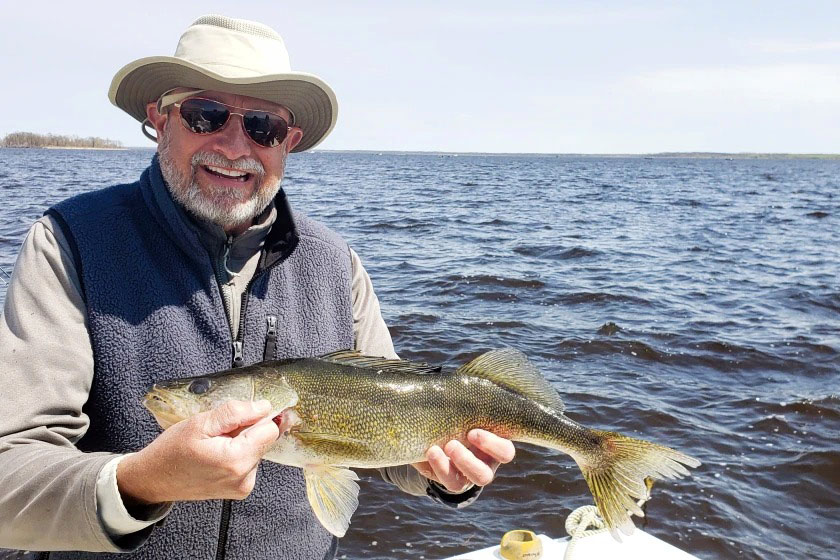
Slight decline in Lake of the Woods walleye catches no cause for concern, DNR says

BAUDETTE, Minn. – Walleye catches were below historic averages during the annual fall fisheries assessment on Lake of the Woods, but the abundance of “harvestable-size” walleyes remains above historic averages, a report from the Minnesota Department of Natural Resources shows.
In addition, sauger numbers remain at a high level of abundance, the report indicated.
As part of the fall survey, which traditionally begins the Tuesday after Labor Day and continues for 17 days, Baudette DNR fisheries personnel set 64 nets – 52 near-shore sites in less than 25 feet of water and 12 offshore sites in 33 to 37 feet of water – across Minnesota’s 320,000-acre portion of the lake from the south shore to the Northwest Angle and leave them in the water overnight.
During this year’s survey, the survey tallied an average of 15.5 walleyes and 16 saugers per gill net lift, according to the DNR report. That’s down slightly from the historic average of 16.6 walleyes per net, but above the historic sauger average of 15.3 fish per net.
Matt Skoog, area fisheries supervisor for the DNR in Baudette, said he doesn’t have “any major concerns” at this point about the decreased walleye catch. The dropoff is likely driven by a decline in the catch of smaller walleyes, he says, 9- to 10-inch fish that can make up “a large portion of the catch” some years.
Matt Skoog, right, area fisheries supervisor for the Minnesota Department of Natural Resources in Baudette, Minn., hands a net full of juvenile lake sturgeon to Ryan Carrow, of the DNR’s area fisheries office in Detroit Lakes, on Wednesday, Oct. 2, 2024, during a stocking effort on the Roseau River in northwestern Minnesota. (Brad Dokken / Forum News Service)
The decline in smaller walleyes likely results from weaker year-classes in 2023 and 2024, Skoog said. A year-class refers to fish recruited to the population from a particular year’s hatch. The 2021 year-class was one of the strongest on record, Skoog says, and combined with a slightly above average year-class in 2022, the abundance of smaller fish could have suppressed the hatches in 2023 and 2024.
On the upside, it should be noted that numbers of “eater-size” walleyes in the 12- to 14-inch size range and 14- to 16-inch range both were above average, Skoog said, as were smaller “slot fish” – walleyes in the 19½- to 28-inch range that anglers must release on Lake of the Woods.
The abundance of 22- to 25-inch walleyes also is above the 2002-2024 average, Skoog said.
“If you look at the catch of ‘eater-size’ and smaller slot fish, both are above the average,” he said. “We are still analyzing the data to look at the rest of the performance indicators, but the current catch rate exceeds both the sustainability indicator of 10 walleye per net and the quality objective of 14 walleye per net.”
The off-shore nets set in deeper water can paint a “very different” picture of the walleye population than the near-shore nets, the DNR report said. The off-shore nets also tend to produce larger walleyes than the nets set closer to shore.
That was the case again this year. The off-shore nets produced an average of 19.8 walleyes per net, compared with 14.9 for the near-shore nets.
Saugers remain solid
Meanwhile, Lake of the Woods sauger populations have been above the 1981-2025 average since 2006, the result of consistent moderate to strong year-classes, with relatively few weak year classes.
Saugers from 9 through 14 inches were all above historic averages, the report indicated, the result of excellent recruitment in 2017, 2019 and 2023. Smaller 6- to 8-inch saugers were below average, reflecting weaker year-classes.
Saugers tend to be the “bread and butter” of Lake of the Woods’ booming winter fishery, as they generally bite throughout the day. Walleyes, by comparison, generally are most active early in the morning and again before dark.
The continued sauger abundance bodes well for winter fishing prospects – providing, of course, the fish cooperate.
Based on results from the DNR’s winter creel survey, anglers during the winter of 2024-25 logged an estimated 2 million angler-hours of fishing pressure on Lake of the Woods. Winter fishing pressure on the big lake has exceeded 1 million angler-hours since 2000, the DNR said, with steady increases until the past few winters.
Anglers kept about 150,000 pounds of saugers during the mid-December 2024 through mid-March 2025 survey period, the DNR said, well below the six-year average of 235,000 pounds. The walleye harvest was about 175,000 pounds, which is above the six-year winter average of 161,000 pounds. Anglers also kept an estimated 39,000 pounds of perch, double the six-year average of 18,000 pounds.
As part of the survey, creel clerks set up at popular access points along the south shore of the lake, interviewing anglers as they leave the ice. The survey design allows the DNR to more accurately estimate fishing pressure from anglers who stay on the ice for days at a time in deluxe wheelhouses.
Anglers on Lake of the Woods can keep an aggregate limit of six walleyes and saugers, of which no more than four can be walleyes. All walleyes from 19 ½ to 28 inches must be released.
On the web
A description of the sampling programs and management strategies conducted on Lake of the Woods is available on the Lake of the Woods page of the DNR website at mndnr.gov.
Related Articles
Tettegouche State Park debuts new footbridge after Baptism River washout
Holiday arts and entertainment: 15 fun family activities to light up the winter season
MN State Parks, Washington County Parks offer free entry Friday
Skywatch: No turkeys, but many other birds in night sky
Ice safety is important any time, but especially right after freeze-up


More Stories
Hate the new Jaguar? Good. That’s rather the point
Most Sunday mornings in winter, I can be found in a cold garage doing what owners of classic cars do...
Beyond the Microphone: British Comedians Who Became Directors and Presenters
Stephen Merchant co-created The Office and went on to write and direct for the cinema. Simon Amstell writes and directs...
Top 10 Best Hair Transplant Doctors in Turkey: A 2026 Guide to Surgeons
This guide names the top 10 best hair transplant doctors in Istanbul for 2026 and explains, in plain terms, how...
How to Choose an HR System for a Growing UK Business
For a while, email and spreadsheets seem good enough. Then managers start asking where the latest file is, staff have...
Top 10 Best Hair Transplant in Turkey
Turkey has become one of the world’s most familiar destinations for hair restoration, with Istanbul attracting patients from Europe, the...
How to Register a Company in Hong Kong in 2026: A Guide for UK SMEs
You can register a company in Hong Kong remotely, but plan tax, banking and compliance before you start. Why UK...