
Optimist Club scholarship winners are ‘focused on trying to make a better future’

One fled war-torn Ethiopia and arrived in St. Paul at age 20. Another has a degenerative neuromuscular condition called Charcot-Marie-Tooth disease. There’s one who hopes to represent Haiti in the 2028 Olympics. Others have dealt with addiction and alcoholism in their families. Most come from low-income or working-class families.
The 16 winners of this year’s Optimist Club of St. Paul Youth Appreciation college awards were recognized for “their success in overcoming significant obstacles in their young lives,” said John Tillotson, a longtime club member and senior vice president at Stifel investment services.
“Many of them have adopted an attitude of not accepting ‘No’ for an answer,” he said. “Their drive, dedication, optimism and hope are all focused on trying to make a better future.”
Tillotson said reading this year’s nomination forms made him think of a quotation from Helen Keller.
“Optimism is a faith that leads to achievement,” Keller wrote. “Nothing can be done without hope and confidence.”
“These kids are all living examples of these words, and our community is better from their efforts,” Tillotson said.
Each winner received $3,000.
Haben Demoz, Dexter Paasch, Beza Sanon and Deacon Vang are four of this year’s winners.
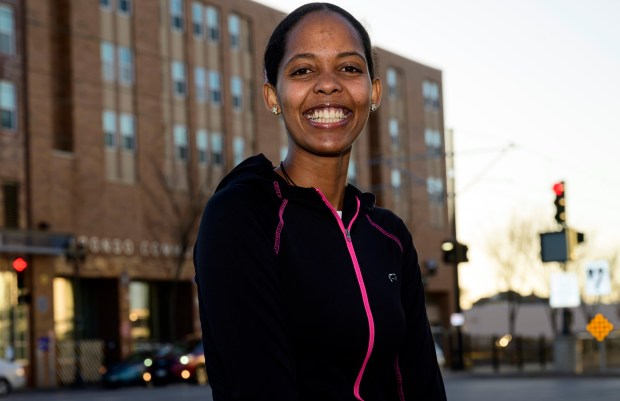
Optimist Club scholarship winner Haben Demoz, a student at ALC International and LEAP High School, near the Rondo Community Library in St. Paul on Tuesday, Nov. 11, 2025. (John Autey / Pioneer Press)
Haben Demoz
When Haben Demoz was 11, her father, who lived in the United States, persuaded her and her 12-year-old brother to walk from their home in Eritrea to Ethiopia and register at a nearby refugee camp so he could petition for them to come to America.
The siblings slipped away one day without saying goodbye to their mother – a decision that Demoz says she will always regret.
Demoz later learned that her mother had been arrested in Eritrea. “I didn’t know that if a parent allowed their child to leave for the refugee camp, they would be jailed,” she said.
Demoz, 21, a student at ALC International and LEAP High School, said that she and her brother suffered greatly in the refugee camp without an adult caregiver. Their mother was released after six months and found Demoz and her brother in the camp. They could not safely return to Eritrea, and her father had stopped communication about the family petition, so the family spent nine years in the Ethiopian refugee camp, she said. Eventually, her brother decided to go back to Eritrea.
When war broke out in the Tigray region of Ethiopia in November 2020, Demoz was 16. “It became extremely dangerous, and I honestly did not expect to live,” she said. “There were military tanks everywhere, and soldiers entered the camp as they pleased.”
Many girls her age were kidnapped, and Demoz was forbidden to go outside unaccompanied for any reason, she said.
When her mother became ill, Demoz said she had to leave to find food and medicine. “It was bad. I didn’t have a choice. If I didn’t go, maybe my mom would die. I walked for one week, and got to a new camp. I was able to send her money.”
Eventually, her mother was able to join her at the new camp. Her mother remarried and had another child. The family was able to immigrate to the U.S. in June 2024.
“When I came to St. Paul, I was like, ‘Am I really here? Are you serious? It’s not a dream, right?’” she said. “I was able to start school and learn English. Oh, my God. It is a dream.”
Demoz is a member of LEAP’s Medical Club, an after-school club that has traditionally been for students with more advanced English skills, but Demoz said she spoke to the teacher and got permission to join. She is learning CPR.
Demoz plans to attend a community college, where she can study nursing and take advanced English as a Second Language courses.
“I’m interested in medical things, and I like helping people,” she said. “If I help people, it gives me peace.”
One of the people she likes helping the most is her 5-year-old brother, Mnasie, who is in kindergarten at Maxfield Elementary School. She is teaching him how to speak Tigrinya, the language of Eritrea, she said.
“I’m so happy with him,” she said. “I have friends, but I don’t have best friends, so when I play with him, I like teaching him what I’m doing. He’s following me all the time, doing what I’m doing, so I have to be careful to teach him right.”
Demoz said she is grateful for her experiences in Ethiopia because they helped shape her into the person she is today.
“It was war. It was a hard time, but I lived,” she said. “I am a survivor. I survived by God. When I feel bad or depressed, I turn to God. I can survive anything. I can do it. It’s easy for me, you know? It’s nothing. If a bad thing comes to my life, I don’t care. Even if it’s bad, it’s normal for me. I know I can live through anything.”
Optimist Club scholarship winner Dexter Paasch, 17, a student at Harding High School in St. Paul and a member of the Ho-Chunk nation, prepares a recently harvested deer hide for tanning at his St. Paul home on Friday, Nov. 7, 2025. (John Autey / Pioneer Press)
Dexter Paasch
Dexter Paasch dreams of making a difference on the political stage – at both the state and national levels.
The Harding Senior High School senior is already familiar with the inner workings of the Minnesota State Capitol. He worked last year on a proposal for mandatory education on the dangers of fentanyl for all Minnesota high-school students, which was adopted and passed into law as part of the 2024-2025 Education Omnibus Bill.
“It was terrifying,” he said. “They have you at this little table, and they’re all circled around you.”
Next up, Paasch says, is advocating for Minnesota’s recognition and protection of the Ho-Chunk Nation’s tribal rights.
“We were exiled from (Blue Earth County), Minnesota in 1863,” said Paasch, 17, an enrolled member of the Ho-Chunk Nation. “We were moved to plenty of places, most notably Nebraska. But a lot of us still came back to Minnesota and Wisconsin.”
Paasch said he wants the Minnesota Legislature to recognize the Ho-Chunk Nation as indigenous to the state and to require that the history of the tribe be taught in Minnesota schools.
“I want people to know how it happened,” said Paasch, who has been studying the Ojibwe language in school for the past two years and has been learning Ho-Chunk on his own.
Paasch currently serves as a senior chief petty officer with the Navy Junior Reserve Officers Training Corps program, where he oversees about 100 cadets. Among his duties: leading drill sessions and conducting inspections.
Last summer, Paasch served as a cadet instructor for the U.S. Naval Sea Cadet Corps in Pineville, La. He spent a month training recruits, teaching them teamwork, problem-solving, life skills, and stress management.
Paasch said he plans to attend either the University of Minnesota-Twin Cities, University of Saint Thomas or the University of Wisconsin-Madison and major in political science. Law school and the Judge Advocate General’s Corps, the legal arm of the United States Navy, would be next, he said.
“I really want to work to make a change,” Paasch said. “I would like to become a lawyer for my tribe or kickstart my political career. Hopefully, someday, I will become a U.S. senator if I decide to go a more political path.”
When he’s not doing work for his American Indian Studies program at Harding or the Navy Junior Reserve Officers Training Corps program, Paasch, of St. Paul, works at Jimmy John’s on Grand Avenue in St. Paul.
His hobbies include playing traditional Native American lacrosse, participating in powwows and tanning deer hides.
He recently tanned a buckskin hide as a gift for a relative who planned to use it for a “memorial for somebody who has recently passed in our tribe.”
He learned how to tan deer hides from Levi Blackshear, one of his tribal elders, he said.
“The process takes 12 hours, so I break it up into two days,” he said. “Saturday, I leave solely for the scraping and stretching of the hide, and then Sunday, I smoke the hide with sumac wood. I scrape the hide with a fleshing knife. You have to get all the hair off, all of the membranes. Then I sew up all the holes from when it was harvested, and punch tiny holes all around the edge of it, and then I create a ‘brain smoothie’ of sorts with a pound of pig’s brain water, and soak the hide in that. Stretch it out, get the fibers separated, and get the fat from the (pig’s) brain embedded in it. That’s what makes it soft and fluffy.”
The hide is stretched out on a hide stretcher with string, and Paasch uses a sanded-down axe handle to push it and make it malleable.
“We believe that when someone passes, they have a four-year journey, so we leave that hide in the tree, so that they can make moccasins and any other materials that they’ll need,” he said. “They’ll need moccasins and other things to get them through.”
Optimist Club scholarship winner Beza Sanon, a 16-year-old senior at Great River Montessori School in St. Paul, at the school on Tuesday, Nov. 18, 2025. (John Autey / Pioneer Press)
Beza Sanon
Daknishael “Beza” Sanon plays basketball, composes music, works as a lifeguard and swim instructor, and wants to be a forensic scientist when she grows up.
But the Great River School senior has an even greater goal: She wants to make the Haitian Olympic swim team and compete in the 2028 Olympics in Los Angeles.
“It’s a really stretch goal, but I would like to be the first Haitian to qualify for the Olympics – not through ‘universality,’ but to actually qualify for the Olympics,” she said. “It’s a really far dream. If I don’t make it in 2028, I’ll make it in the next four years. I just have to be the first Haitian to qualify.”
Backed by the International Olympic Committee, “universality” allows athletes who represent poorer nations with less-established sports programs to compete, even though they did not meet the sporting criteria.
But Sanon, 16, hopes to make it in either the 50 freestyle, 100 freestyle or 100 butterfly by time alone.
“I’m trying to do the 200 IM right now,” referring to the 200-meter individual medley, a race that requires swimmers to complete four different strokes — butterfly, backstroke, breaststroke, and freestyle — over four 50-meter lengths of the pool. “I have a long way to go.”
Sanon gets up around 4 a.m. and does “dryland” training from 5 a.m. to 5:45 a.m. at the University of Minnesota’s St. Paul campus, where she works on bodyweight-exercises, resistance training, stretching and cardio. She then hops into the pool and swims from 6 a.m. to 7 a.m.
Sanon’s father, Dakson, was born and raised in Haiti. Beza Sanon was born in Orlando, Fla., while her father was getting his master’s degree in horticultural science at the University of Florida.
The family moved back to Haiti when she was 5, and Beza Sanon stayed for five years, before moving back to Florida to live with an aunt in Bradenton.
When her father came to the University of Minnesota in 2024 to get his Ph.D. in agroecology and sustainable agriculture, Beza Sanon moved with him to St. Paul.
Beza Sanon hopes to attend Pennsylvania State University, University of Florida, Loyola University of Chicago, or Cedar Crest College in Allentown, Pa. She picked those schools because they are known for their forensic-science programs, she said.
Her interest in forensic science came a couple of summers ago while watching “CSI: Crime Scene Investigation” and other forensic science TV shows “because we didn’t have any other channels,” she said. “I was like, ‘That’s so cool. I want to be just like them.’ When I looked more into it, I was kind of confused at first. I wanted to be a criminal investigator. Then I realized, ‘No, I don’t think that’s for me. I don’t want to watch gory stuff.’ Then I realized you could actually find data to, like, see whether a crime happened or how it might have happened. I found out that it was called forensic science, and I’m like, ‘OK, I want to do that.’”
A member of Great River’s Black, Indigenous, and People of Colorclub, Sanon said she tries to be a “bridge builder” whenever she can. “I’m working to build a bridge between BIPOC and the student leadership, where they can coexist and help each other out,” she said.
Sanon, who is pursuing a full I.B. World Diploma at Great River, said she likes to make music during her free time.
“I play the piano, and I’m learning the guitar, but most of my song pieces are just my voice,” she said. “I haven’t published any (songs). I’m kind of a shy person in the sense that I don’t want to show my work, but I have a song called ‘Lovely’ that I composed myself.”
Sanon said her strong faith has helped make her an optimistic person.
“I strive to be the best version I can be every day to help others and to put others’ interests not before mine, but at my level, where I could contribute with the talents that God gave me,” she said.
Optimist Club scholarship winner Deacon Vang, a senior or Johnson High School in St. Paul, in the school’s library on Wednesday, Nov. 12, 2025. (John Autey / Pioneer Press)
Deacon Vang
Deacon Vang’s life was upended last year when his older brother, Drake, died of complications related to brain cancer.
Vang, a senior at Johnson Senior High School, said his brother, who was 23 when he died, was his hero and mentor because he “always tried to live his life to the fullest.”
“I look at life a little differently now since he’s passed away,” said Vang, 17, of Oakdale. “Ever since I was a little kid, I had always looked up to him.”
Drake Vang was one of Vang’s biggest cheerleaders and an eternal optimist, he said.
“Throughout my whole life, if I didn’t want to do something or if I didn’t feel motivated, he would just tell me, ‘Deacon, just do it. What’s the worst that can happen?’” he said.
Vang, who has cerebral palsy and limited mobility, said his brother always encouraged him to look on the bright side.
“I used to look at the cup half empty,” he said. “I feel like that’s what a lot of people do. But now that my brother Drake isn’t here anymore, I’m starting to look at the cup half full because that’s how he would look at it. I do things to make me happy, and I do things that would make him happy.
“I made a promise to him before he died that everything I do from here on out is going to be for him, even though he’s not physically here,” he said. “I feel like I’m living for him now, too.”
That means spending extra time on academics, twice-daily weight-lifting sessions and walking instead of using a wheelchair, he said.
Drake Vang would never let him wallow in bed, he said. “None of that, for sure,” he said. “It was ‘Get up and get going.’”
Deacon Vang weighed about a pound when he was born extremely prematurely, at 25 weeks, he said. “My parents called me ‘Miracle Boy,’ especially my mom,” he said.
Vang, who has limited function in his right hand, has had to undergo numerous surgeries to treat issues associated with his cerebral palsy, which is the most common motor disability in childhood.
“I’ve been through a lot, but I still have a lot of optimism,” said Vang, who uses a cane for walking. “Sometimes people might look at somebody, and think ‘Oh, that person must be miserable,’ or “Oh, that person must be so devastated because they’re like that.’ But me, I just feel very grateful to be here today. I feel powerful because I’ve been through so much.”
Everyone is dealing with something, he says; his disabilities are just more visible.
He said he appreciates people who take the time to learn about cerebral palsy.
“Some people, when I walk into class or I walk in the hallways, they’re like, ‘Hey! What’s wrong with you?’” he said. “I’m like, ‘That’s not cool.’ I try not to take it as an insult because a lot of people just don’t know how to phrase things. They think it, and they think it’s good. But then when they say it, it’s not that good, you know?”
Vang said he is still trying to come up with a good response when people make rude comments.
“I guess I just explain it to them, and if they don’t get it, then they don’t get it,” he said. “People don’t know what to say.”
Deacon Vang plans to study business management at Century College in White Bear Lake next year.
One day he would like to own his own business, perhaps one that helps people with special needs, he said.
“I’d like to help people who maybe don’t have family to go to or friends to go to, or somewhere to live,” he said. “I want to provide that for them.”
Related Articles
St. Paul City Council to host Truth in Taxation hearing Tuesday
Voters say ‘yes’ to St. Paul Public Schools levy referendum
Hamline University, Manitou Fund send St. Paul teachers into the woods to write lesson plans
St. Paul: What you need to know about the school levy question
St. Paul Public Schools using taxpayer funds on special levy. But is it advocacy?
The winners of the 2025 Optimist Club of St. Paul Youth Appreciation college scholarship awards were honored at Town and Country Club in St. Paul on Nov. 13, 2025. Bottom row: Trysopiseth King, Aung Ta, Serenity Vang, Nicole Moo, Ezran Bettison and Beza Sanon. Top row: Haben Demoz, Kelin Fuentes Soriano, Aanaiyah DeLaCruz-Stevens, Deacon Vang, Britany Garcia-Rodriguez, Greysy Villatoro Gomez, Madison Kate, Hallie Kes-Nelson and Dexter Paasch. Not pictured is Mari Joers. (Courtesy of Jack Orme)
Other winners
The other 2025 Optimist Club of St. Paul Youth Appreciation college scholarship award-winners are:
— Hallie Kes-Nelson, Central High School
— Madison Kate, Creative Arts Secondary School
— Mari Joers, Great River School
— Aung Ta, Harding High School
— Britany Garcia-Rodriguez, Humboldt High School
— Aanaiyah DeLaCruz-Stevens, Nicole Moo, Serenity Vang, Johnson High School
— Kelin Fuentes Soriano, Trysopiseth King, Greysy Villatoro Gomez, LEAP
— Ezran Bettison, St. Paul Conservatory for Performing Arts


More Stories
Britain’s hidden productivity boom masked by ‘flawed’ ONS data
Britain’s economy has undergone a silent productivity boom over the past two years, according to new research which suggests that...
Uber faces €825m GDPR fine over automated driver deactivations
Uber is facing an €825 million fine from a Dutch watchdog for breaching Europe’s general data protection regulation (GDPR) by...
Dragons’ Den star Sara Davies takes stake in Not On The High Street turnaround
Sara Davies has joined Not On The High Street as a non-executive director and taken a stake in the Bristol-based...
JLR pauses Defender redesign, pushing all-electric version into the 2030s
Jaguar Land Rover has delayed plans for an all-electric version of the Defender, its bestselling model, after placing a two-year...
Camra membership falls to eight-year low as beer campaigner slips £800,000 into the red
Membership of the Campaign for Real Ale fell to an eight-year low of 143,038 in the year to 30 November...
Samsung Dryers not heating? Expert Troubleshooting & Repair Guide by Wilson & Myers
When a dryer suddenly ceases to heat, laundry day can be an aggravating experience. When your samsung dryer not heating,...