
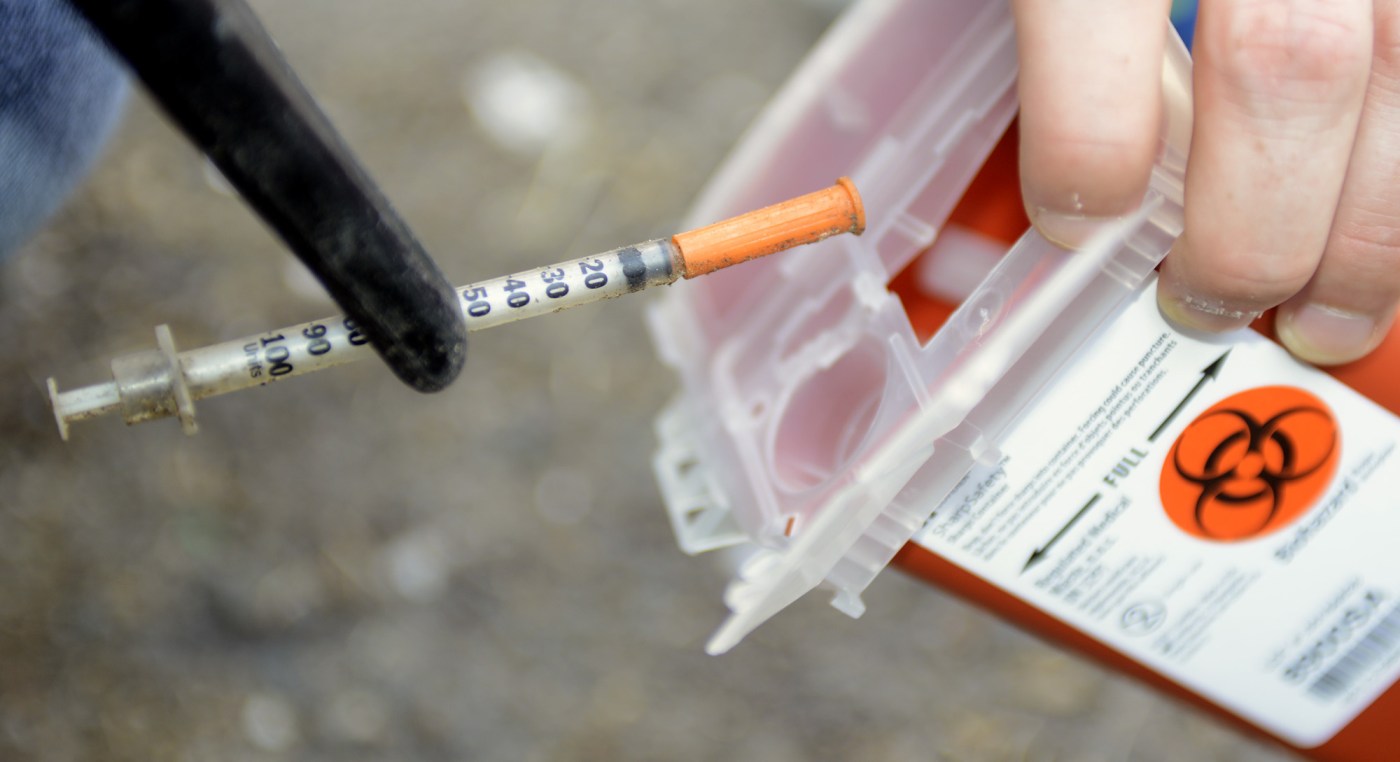
Syringe City: Boston hands out 4.5 million needles to drug users during Mayor Wu’s tenure

The City of Boston handed out more than 4.5 million needles to drug users during the first four-year term of Mayor Michelle Wu, as part of her administration’s harm-reduction approach to tackling the Mass and Cass open-air drug market.
The Boston Public Health Commission disclosed its median syringe distribution per month for 2022 through Oct. 31, 2025, in response to a Herald public records request.
The data show that the city handed out 106,632 needles per month in 2022, which amounts to nearly 1.28 million in the first year of the Wu administration; 104,702 per month, or more than 1.25 million in 2023; 96,016 per month and more than 1.15 million in 2024, and 84,572 per month, or 845,720 so far this year, as Oct. 31.
The 2025 numbers put the city on pace to exceed the 1 million syringe distribution mark again this year, at more than 1.01 million, per city data.
While the 2025 numbers are down from the first three years of the Wu administration, they are higher than what Boston Public Health Commissioner Bisola Ojikutu reported to the Boston City Council in early September. At the time, Ojikutu said the city distributes 81,112 needles on average per month to drug users.
The Public Health Commission, in its records response, declined to provide figures for how much the city is spending on distributing needles to drug users each year, but said that it collects more syringes through various programs than it distributes.
“Regarding yearly distribution costs, BPHC does not receive city appropriated funds for the purpose of syringe distribution,” BPHC Assistant General Counsel Javier Salas wrote. “The funds that we use come from the Commonwealth of Massachusetts and therefore we do not have any responsive records.”
However, a look at the city budget and a past Boston Public Health Commission request for proposals and quote for harm reduction supplies sheds light on what the city spends each year on needle distribution.
The Commission’s budget line for “risk reduction and overdose prevention” was approved at just north of $2 million for this fiscal year, FY26. The BPHC sent out a request for proposals for harm reduction supplies in May 2024 that noted “the annual expenditure on supplies is approximately in the range of $1 million.”
Since fiscal year 2023, the City of Boston has received millions of dollars from the state for its harm reduction, treatment and recovery efforts, as part of an opioid settlement with pharmaceutical companies. The city will receive at least $40 million through 2039, which includes more than $14.7 million from FY23 through the current fiscal year, according to a spreadsheet on the state website.
BPHC’s request for proposals included other items beyond needles in the category of harm reduction supplies handed out by the city, among them: condoms and dental dams for safer sex, tourniquets, cotton pellets, saline and personal hygiene items.
The Public Health Commission, while including an extensive list of harm reduction supplies in its request for proposals, took issue with the Herald’s request for data on how many crack pipes and other drug paraphernalia it distributes.
Rather than provide the information as part of its records response, the Public Health Commission belittled the Herald’s chosen language.
“BPHC objects to the use of the terms: ‘crack pipes and other drug paraphernalia,” Salas wrote. “Smoking pipes is an overdose prevention strategy that makes it less likely for people to overdose compared to injections. Pipes are also better for public safety because they do not pose a biohazard risk to the public if discarded improperly.
“To the extent you are requesting pipe distribution information, BPHC does not have reliable data to report accurate figures, which are only available in limited numbers,” Salas wrote, adding that he was rejecting the request for “other drug paraphernalia” due to it being “vague” and “broad.”
The newly-released needle data comes at a time when residents in neighborhoods taxed by the open-air drug use, dealing and related crime that’s spilled over from the troubled intersection of Massachusetts Avenue and Melnea Cass Boulevard are begging for a police crackdown and contemplating moving out of safety concerns.
Residents, particularly in the South End, have complained about the health and safety risk discarded needles pose to their children at parks and playgrounds, and to their dogs out for walks with them around the neighborhood.
A 4-year-old boy had to undergo HIV testing this past summer after stepping on a discarded needle at a South Boston park.
A man spoke at a South End public safety meeting last month of having to Narcan his dog who was overdosing from a discarded needle with drug residue, and advised others to carry the lifesaving overdose drug when walking their own pets in the neighborhood — a hot-spot area for spillover from Mass and Cass.
Ojikutu defended the city’s harm reduction approach at a City Council meeting in early September, as key to fending off HIV and other diseases that are commonly spread through shared needles used for drug injection.
“If you consider the number of times someone is using fentanyl — it’s 10 to 15 injections per day,” Ojikutu said. “We are trying to decrease the risk of HIV exposure.”
Related Articles
Battenfeld: Sketchy $100K scheme to raise revenue could be latest Boston boondoggle
Collins: Treatment first best strategy for Mass and Cass
South End resident sues city, Boston Police for skirting public records law, hiding Mass and Cass crime data
Wu official indicates Boston is moving away from harm reduction strategy amid Mass and Cass surge
Boston city councilor pushes for emergency hearing on Mass and Cass spillover needle spikes
She said the city’s Public Health Commission has identified a cluster of HIV cases in the Boston region. Most of the more than 200 HIV cases in the region are connected to Mass and Cass drug injection, Ojikutu said, adding that the number would be higher without the city’s harm reduction approach.
Ojikutu said at the time that the city’s monthly needle distribution has decreased by 22% this year, compared to last year — although she acknowledged that the numbers of needles distributed each month is actually higher than disclosed by the city, when also accounting for its partner organizations.
Kellie Young, director of the city’s coordinated response team, indicated last month that the city may be moving away from its harm reduction approach, and will have recommendations for the mayor by January.
Boston has handed out more than 4.5 million needles during Mayor Michelle Wu’s first term, so far, as of Oct. 31.


More Stories
London’s female founders pass £100m in Start Up Loans
Female-founded businesses in London have borrowed £100m through the British Business Bank’s Start Up Loans programme, the bank has confirmed,...
Why Successful Investors Focus on Capital Preservation Before Profit
Successful investors prioritise capital preservation because unnecessary losses reduce the amount available to generate future returns. A damaged portfolio must...
Caudwell and Rose warn Britain is training entrepreneurs for export
John Caudwell, the Phones 4u founder, and Lord Stuart Rose, the former chief executive of Marks and Spencer, have joined...
Profits almost halve at Britain’s 100 biggest restaurant groups
Profits at Britain’s 100 biggest restaurant groups have fallen by almost half in the past year as hospitality businesses grapple...
Business rates review to reset how pubs and hotels are valued
Andy Burnham has launched a review into how business rates are calculated for pubs and hotels, in an attempt to...
Britain’s hidden productivity boom masked by ‘flawed’ ONS data
Britain’s economy has undergone a silent productivity boom over the past two years, according to new research which suggests that...